Concrete Repair Kansas City
Cracks, spalling, sunken slabs, and trip hazards — diagnosed at the cause and repaired the right way, with same-week estimates across the Kansas City metro.
Concrete Repair in Kansas City
Concrete crack repair, spalling repair, joint sealing, and structural restoration for all concrete surfaces.
We serve both residential and commercial clients — from homeowners upgrading their property to general contractors building national brands. The same standards apply to every project.
Who does concrete repair near me in Kansas City?
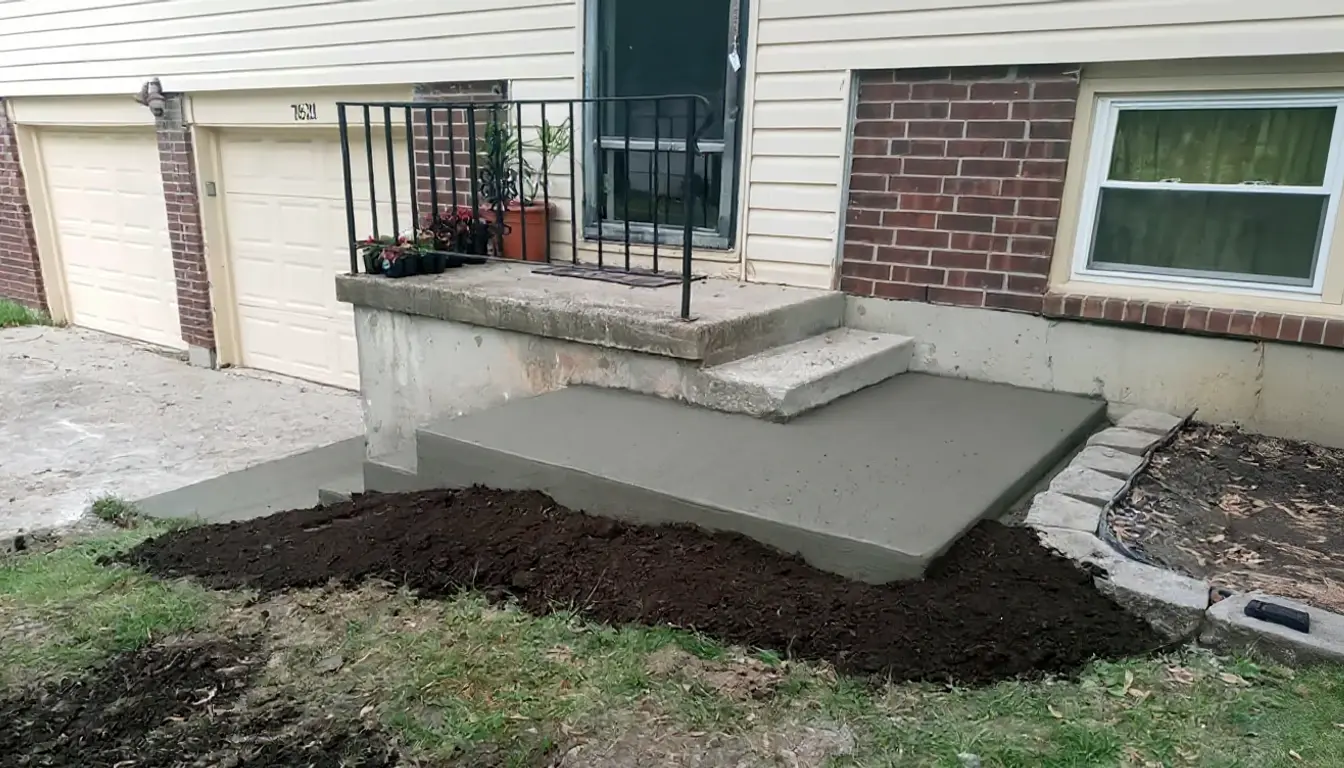
Ford Concrete Construction repairs cracked, spalling, and sunken concrete across the Kansas City metro, with same-week estimates. We diagnose the cause first — freeze-thaw damage, a washed-out subgrade, missing joints — then match the fix to it, from polyurethane crack injection to slab-lifting to partial-depth repair. More than a decade and a 4.9-star rating across 29 reviews back the call.
We repair in Independence, Overland Park, and Lee’s Summit among the 46 cities we serve. When the damage is too far gone to patch honestly, we say so and pour new flatwork instead — a repair that won’t last is not a repair.
Can this concrete be repaired, or does it need replacing?
Most concrete problems have a right fix and a wrong one, and the wrong one is patching a symptom while the cause keeps working. Here is how we read the common ones — what you see, what’s actually causing it, the repair, and the point where replacement is the honest answer.
| Symptom | Likely cause | Repair method | Replace instead when… |
|---|---|---|---|
| Sunken slab / uneven sections | Washed-out or settled subgrade void | Slab-lifting (polyjacking) | Slab is also cracked full-depth |
| Surface flaking / scaling | No air-entrainment; deicer salt | Resurfacer / overlay | Damage is deeper than 1/4 in over wide area |
| Corner / edge spalling | Rebar corrosion or impact | Partial-depth patch | Multiple failed edges, structural |
| Wide crack, faces still aligned | Shrinkage; missing control joint | Polyurethane / epoxy injection | Crack is active and vertically offset |
| Trip-hazard offset at a joint | Differential settlement / heave | Slab-lifting or grinding | Offset with full-depth breakup |
| Crumbling, multiple full-depth breaks | End-of-life slab / bad base | — | Always — pour new |
Epoxy injection restores structural bond in a static crack; polyurethane injection seals and stays flexible for one that still moves. Choosing wrong is why so many patches fail.
How do you lift a sunken concrete slab?
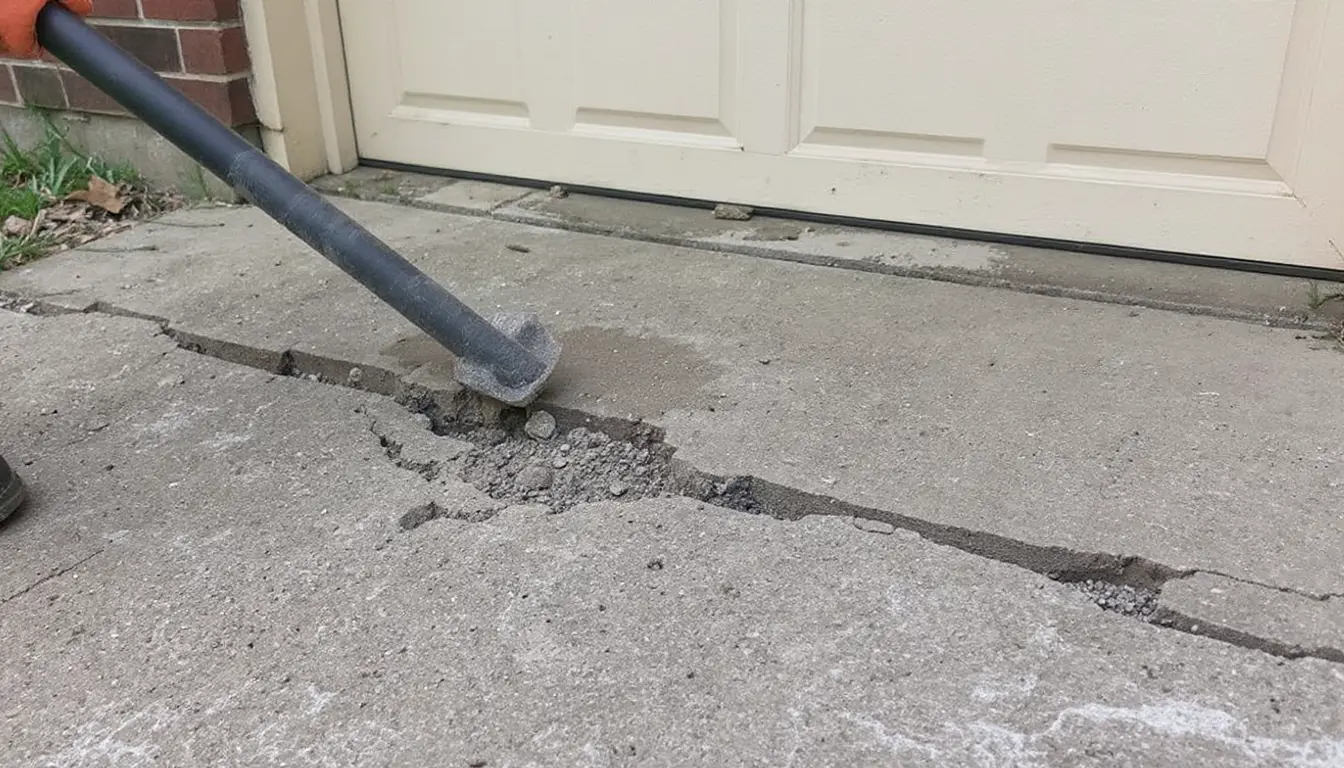
A slab that’s dropped at one corner usually hasn’t failed — the soil under it has. Water washed out a sub-slab void, or expansive clay shrank in drought and left the slab unsupported. Rather than tear out sound concrete, we lift it. Slab-lifting (also called polyjacking) injects expanding polyurethane foam through dime-sized ports; the foam fills the void and raises the slab back to grade in one visit.
It’s faster, cleaner, and less disruptive than replacement, and it drives at the actual problem — the void — instead of the cracked surface. It works for driveways, walkways, patios, garage floors, and ADA approach slabs. When a slab is both sunken and cracked full-depth, lifting won’t save it and we’ll quote replacement honestly.
Why does concrete spall, scale, and crack in Kansas City?
Our climate is hard on concrete. The metro runs 35–40 freeze-thaw cycles a year: water soaks into the surface, freezes, expands about 9%%, and flakes off the top layer — that’s scaling. Deicing salt makes it worse by pulling in more water. Concrete that was never air-entrained has no internal void structure to absorb that ice pressure and fails first.
Cracking has two main drivers: normal shrinkage that should have been directed into a control joint but wasn’t, and movement from expansive Wymore-series clay swelling and shrinking under the slab. We fix the surface and, where needed, cut proper joints so the next crack lands where it should. The soil side is detailed on our Kansas City soil conditions guide.
Commercial, ADA, and trip-hazard repair
For property managers and general contractors, concrete defects are liability before they’re cosmetics. A trip hazard where a sidewalk slab has offset at a joint is an ADA and injury exposure; we correct it by slab-lifting or grinding the offset flush, and bring non-compliant approaches up to spec with new ADA ramps.
We repair parking lot sections, warehouse floor joints and spalls, and storefront flatwork for retail and commercial clients on schedules that respect operating hours. When a repair won’t hold, we say so. See finished work on the project gallery and call (816) 721-1699 for a same-week estimate.
How long will a concrete repair last?
A repair lasts when the fix is matched to the cause, and fails fast when it isn’t. Slab-lifting holds as long as the soil stays put — which is why we also correct the drainage that washed out the void in the first place, instead of just refilling it. Epoxy injection in a static crack is effectively permanent because it welds the faces back together; polyurethane injection in a moving crack stays flexible and keeps sealing as the slab shifts seasonally.
A partial-depth patch bonded to sound concrete and cured properly lasts years of normal use. The repairs that fail in a single season are the mismatched ones — a rigid patch over a moving crack, a surface skim over a subgrade void, an epoxy weld in a joint that needs to flex. That’s the whole reason we diagnose the cause before we quote the fix. The soil movement behind so much of it is covered on our Kansas City soil conditions guide.
Cracked, sunken, or spalling?
From call to concrete — the fastest in KC.
We’ll diagnose the cause and quote the right fix this week — not a patch that returns next winter. Call (816) 721-1699 or request a free estimate.
How We Handle Concrete Repair in Kansas City
Diagnose the cause
We read the slab — freeze-thaw, subgrade void, missing joint, or rebar corrosion — because the cause decides the correct repair.
Repair-or-replace call
We give an honest verdict: what can be injected, patched, or lifted, and what has failed past the point of a lasting repair.
Prep the defect
Cracks are routed and cleaned, spalls squared to sound concrete, and voids located so the repair bonds to solid material.
Execute the fix
Epoxy or polyurethane injection, partial-depth patch, resurfacer, or polyurethane slab-lifting — matched to the diagnosis.
Joint, seal, protect
We cut or reseal control joints so the next crack lands where it should, then seal the surface against water and deicing salt.
Signs You Need Concrete Repair
Sunken or uneven slab
A driveway or walk dropped at one corner sits over a washed-out void — often lifted back to grade rather than replaced.
Surface scaling and flaking
Top-layer peeling means the concrete was never air-entrained for freeze-thaw and salt is accelerating the damage.
Spalled corners and edges
Chipping at edges points to rebar corrosion or impact and is corrected with a partial-depth patch.
Widening cracks
A crack that keeps opening signals shrinkage with no control joint or active soil movement beneath the slab.
Trip-hazard offsets
A raised lip at a sidewalk joint is an ADA and injury liability — leveled by slab-lifting or grinding.
Pooling water
Water sitting on a slab has lost its pitch; standing water freezes and drives the next round of surface damage.
Why Kansas City Chooses Ford Concrete
Diagnosis before patch
We find the cause — freeze-thaw, a washed-out void, a missing joint — then match the repair to it, instead of patching a symptom that returns.
Same-week estimates
Concrete problems get worse with every freeze. We get out fast, read the slab, and put a firm scope in writing without the runaround.
Lift, don’t tear out
A sunken but sound slab gets polyurethane slab-lifting back to grade in one visit — faster, cleaner, and cheaper than replacement.
Honest repair-or-replace
When a slab is too far gone to patch, we say so and pour new — a repair that won’t last isn’t a repair we’ll sell you.
Trusted by National Brands
From your driveway to an Amazon warehouse — the same crew, the same standards, every project.
Taco Bell
New Construction
Overland Park, KS
Domino's Pizza
New Construction
Independence, MO
Freddy's
New Construction
Kansas City
Tidal Wave Car Wash
New Construction
Kansas City
Amazon
New Construction
Riverside, MO
Nortian Food Grade Protein Facility
New Construction
Springfield, MO
Get Your Free Concrete Repair Estimate in Kansas City
Or call us directly: (816) 721-1699
Concrete Repair in Kansas City — FAQs
Can my sunken concrete be lifted instead of replaced?
Is it worth repairing spalling concrete?
How fast can you look at my concrete?
What's the difference between epoxy and polyurethane crack repair?
Can you fix a sidewalk trip hazard for ADA compliance?
Why does my concrete keep cracking in the same spot?
Decision Tool
Should You Repair or Replace It?
Answer a few questions about what you are seeing and get an honest lean — repair, replace, or worth an on-site look. It weighs the structural signals; it does not replace a walk-through.
Your assessment
This leans toward a repair
The signals you picked point to cosmetic or surface damage on a slab that is still sound underneath. A crack seal, overlay, or partial fix usually holds here — as long as nothing is moving below the slab.
0 signals point toward replacement, 3 toward repair.
This is a lean, not a diagnosis. The deciding factor is the cause of the damage — surface wear versus movement below the slab — and that is read on site, not from a form. We do both repair and replacement, so we have no reason to push you either way. Read the full repair-or-replace guide or have us walk the slab.
In-Depth Guides
Before You Decide, Read These
Ready to Get Started?
From call to concrete — the fastest in KC.
Get a free, no-obligation estimate for your concrete project. We serve the entire Kansas City metro — call (816) 721-1699 or request your estimate online.