Concrete Parking Lots Kansas City
Poured-in-place commercial parking lots — ACI 330 pavement sections, load-transfer joints, and truck-rated approaches for retail centers, QSR sites, and industrial yards across the metro.
Concrete Parking Lots in Kansas City
Commercial parking lot construction, expansion, and replacement for businesses, restaurants, and retail centers.
Who builds commercial concrete parking lots in Kansas City?
Ford Concrete Construction designs and pours commercial concrete parking lots across the Kansas City metro — from retail and restaurant lots to industrial truck yards. We have built site concrete for national brands since 2013 and hold a 4.9-star rating across 29 reviews. A concrete lot is engineered as a rigid pavement to ACI 330: a jointed 4,500 PSI slab over a compacted subgrade, with thicker sections and load-transfer joints where trucks turn and brake.
The same crew that poured new-construction site concrete for Taco Bell in Overland Park, Domino’s in Independence, and Tidal Wave Car Wash paves your lot. A parking lot is part of the flatwork & paving family and typically ties into curbs, gutters, and site drainage we pour on the same mobilization.
We pave lots in Overland Park, Lenexa, and Independence among the 46 metro cities we serve.
How thick should a concrete parking lot be?
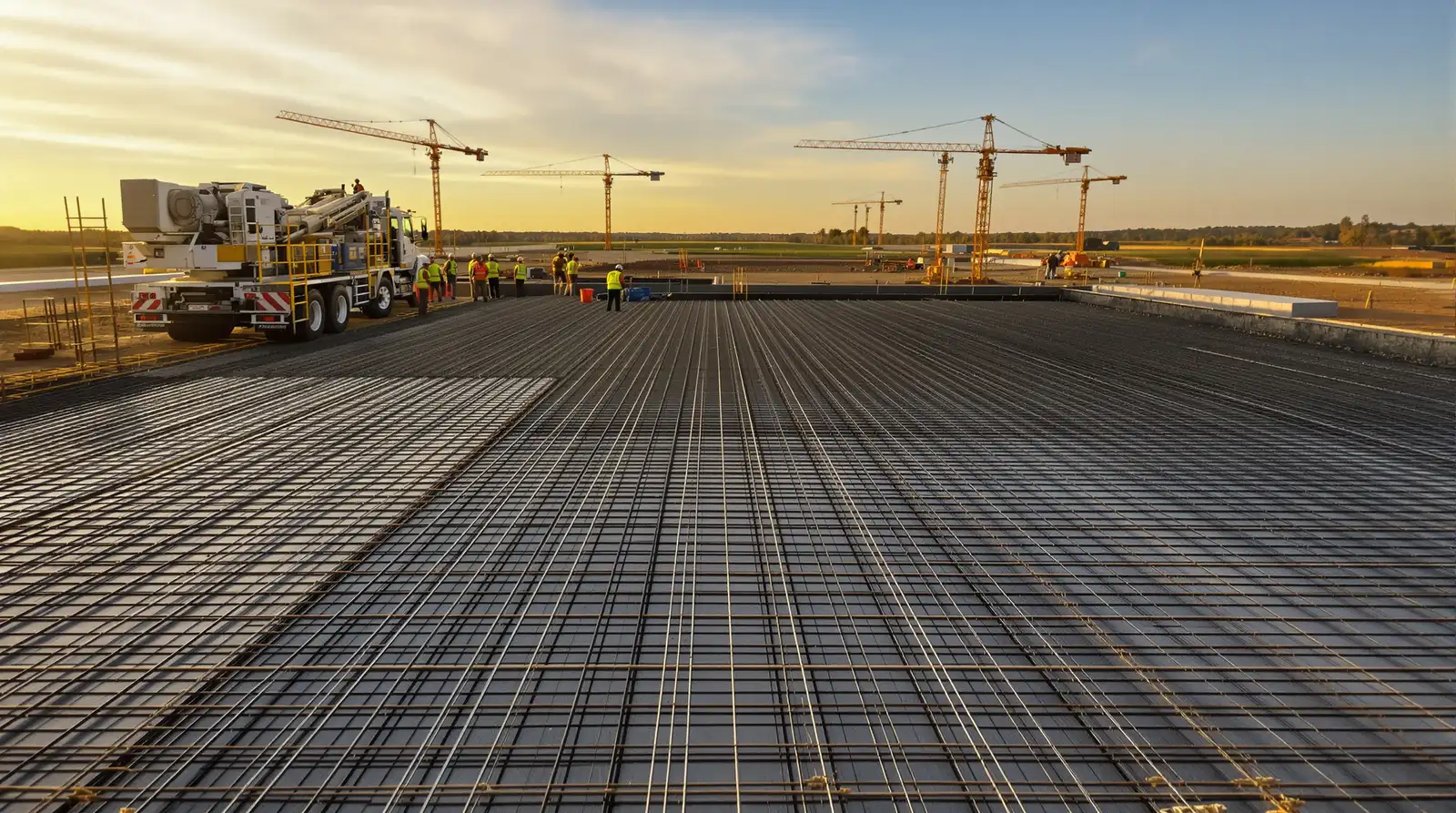
A concrete lot is not one thickness — it is zoned. Parking stalls carry static car loads; drive lanes, dumpster pads, and truck approaches take turning, braking, and point loads that demand a thicker section and doweled joints. The table is the pavement section we design per ACI 330 by zone.
| Lot zone | Slab thickness | Mix (PSI) | Jointing | Reinforcement |
|---|---|---|---|---|
| Standard parking stalls | 5 in | 4,000 | Saw-cut @ 12–15 ft | Wire mesh (optional) |
| Drive lanes / fire lanes | 6 in | 4,500 | Doweled contraction joints | #4 rebar grid |
| Dumpster / trash enclosure pad | 8 in | 4,500 | Thickened edge, isolation joints | #4 @ 12 in |
| Truck approach / loading | 7–8 in | 4,500 | Dowel baskets at joints | #4 @ 12 in |
The dumpster pad is where lots fail first: a fully loaded front-load truck plants its front axle on that slab every week. We pour it at 8 inches with a thickened edge and isolation joints so it does not spall and sink while the rest of the lot is fine.
Why concrete over the alternative for a Kansas City lot?
Concrete’s case on a commercial lot is the maintenance ledger. A rigid pavement carries point loads without the rutting and shoving that appears at drive-through windows, trash approaches, and loading docks, and it reflects light so a lot needs fewer fixtures. On Kansas City’s expansive Wymore-series clay and 35–40 annual freeze-thaw cycles, a properly jointed, air-entrained slab moves as designed instead of cracking randomly. The soil work under the pavement is detailed in our soil conditions guide, and we handle the storm drainage and grading that keep water off the surface.
We self-perform the sitework under the lot — grading, subgrade prep, and drainage — so there is no handoff between the dirt contractor and the concrete crew, and no finger-pointing if the base is wrong.
How much does a commercial parking lot cost in Kansas City?
Lot bids move on square footage, the pavement section (how much of the lot is 5-inch stalls vs. 8-inch truck zones), subgrade condition and any undercut of soft clay, and site items — curb and gutter, drainage, and ADA ramps and striping tie-ins. We build the estimate from the engineered section and the geotech, not a blanket per-foot rate, and put the scope in writing before mobilization.
General contractors and developers get a firm bid with the pavement section, jointing plan, and schedule spelled out. No financing; we accept Visa, MC, Discover, Amex, debit, cash, and check.
Retail, restaurant, and industrial lots — built to open on schedule
A lot that opens late holds up a store opening. With a crew of roughly 13 self-performing grading, forming, and pours, we sequence the lot in phases so a retail center or QSR site can occupy finished sections while we pour the rest. We coordinate the pavement with the building slab and warehouse floor so joint lines and grades match across the whole footprint.
Building a full site? Pair the lot with commercial foundations and sitework under one contract. See finished commercial work on the project gallery.
Bidding a commercial lot?
From call to concrete — the fastest in KC.
Send us the civil plans and geotech — we’ll return an ACI 330 pavement section, jointing plan, and firm bid. Call (816) 721-1699 or request a consultation.
How We Handle Concrete Parking Lots in Kansas City
Design and takeoff
We review the geotech and civil plans, set the pavement section by zone to ACI 330, and produce a jointing plan and firm bid.
Grading and subgrade
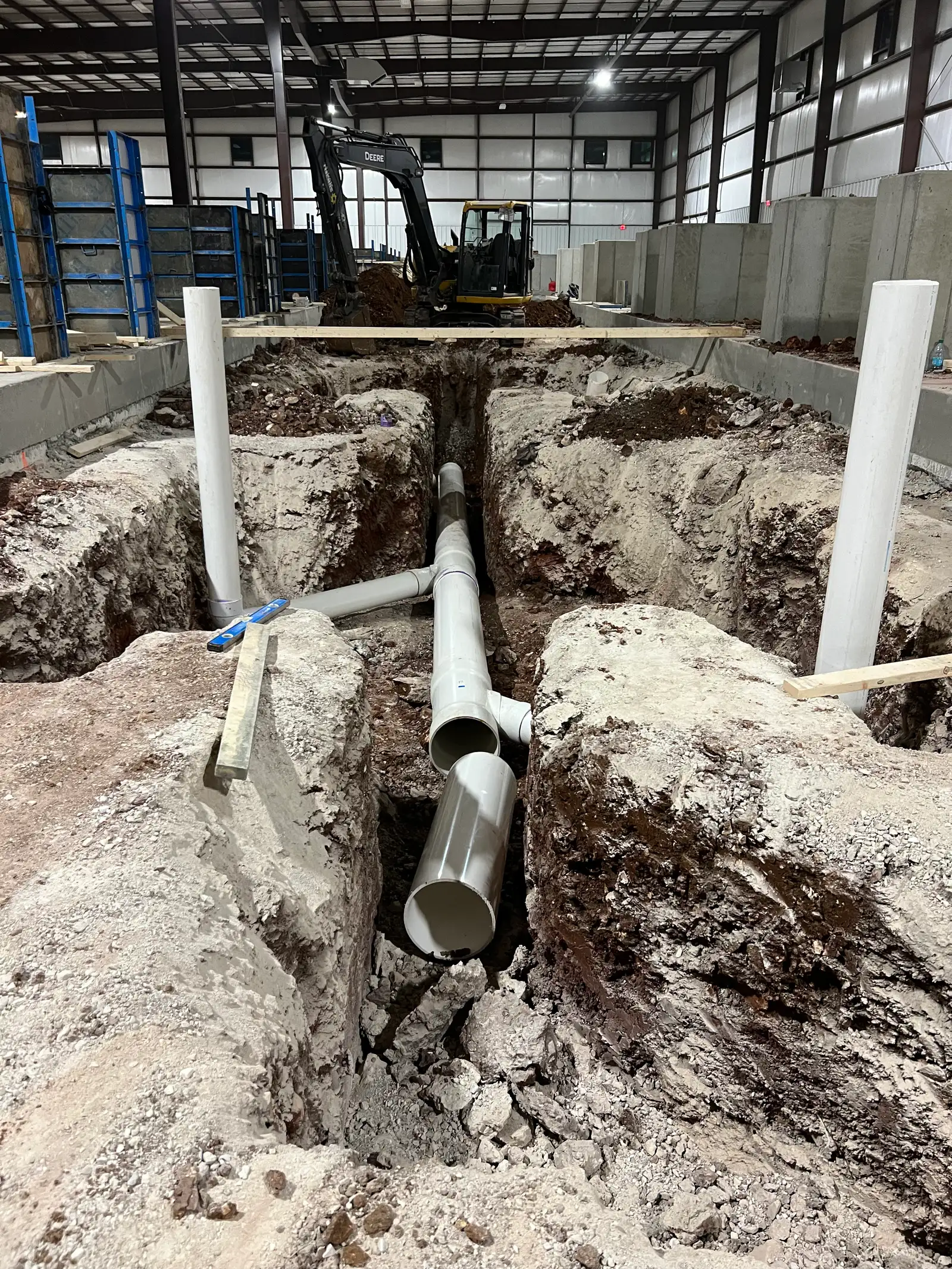
We cut to grade, undercut soft clay where the geotech calls for it, and compact the subgrade and any aggregate base to spec.
Drainage and curbs
Storm structures, area drains, and curb-and-gutter lines go in before paving so water leaves the finished surface by design.
Form, dowel, and pour
We set forms and dowel baskets, place the 4,000–4,500 PSI air-entrained mix by zone, and screed and float to grade.
Joint and cure
Contraction joints are saw-cut on time to control cracking; we cure the slab and seal joints against water and salt intrusion.
Stripe tie-in and turnover
We coordinate ADA stalls and striping layout, walk the lot with the GC, and turn over finished sections on the agreed schedule.
Signs You Need Concrete Parking Lots
Rutting or shoving at the drive-through
Waves and ruts where cars idle and brake mean the pavement section was too thin for repeated point loads at that spot.
Cracked, sinking dumpster pad
A spalled or settling trash pad is the classic under-designed zone — front-load trucks need an 8-inch slab with a thickened edge.
Random cracking between stalls
Cracks that ignore the joint layout point to missed or over-spaced saw-cuts, or a subgrade that was never properly compacted.
Ponding water and ice
Standing water after rain signals a grading or drainage miss; in KC winters that water freezes into a liability at every stall.
Faulted joints and lippage
Slabs that step up at the joints lack load transfer — without dowels, adjacent panels deflect independently and fault under traffic.
Surface scaling in traffic lanes
Flaking under tires and de-icing salt indicates a mix that was not air-entrained or was over-finished before it set.
Why Kansas City Chooses Ford Concrete
Named-brand site concrete
We poured new-construction site concrete for Taco Bell, Domino’s, Freddy’s, and Tidal Wave Car Wash. Your lot gets the same jointing and finish standards.
Engineered to ACI 330
Zoned pavement sections — 5-inch stalls, 6-inch drive lanes, 8-inch dumpster and truck pads — with doweled load-transfer joints where vehicles turn and brake.
Sitework self-performed
Grading, subgrade prep, and storm drainage under the lot are ours — no handoff between the dirt contractor and the concrete crew, no finger-pointing on the base.
Phased to hold the opening
We sequence pours so finished sections can be occupied while the rest cures — the difference between an on-time opening and a delayed one.
Trusted by National Brands
From your driveway to an Amazon warehouse — the same crew, the same standards, every project.
Taco Bell
New Construction
Overland Park, KS
Domino's Pizza
New Construction
Independence, MO
Freddy's
New Construction
Kansas City
Tidal Wave Car Wash
New Construction
Kansas City
Amazon
New Construction
Riverside, MO
Nortian Food Grade Protein Facility
New Construction
Springfield, MO
Get Your Free Concrete Parking Lots Estimate in Kansas City
Or call us directly: (816) 721-1699
Concrete Parking Lots in Kansas City — FAQs
How thick should a commercial concrete parking lot be?
What PSI should a Kansas City parking lot be?
Why does the dumpster pad always fail first?
Do you self-perform the grading and drainage?
Can you phase the pour to keep the site open?
How long before the lot can carry traffic?
Plan Your Project
How Much Concrete Will Your Parking Lots Need?
Enter your dimensions for the cubic yardage, then see the factors that actually move the price. We do not post fixed pricing — every site is different, so this shows the drivers, not a fake quote.
4" for cars, 5–6" if trucks or RVs park on it
Estimated volume
4.94 cu yd
400 sq ft at 4" thick
Order about 5.43 cu yd with a 10% overage for waste, grade, and spillage.
What’s driving your cost
- Sub-base condition: Standard grade + baseBaseline
Typical prep: grade, add and compact aggregate base. Baseline for most KC jobs.
- Reinforcement: Wire meshBaseline
A common middle option for residential flatwork.
- Surface finish: Broom / standardLowers cost
A broom finish is durable, slip-resistant, and the most economical surface.
- Existing slab: New / open groundLowers cost
No demolition — nothing to break out and haul off.
- Site access: Open — truck can reach itLowers cost
A mixer chute or direct pour keeps labor down.
Volume is exact math; price is not. We do not post per-yard or per-foot pricing because sub-base, access, finish, and reinforcement move the number more than square footage does. For a real figure on your project, get a free on-site estimate.
In-Depth Guides
Before You Decide, Read These
Proof at Scale
See This Work at Commercial Scale
Amazon — Riverside, MO
The commercial scale behind our lot and pad work — a 50,000+ sq ft Amazon facility.
Read the case study → Pad + FlatworkTaco Bell — Overland Park, KS
New-construction restaurant pad, drive-thru, and parking self-performed excavation through backfill.
Read the case study → Pads + DrainageTidal Wave Car Wash
Equipment foundations, tunnel slab, and drainage-critical flatwork for a new car wash.
Read the case study →
Ready to Get Started?
From call to concrete — the fastest in KC.
Get a free, no-obligation estimate for your concrete project. We serve the entire Kansas City metro — call (816) 721-1699 or request your estimate online.