
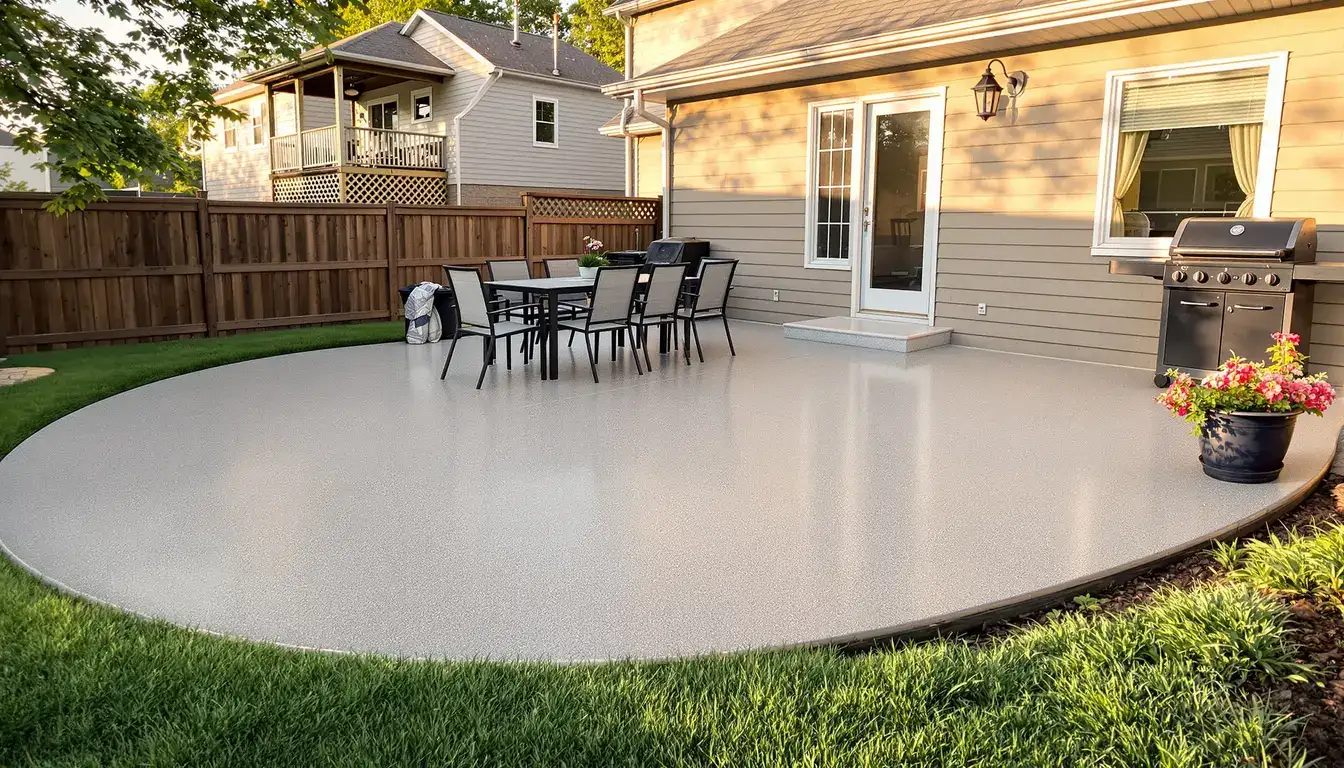
Concrete Patios & Outdoor Spaces in De Soto, KS
Concrete patios built for De Soto's new ground — from the Kaw valley flats near Kill Creek to the graded pads of a fast-growing town
Concrete Patios & Outdoor Spaces in De Soto
Custom concrete patio design and installation for backyards, outdoor living areas, and commercial courtyards. Ford Concrete serves De Soto, KS and the entire Kansas City metro with more than a decade of experience and a 5-star reputation.
De Soto at a Glance
- Population
- 6,539
- State
- Kansas
- County
- Johnson County
- Schools
- De Soto USD 232
Is the ground under your De Soto patio as new as the neighborhood?
A concrete patio in De Soto lasts when the ground under it is proven before the pour, not assumed. In a town being regraded around the Panasonic build, a backyard pad may sit on fill only a season or two old, so we probe it, build a compacted base in lifts, and pitch the slab for positive drainage.
De Soto has changed faster than almost any town in Johnson County. New subdivisions off K-10 sit on pads that were farm ground three years ago, while older lots down toward Kill Creek and the Kansas River hold valley soil that drains slow and stays damp. Those two grounds don't take a slab the same way, so we check which one you have before we quote. If your existing patio is only worn on top, our resurfacing may carry it; on a slab that has already dropped on soft fill, a rebuild usually costs less across ten years.
Proving the pad before we form a De Soto patio
On fresh fill the base decides everything. We dig down to see what the pad is really made of, then rebuild it in thin lifts of compacted base stone so it won't consolidate under the slab the way loose builder's fill does after the first wet winter. A held restraint point at the perimeter keeps the edge from creeping where the fill is softest.
We separate the patio from the house slab and any porch footing with an isolation joint so the two move on their own as the fill settles and the seasons work the ground. The concrete itself goes down at 4,000 PSI over that proven base — the same mix and the same crew that pours heavy commercial flatwork across the metro, sized here for a backyard and finished by hand.
How deep we go depends on what the probe finds. On a lot where the fill is shallow and clean, a foot of rebuild over firm ground is enough; where a builder pushed loose spoil three or four feet deep, we dig until the base has something solid to press against. Part of De Soto's ground is reclaimed — the Sunflower redevelopment turned a former Army munitions site into buildable land — so checking what's underfoot isn't a formality here, it's how you learn what you're actually pouring on.
Keeping water off a patio in the Kaw valley
Down toward Kill Creek and the river the ground is flat and slow to drain, so a patio that sits a hair too low collects every roof-shed gallon against the house. We set the threshold elevation a step below the door and pitch the whole slab away from the foundation so water leaves on its own instead of pooling where the fill is weakest.
That fall — a steady positive drainage pitch of about a quarter inch per foot — is decided at the doorway and carried to the far edge, not patched in later with a surface drain. On a valley lot we would rather move water across open ground than trust it to a pipe that silts up, because standing water is what softens new fill and starts a corner sinking.
Roof water is the other half. We tie the patio grade to where your downspouts land so runoff crosses the slab and keeps going, rather than sheeting back under it. On a low lot near the Kill Creek bottoms, that extra bit of fall between the door and the yard is often the difference between a dry slab and a mossy one that never quite dries out between rains.
Why a De Soto patio cracks at an inside corner
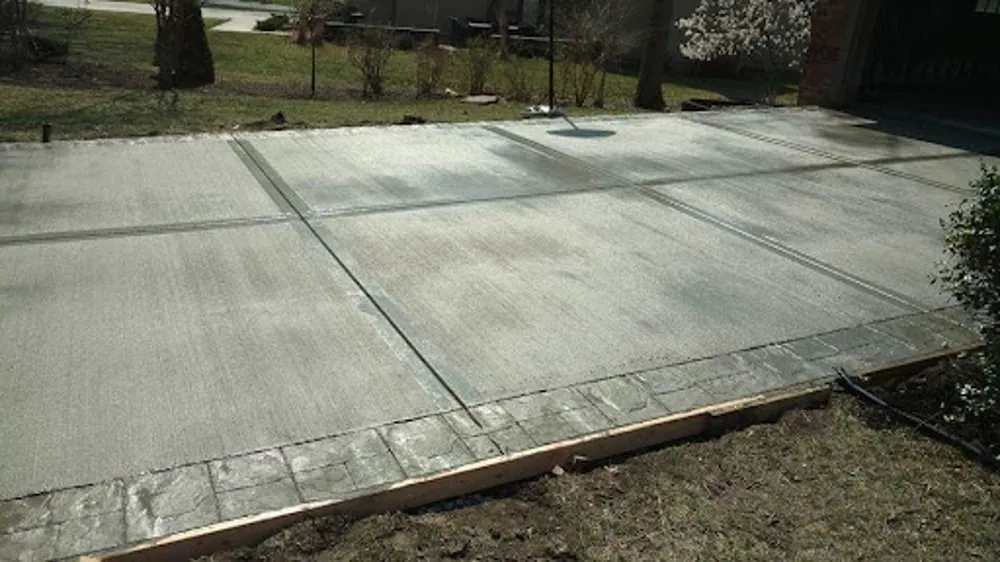
Concrete cracks; the work is deciding where. The weak spot on most patios is the re-entrant corner — an inside angle where the slab wraps a step or a doorway — because stress concentrates there as the fill flexes. We cut contraction joints on a planned grid, roughly ten feet apart, so the slab relieves that stress in a straight tooled line instead of a ragged crack across the middle.
On new fill that movement is bigger in the first couple of years while the ground finds its level, which is exactly why joint placement and timing matter more here than on settled ground. We saw the joints on time — early enough to beat the shrinkage, deep enough to control it — and lay them out to fit the shape of your patio rather than a default square.
Broom or stamped for a new De Soto backyard
A new house deserves a patio that reads as part of it. The choice usually comes down to a broom vs stamped finish: a broomed surface is clean, slip-sure, and quiet under furniture; a stamped surface carries a stone or plank pattern that ties to the house. Before we commit the whole pour we set a mockup so you approve the color and texture on the ground, not off a phone screen.
We also lay out the joints as part of the design. Joint pattern continuity — lining the control joints up with door frames, columns, and the pattern lines — is the difference between a slab that looks engineered and one that looks poured by the yard. On a stamped patio we detail the color in our stamped concrete work so it holds up outdoors.
Color holds up outdoors when the sealer does its job. We finish a stamped patio with a breathable sealer and plan on a light reseal every couple of years, so the pattern keeps its depth instead of graying out under the open Kansas sun. A broomed slab wants the same care on a longer cycle.
Replacing an older patio in downtown De Soto
Not every De Soto lot is new. Around downtown and the older streets off 83rd, patios poured decades ago are thin, unreinforced, and jointless, and they have spent every winter since taking on water and giving it back. Without a real base or a single contraction joint to guide them, they crack early and scale on top.
When the surface flakes but the slab is still solid underfoot, resurfacing can buy years. When the panels have stepped apart or a corner has dropped, the trouble is under the concrete, and a new pour over a rebuilt base is the honest fix. We'll tell you which one you're looking at — and if we're already tearing out, that's the moment to make the patio bigger or square up an awkward shape.
Do you need a permit for a patio in De Soto?
A ground-level patio usually falls under the City of De Soto's accessory-structure rules, and anything attached to the house or carrying a roof draws more review. We pull the permit, keep the slab off the setback and easement lines, and confirm the threshold elevation won't shed water toward a neighbor before we start.
We build patios across western Johnson County, so if you're comparing notes with family in Olathe, Gardner, or Shawnee, the ground rules shift with the soil — and De Soto's fresh fill is its own case. You can see finished work in our gallery or read more on the main concrete patio page.
Ready to build your De Soto patio?
From call to concrete — the fastest in KC.
In a town growing this fast, the ground under your patio is the whole question. Ford probes the pad, builds the base in lifts, and hands you a written number instead of a guess from the curb. Call (816) 721-1699 for a site visit.
How we build Concrete Patios & Outdoor Spaces that lasts in De Soto
Walk the lot and probe the pad
We check whether your patio sits on new subdivision fill or older Kaw-valley ground, dig to see what's under it, and set the base plan from what we find.
Set the layout and threshold
We mark the shape, the joint grid, and the threshold elevation a step below the door so water always leaves the house.
Rebuild the base in lifts
We compact clean stone in thin lifts to a firm, even base that won't consolidate the way loose builder's fill does.
Form, grade, and hold the edges
We form the slab, build the drainage pitch into the grade, and set the restraint point and any doweled joints before the pour.
Pour 4,000-PSI concrete
We place and screed 4,000-PSI concrete, then float and finish to the broom or stamped texture you approved on the mockup.
Cut the joints on time
We saw the contraction joints on a planned grid, early enough to control where the slab cracks as the fresh ground moves.
Seal, cure, and walk it with you
We cure the slab, seal it, and walk the finished patio with you so you know how it was built and how to keep it.
Signs your De Soto Concrete Patios & Outdoor Spaces needs attention
A young patio that's already dropped
A slab poured a year or two ago sitting lower at one edge means the fill under it was never compacted for the load — it's still finding its level.
Cracks fanning from an inside corner
Cracks running out of a re-entrant corner near a step or doorway are the slab relieving stress the joints should have taken.
Water standing against the house
A patio that ponds at the foundation after rain was set too low or pitched the wrong way — a drainage problem, not a concrete one.
Panels stepping apart at a joint
When one panel sits higher than its neighbor across a joint, the base under the low side has washed or settled and lost its support.
A surface flaking and shedding grit
Spalling and scaling on top usually means a weak surface or a slab that stays wet — often the first thing to fix on an older De Soto patio.
A seam creeping open at the doorway
A gap widening where the patio meets the house shows the two are moving together instead of on their own isolation joint.
The Ford difference on De Soto Concrete Patios & Outdoor Spaces
We prove the pad before we form
In a town this new, we don't assume the fill was built for a slab. We dig, check what's under the pad, and set the base to what we actually find.
A short run down K-10
De Soto sits right on the K-10 corridor, so we're an easy trip out to walk your lot, quote it, and pour it without the delays of a crew coming from across the metro.
Commercial-scale finishing on a backyard slab
The same crew that pours heavy commercial flatwork brings that flatness and joint control to a patio — and finishes it to the texture you signed off on.
4.9 stars, 29 Google reviews
Homeowners across the metro rate Ford Concrete 4.9 stars over 29 Google reviews, and the reviews keep coming back to the same thing: we answer, we show up, and we finish.
Where our Concrete Patios & Outdoor Spaces crews have delivered
From your driveway to an Amazon warehouse — the same crew, the same standards, every project.
Taco Bell
New Construction
Overland Park, KS
Domino's Pizza
New Construction
Independence, MO
Freddy's
New Construction
Kansas City
Tidal Wave Car Wash
New Construction
Kansas City
Amazon
New Construction
Riverside, MO
Nortian Food Grade Protein Facility
New Construction
Springfield, MO
Get your free Concrete Patios & Outdoor Spaces estimate in De Soto
Or call us directly: (816) 721-1699
Concrete Patios & Outdoor Spaces in De Soto — FAQs
How does De Soto's building boom affect a new patio?
Do I need a permit for a patio in De Soto?
Why do patios crack at the corners?
How do you keep a patio flat on fresh fill?
How long does a patio take to build in De Soto?
Can you make my patio bigger when you replace it?
Beyond Concrete Patios & Outdoor Spaces: our De Soto work
De Soto and neighboring communities
Ready to pour in De Soto?
From call to concrete — the fastest in KC.
Get a free, no-obligation estimate for your concrete project. We serve the entire Kansas City metro — call (816) 721-1699 or request your estimate online.