
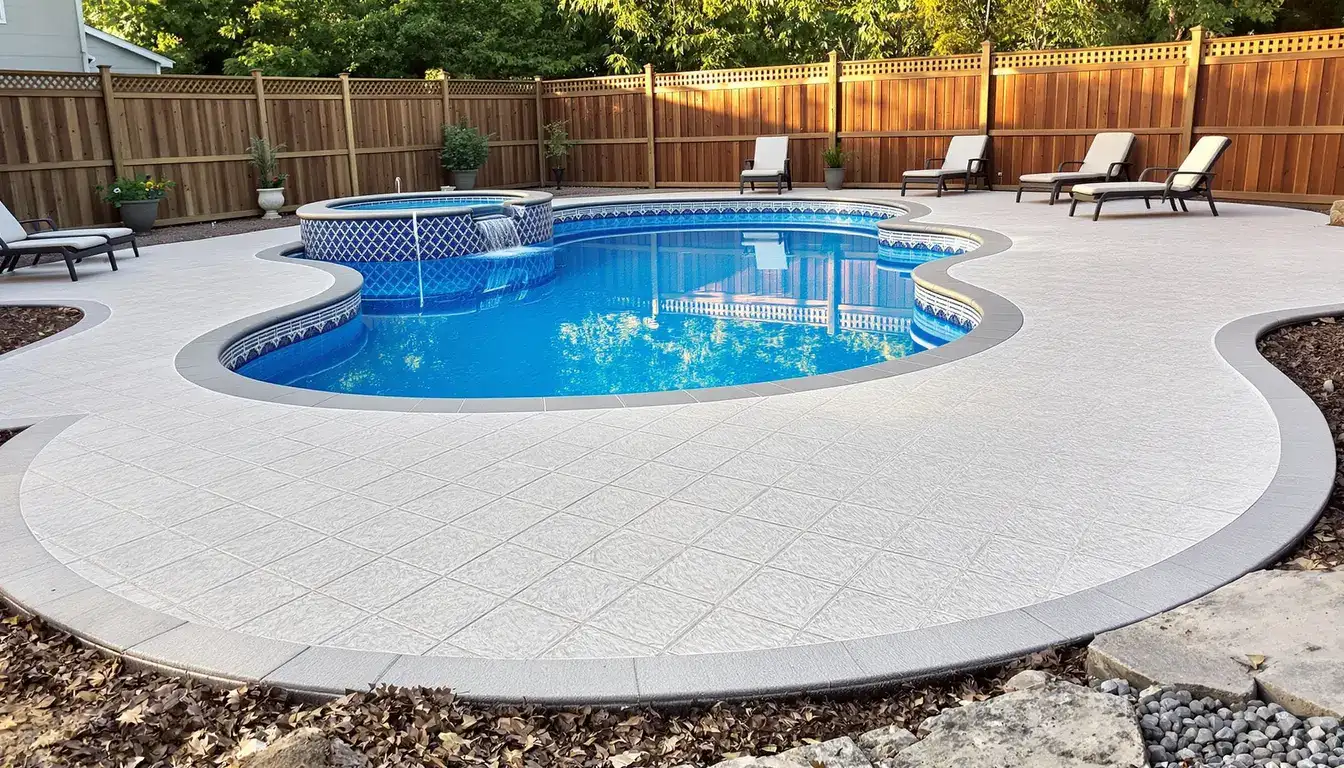
Concrete Pool Decks in Grandview, MO
Pool decks built for Grandview's established backyards — from the mid-century streets off Blue Ridge Blvd to the newer lots near Longview Lake, graded for mature ground and Jackson County's expansive clay.
Concrete Pool Decks in Grandview
Slip-resistant concrete pool deck installation and resurfacing for residential and commercial swimming pools. Ford Concrete serves Grandview, MO and the entire Kansas City metro with more than a decade of experience and a 5-star reputation.
Grandview at a Glance
- Population
- 26,682
- State
- Missouri
- County
- Jackson County
- Schools
- Grandview C-4 School District
What makes a Grandview pool deck last?
A Grandview pool deck lasts when the lot is graded to carry water off the slab, the concrete is poured four inches thick at 4,000 PSI, an isolation joint keeps the deck free of the pool shell, and the surface is broomed for slip resistance underfoot. On Jackson County's expansive clay, a compacted base and honest drainage decide the rest.
Grandview is one of the metro's settled southern suburbs — much of it built out during the Richards-Gebaur era, with mature streets off Blue Ridge Boulevard and MO-150 and newer lots edging toward Longview Lake. The backyards here are established, the trees are grown in, and the clay under them has been moving with the seasons for decades. We build a deck that reads that ground before the first form goes down.
Reading an established Grandview backyard
A pool deck in a grown-in neighborhood like Meadowmere or Bel-Aire is a different job than one behind new construction. The ground has settled, the drainage patterns are set, and there is usually mature landscaping to work around. We walk the yard first — where the low corner sits, how the lot sheds a hard rain, where a mature maple or oak has pushed its roots toward the pool. That read shapes where the deck sits, how it drains, and where we hold every joint so a wet deck never collects at the low corner. On a settled lot the clay has already done much of its heaving, which is an advantage: we can see how the ground behaves instead of guessing at fresh fill.
A base for Jackson County clay
The Wymore-association clay under Grandview swells when it takes on water and shrinks back as it dries — the same seasonal movement we plan around on decks over in Raytown and Lee's Summit, and the same movement that cracks a slab poured straight onto raw soil. We excavate to a stable subgrade and rebuild a compacted stone base in lifts so the deck bears on stone, not on clay that never holds still. Where an addition or an older pool left disturbed ground behind, we watch for backfill consolidation — loose fill that keeps settling for a season — and stage the base on ground that has stopped moving. Soil and grading here fall under MoDNR guidance, and the metro's freeze-thaw winters make sealing the finished slab non-negotiable.
Working around mature trees and grown-in roots
The grown canopy that makes an established Grandview yard worth sitting in is also the thing that lifts a poorly-planned deck. Tree roots travel toward the moisture a pool holds, and a large root under a thin slab will heave a panel out of line within a few years, tipping water back toward the pool and leaving a wet deck at the edge. We map the mature trees before we set the deck line, keep the slab back from the trunks where we can, and thicken and reinforce the sections that have to bridge a root zone. Where a deck runs close to a big tree, a contraction joint placed on plan gives the slab a controlled place to move rather than a random crack. Reading the trees is part of reading the lot — skip it and the yard's best feature becomes the deck's first failure.
Why the deck stays free of the pool shell
The pool shell stays put in the ground while the deck rides the surface and works with each season. Cast the two as one and the shell/deck interface pulls apart at the first hard freeze, splitting the slab right at the water. We set an isolation joint around the entire pool perimeter so deck and shell each travel on their own. It is a small detail at pour time and the reason a Grandview deck stays tight along the coping for decades instead of cracking out in its first few winters.
Where the water goes on a lot near Longview Lake
Grandview's southern and eastern edges drain toward the Longview Lake watershed, and a deck built across that fall has to shed its own runoff on purpose. We slope every foot of the surface to one discharge point, so runoff sheds off the slab rather than collecting at the coping and loading hydrostatic pressure beneath the shell. On a lower lot near the lake or a creek draw, that drainage plan is the difference between a deck that clears every storm and one that stays wet at the edge, holding a slick wet deck long after the sun comes out.
Finish, resurfacing, permits, and the bonding grid
We broom the surface for slip resistance, or for a decorative look we cast a stamped concrete mockup panel in your yard so you approve the color and texture before the pour. An older Grandview deck with a sound slab underneath may only need resurfacing — a bonded overlay restores the surface without a tear-out; if the base underneath has gone, we say so and call for a rebuild rather than skinning over a slab that keeps shifting. A new or rebuilt deck pulls a permit through the City of Grandview, and the electrical inspection has to include equipotential bonding — a grounding grid tied into the deck so the pool area sits at one electrical potential. We coordinate that sign-off before the concrete closes it in. It is the same discipline the crew brings to the commercial slabs we pour across the metro, at backyard scale.
Ready to build your Grandview pool deck?
From call to concrete — the fastest in KC.
In Grandview, a pool deck starts with reading an established yard, the low corner, the grown-in trees, the clay that has been moving under it for years. We plan the runoff, build a base that holds, leave the shell free, and put a number on paper. Call (816) 721-1699 for a site visit, most often inside a day.
How Grandview soil shapes your Concrete Pool Decks
Survey the yard and its trees
We look at how you use the yard, find the low side, map the mature trees, and read how your Grandview lot drains and how the clay behaves.
Set the drainage line
We fix the discharge point and slope the deck toward it, accounting for the fall toward the Longview Lake watershed on a lower lot.
Rebuild the base in stacked lifts
We dig to firm subgrade and stack a compacted stone base, watching for disturbed fill still settling near an older pool or addition.
Part the deck from the shell
We set an isolation joint around the whole pool perimeter so the deck and shell travel independently without tearing at the edge.
Place, broom, and cure the slab
We pour 4,000-PSI concrete, drag a broom finish for slip resistance, cut the joints on plan around the root zones, and cure it slow.
Form the coping and bond the grid
We form the cantilever coping over the bond beam and line up the equipotential bonding inspection before the pour closes it in.
Seal it and walk it with you
We seal the surface against the metro's freeze-thaw and walk the finished deck with you before we leave.
When Concrete Pool Decks in Grandview is ready to replace
Cracking along the coping line
A crack that follows the coping tells you the slab was poured tight to the shell without an isolation joint, so the two ripped apart as they shifted.
A panel lifted out of line
A slab heaved above its neighbors on an established lot usually means a mature tree root grew under a section that was never thickened for it.
Rainwater pooling on the slab
Standing water after a storm shows the deck drains toward the pool rather than away, forcing hydrostatic pressure under the shell on a low Grandview lot.
The top surface flaking off
A deck that sheds thin flakes has been bitten by freeze-thaw over the metro's winters, almost always because it was never sealed.
A slippery surface underfoot
A wet deck gone slick has worn off its broom texture or was finished too smooth, dangerous around a pool and worse with kids.
Coping working loose
Coping that shifts or lifts off the bond beam means the deck pushed against the shell, a failed or missing isolation joint at the edge.
Why Grandview homeowners call Ford
Built for an established lot
Grandview yards are grown in — settled ground, mature trees, set drainage. We read the lot first and build the deck to the yard you already have.
A base for expansive clay
Jackson County's Wymore clay swells and shrinks each season. We rebuild the footing as compacted stone in lifts so the deck sits on rock, not restless soil.
Planned around your trees
We map the mature trees before we set the deck line, keeping the slab off the root zones that would heave it and jointing the sections that must bridge them.
A straight number, in writing
We read the lot, plan the deck, and put the scope and price on paper, a straight figure with no surprises and no pressure to sign.
Where our Concrete Pool Decks crews have delivered
From your driveway to an Amazon warehouse — the same crew, the same standards, every project.
Taco Bell
New Construction
Overland Park, KS
Domino's Pizza
New Construction
Independence, MO
Freddy's
New Construction
Kansas City
Tidal Wave Car Wash
New Construction
Kansas City
Amazon
New Construction
Riverside, MO
Nortian Food Grade Protein Facility
New Construction
Springfield, MO
Get your free Concrete Pool Decks estimate in Grandview
Or call us directly: (816) 721-1699
Concrete Pool Decks in Grandview — FAQs
I have big trees near the pool — will they crack the deck?
Will the expansive clay under Grandview crack a new deck?
Why can't the deck be poured against the pool?
Can you resurface an older Grandview deck instead of replacing it?
Will winter scaling ruin a new pool deck?
Do I need a permit for a pool deck in Grandview?
Related concrete services in Grandview
Serving Grandview and the surrounding metro
Ready to pour in Grandview?
From call to concrete — the fastest in KC.
Get a free, no-obligation estimate for your concrete project. We serve the entire Kansas City metro — call (816) 721-1699 or request your estimate online.