
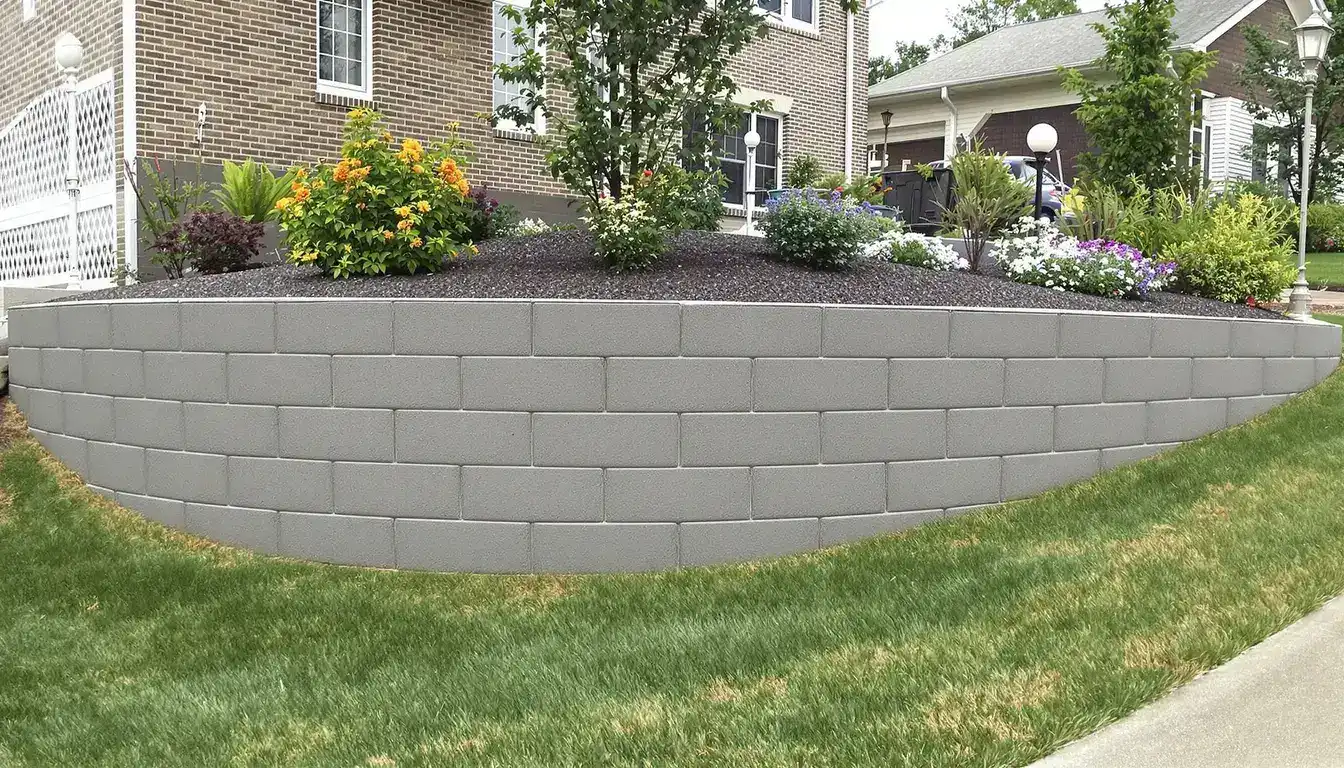
Retaining Walls in Independence, MO
Engineered concrete retaining walls for Independence's expansive clay and rolling, walkout-basement ground
Retaining Walls in Independence
Structural and decorative concrete retaining wall construction for erosion control, landscaping, and property grading. Ford Concrete serves Independence, MO and the entire Kansas City metro with more than a decade of experience and a 5-star reputation.
Independence at a Glance
- Population
- 121,629
- State
- Missouri
- County
- Jackson County
- Schools
- Independence Public School District (ISD)
What holds a retaining wall together on Independence clay?
A retaining wall in Independence holds when its footing reaches firm ground below the 36-inch frost line, its stem carries steel sized for the lateral earth pressure behind it, and a drainage column keeps water from stacking against the face. On Jackson County's expansive clay, the swelling soil pushes harder than most homeowners expect, so the footing and the drainage carry the whole job.
Independence runs across rolling ground — the ridges around the Truman Library and Independence Square, the valleys cut by the Little Blue River and Rock Creek — and much of it is Wymore and Ladoga clay that swells when wet and shrinks when dry. A wall built without accounting for that movement leans, cracks, or overturns within a few seasons. A concrete retaining wall built for it stands for decades.
Why Jackson County clay pushes a wall the way it does
Expansive clay is not a passive backfill. When Wymore-Ladoga clay soaks up water it expands with real force, and that force lands as lateral earth pressure on the back of the stem — on top of the weight of the soil itself. Through a wet-dry cycle the clay swells and shrinks against the wall over and over, and a stem short on steel or a footing set too shallow slowly loses the argument.
We design for the wet-season load, not the dry one. The stem's reinforcement, the footing width, and the shear key that resists sliding are all sized to the pressure Jackson County clay reaches when it is fully saturated. Building for the dry-season number is how a wall that looked fine in July leans by spring.
Walls that hold a walkout basement's grade
A lot of Independence homes on the rolling ground off M-291 and US-24 have walkout basements, and the walls that shape those grades are doing structural work against a living space. A wall holding the cut beside a walkout carries surcharge from the patio or driveway above it and has to keep water off the foundation it sits near.
Those walls get engineered like the load-bearing structures they are: footing to firm bearing, reinforced stem, and a drainage column that routes water away from the house, not toward it. Getting the drainage wrong on a walkout wall risks more than the wall itself — it puts water against the basement.
Little Blue River, Rock Creek, and the drainage column
Water is what takes down retaining walls in Independence. The clay along the Little Blue River and Rock Creek corridors holds water long after a storm, and water trapped behind a wall builds hydrostatic pressure — a load that can push over a wall the dry earth never would.
Every wall we build gets a drainage column engineered to bleed that pressure off: clean drainage aggregate against the back of the stem, a perforated drain wrapped in filter fabric at the base, and weep outlets that give the water a way out. Backfill goes in compacted lifts so it never settles into a low spot that feeds water back to the wall. On Independence clay, the drainage column is the difference between a wall that stands and one that fails.
Footing, heel, and toe: how the base resists sliding and overturning
A retaining wall fails in one of a few ways, and each has a design answer. It can slide forward on its base, tip over at the top, or press its footing into ground too soft to hold it. The base — footing, heel, and toe — is engineered against all three.
The heel extends back under the retained soil so the weight of that soil helps hold the wall down against overturning. The toe spreads the load forward to keep bearing pressure inside what the ground can carry. The shear key cast into the footing bites into firm soil to resist sliding. On a tall or tiered Independence wall we also check global stability — whether the whole slope, wall and all, could move together — before a drawing is final.
Independence permits and engineered plans
The City of Independence requires a permit for retaining walls above a set height, and taller or tiered walls need plans stamped by a licensed engineer. Walls near a property line, over an easement, or holding a surcharge get closer review, and walls tied to a walkout or foundation are held to a higher bar. We pull the permit, build to the stamped drawings, and keep the wall ready for inspection.
Soil and stormwater work in Missouri is regulated through the MoDNR, and we keep our drainage and backfill inside those rules. If you are comparing options nearby, our Blue Springs and Lee's Summit wall pages cover the same clay on neighboring ground, and the Kansas City soil guide maps what sits under your lot.
The crew behind a commercial pour and your backyard wall
Ford Concrete has worked across Independence since Aaron Ford founded the company in 2013, and the crew that builds your wall is the same one that pours commercial concrete — including the new-construction Domino's Pizza here in Independence. The discipline that goes into a commercial slab goes into a backyard retaining wall.
KC-metro homeowners rate Ford 4.9 on Google across 29 reviews, and responsiveness is the reason most of them give. See finished work in our gallery or compare nearby walls in Liberty, then call (816) 721-1699 for a site evaluation.
Building a wall in Independence?
From call to concrete — the fastest in KC.
Independence sits on expansive Jackson County clay and rolling walkout-basement ground, where a wall's footing and drainage carry the whole job. Ford engineers each one to the clay, the grade, and the water. Call (816) 721-1699 for a site evaluation.
What goes into an Independence Retaining Walls job
Read the clay and the grade
We test the clay, measure the surcharge and slope, and read the water path before any design.
Engineer to the wet-season load
We size the footing, stem, steel, and shear key to the pressure Jackson County clay reaches saturated.
Excavate below frost to firm ground
We dig past soft clay to firm bearing, below the 36-inch frost line, cutting out weak fill first.
Pour the footing and shear key
We place the 4,000-PSI footing and its shear key so the base resists sliding before the stem rises.
Form and pour the reinforced stem
The stem is formed, steel is set to the drawing, and the wall is poured and finished to spec.
Build the drainage column
Aggregate, a perforated drain in filter fabric, and weep outlets go in behind the wall before backfill.
Backfill in lifts and grade
We compact the backfill in lifts, grade the top to shed water, clean up, and walk the wall with you.
Is your Independence Retaining Walls failing?
A stem leaning toward the yard
A wall tipping out is losing to clay pressure the footing or steel was never sized to carry.
Cracks stepping through the wall
Diagonal cracks usually mean the wall is settling unevenly or moving under expansive-clay pressure.
Water against a walkout basement
Water reaching the foundation near a walkout wall means the wall's drainage is routing it the wrong way.
A bulge at mid-height
A wall bowing in the middle is deflecting under pressure it was not reinforced to hold.
A gap opening at the top
A wall pulling away up top is beginning to overturn as the base loses its grip.
Soil washing out below
Fill escaping under the wall means water took a path the drainage should have carried off.
The Ford difference on Independence Retaining Walls
We design for wet-season clay
Jackson County clay pushes hardest when it's saturated. We size the footing and steel to that load, not the dry-season one.
Built for walkout grades
Walls beside Independence walkout basements do structural work near a foundation. We engineer and drain them accordingly.
Commercial-grade crew
The crew behind our commercial pours, including new Domino's construction in Independence, builds your wall to the same standard.
4.9 stars, 29 Google reviews
KC-metro property owners rate Ford 4.9 on Google across 29 reviews. Aaron Ford founded the company in 2013.
Proof we pour at any scale
From your driveway to an Amazon warehouse — the same crew, the same standards, every project.
Taco Bell
New Construction
Overland Park, KS
Domino's Pizza
New Construction
Independence, MO
Freddy's
New Construction
Kansas City
Tidal Wave Car Wash
New Construction
Kansas City
Amazon
New Construction
Riverside, MO
Nortian Food Grade Protein Facility
New Construction
Springfield, MO
Price your Independence Retaining Walls project
Or call us directly: (816) 721-1699
Retaining Walls in Independence — FAQs
How does Jackson County clay affect a retaining wall?
Can you build a retaining wall next to a walkout basement?
Why do retaining walls fail in Independence?
Do I need a permit and engineered plans in Independence?
Can you build a terraced wall on a sloped Independence lot?
Other concrete work we do in Independence
Nearby Independence-area projects
Start your Independence concrete project
From call to concrete — the fastest in KC.
Get a free, no-obligation estimate for your concrete project. We serve the entire Kansas City metro — call (816) 721-1699 or request your estimate online.