
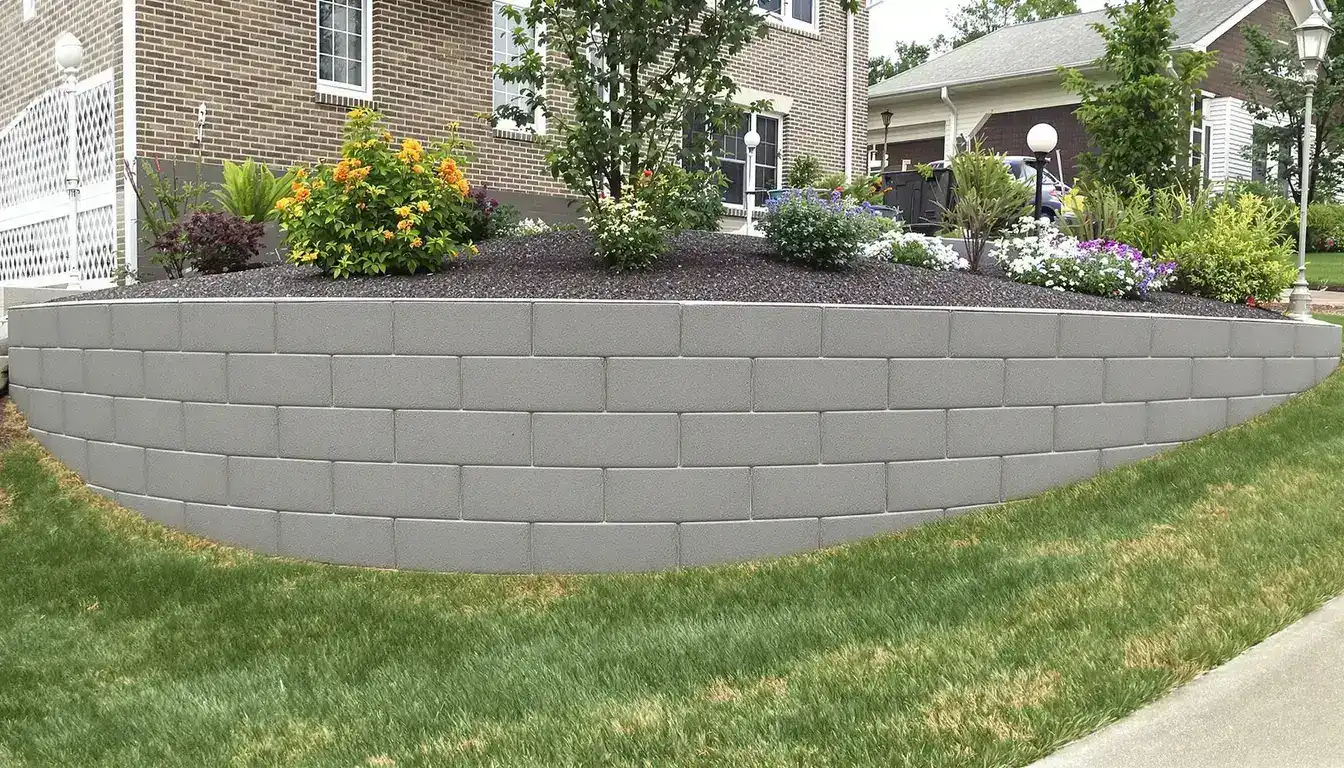
Retaining Walls in Liberty, MO
Engineered concrete retaining walls for Liberty's Northland ground — glacial till, loess, and the low ground along Shoal Creek
Retaining Walls in Liberty
Structural and decorative concrete retaining wall construction for erosion control, landscaping, and property grading. Ford Concrete serves Liberty, MO and the entire Kansas City metro with more than a decade of experience and a 5-star reputation.
Liberty at a Glance
- Population
- 31,755
- State
- Missouri
- County
- Clay County
- Schools
- Liberty Public Schools
What holds a retaining wall up on Liberty's Northland ground?
A retaining wall in Liberty holds when its footing reaches firm bearing below the 36-inch frost line, its stem carries steel sized for the lateral earth pressure behind it, and a drainage column keeps water from stacking against the back. Liberty sits on Clay County's Northland ground — glacial till and loess, not the Jackson County clay across the river — and finding firm bearing in that till is the first thing that decides the design.
The city spreads from the Historic Liberty Square out across rolling ground toward Shoal Creek Valley and the newer subdivisions off MO-152. A wall that ignores what's under it there settles unevenly, leans, or cracks within a few seasons; a concrete retaining wall built to the ground it stands on holds grade for decades.
Clay County glacial till, not Jackson County clay
The Northland was scraped over by glaciers long ago, and the ground they left behind is different from the expansive clay south of the Missouri River. Liberty's uplands are glacial till — a mix of clay, silt, sand, and sometimes cobbles and boulders — often capped with wind-blown loess. It doesn't swell and shrink the way Jackson County's Wymore clay does, but it varies from spot to spot, and a footing can pass from firm till into a soft pocket in a few feet.
That variability is why we probe for firm bearing before we set a footing depth. A wall founded partly on dense till and partly on a soft seam settles unevenly and cracks, so we carry the footing to consistent ground across the whole run instead of assuming the soil is the same end to end.
Shoal Creek, the low ground, and hydrostatic pressure
Down in the low ground — the alluvial pockets along Shoal Creek Valley and the drainageways that feed it — the water table runs higher and the soil holds water longer. A wall built there collects water behind it, and trapped water builds hydrostatic pressure, a load that can push a wall over when the drained soil never would.
Every wall we build gets a drainage column sized to bleed that pressure off: clean drainage aggregate against the back of the stem, a perforated drain at the footing wrapped in filter fabric so it won't silt shut, and weep outlets that route the water somewhere it can leave. On the low, wet ground near a creek, that drainage system is what keeps the wall standing.
New Northland lots and the fill under your wall
Liberty is one of the Northland's fastest-growing cities, and subdivisions like Woodneath Farms and Clay Meadows were graded out of rolling ground — cut on the high side, filled on the low. A wall built across that line sits on undisturbed till at one end and engineered fill at the other.
Fill that wasn't placed in tight backfill lifts keeps settling for years, and a footing bridging the seam can crack as one end drops. We carry the footing to firm bearing across the whole run and account for any surcharge — a driveway or patio loading the slope above — before we size the steel.
Reinforced or gravity: sizing the wall to the load
Not every wall needs the same structure. A low garden wall can sometimes work as a gravity wall — heavy enough that its own weight holds it — while a taller wall retaining real grade needs a reinforced concrete cantilever, with steel in the stem sized to the lateral earth pressure and a shear key under the footing to resist sliding.
We make that call from the height, the slope behind the wall, and the load on top of it, not from a catalog. Sizing a reinforced wall where a gravity wall would do wastes money; using a gravity wall where the load calls for reinforcement is how a wall ends up leaning. Getting the type right is half of getting the wall right.
Liberty permits and engineered plans
The City of Liberty requires a permit for most retaining walls, and taller walls — generally those over four feet from the bottom of the footing — need engineered plans stamped by a licensed professional. A wall carrying a surcharge from a driveway above, or one stepped into tiers, can reach that threshold at a lower height.
We pull the permit and, where the wall needs them, bring stamped plans that show how it resists sliding and overturning under load. Drainage and grading stay within MoDNR guidance on the Missouri side; a Clay County wall gets built to Clay County's rules.
The crew that pours your wall
The same crew that handles our commercial concrete across the metro — including our new Amazon build in Riverside, just down the river — pours these walls to the same standard. That means engineered footings, real drainage, and reinforcement matched to the load, whether the wall holds a backyard grade in Benson Place or a commercial slope off MO-152.
KC-metro property owners rate Ford 4.9 on Google across 29 reviews, and Aaron Ford has run the company since 2013. A retaining wall is a structure, and you get a crew that builds structures — footing, steel, and drainage — not a quick stack that leans by spring.
Planning a retaining wall in Liberty?
From call to concrete — the fastest in KC.
Liberty sits on Clay County's glacial till and rolling Northland ground, where finding firm bearing and controlling the water decide how the wall gets built. Ford engineers each one — gravity or reinforced — to the ground, the grade, and the drainage. Call (816) 721-1699 for a site evaluation.
The Liberty Retaining Walls process, start to finish
Probe the ground
We locate firm bearing in the till and check for soft pockets or a high water table near the low ground.
Read the grade and load
We measure the grade change and any surcharge, then decide between a gravity wall and a reinforced cantilever.
Engineer to the load
We size the footing, stem, steel, and shear key to the load, and bring stamped plans where they're required.
Excavate below frost
We dig to firm, consistent ground below the 36-inch frost line so the footing won't heave or settle.
Form, reinforce, and pour
We set forms, tie the steel, and cast the footing and stem so the wall works as one structure.
Build the drainage column
We place drainage aggregate, a perforated drain in filter fabric, and weep outlets before any backfill goes in.
Backfill in compacted lifts
We backfill in tight, compacted lifts so the wall loads evenly and the finished grade behind it holds.
Is your Liberty Retaining Walls failing?
A wall settling at one end
Uneven settlement usually means the footing passed from firm till into a soft pocket that couldn't carry it.
A bulge in the face
A wall bowing outward usually means water is stacking behind it and building hydrostatic pressure with nowhere to drain.
A stem leaning outward
A wall tipping toward the low side is losing to earth pressure the footing or steel was never sized to carry.
Cracks stepping diagonally
Diagonal cracks often mean the footing is settling unevenly, common where a wall bridges a cut-and-fill seam.
Soil washing out below the wall
Water escaping under the footing instead of through a drain is undermining the ground the wall stands on.
A gravity wall that's creeping
A stacked wall gradually sliding forward is carrying a load that really needed a reinforced, footed design.
The Ford difference on Liberty Retaining Walls
Founded on firm till
Liberty's Northland ground is glacial till that varies foot to foot. We probe for firm bearing and carry the footing to consistent ground across the whole run.
Drainage for the low ground
Near Shoal Creek the water table runs high. Every wall gets a drainage column — aggregate, a perforated drain, and weep outlets — to bleed off hydrostatic pressure.
The right wall for the load
We size each wall — gravity or reinforced cantilever — from the height and load it actually holds, not a one-size template.
4.9 stars, 29 Google reviews
KC-metro property owners rate Ford 4.9 on Google across 29 reviews. Aaron Ford founded the company in 2013.
Where our Retaining Walls crews have delivered
From your driveway to an Amazon warehouse — the same crew, the same standards, every project.
Taco Bell
New Construction
Overland Park, KS
Domino's Pizza
New Construction
Independence, MO
Freddy's
New Construction
Kansas City
Tidal Wave Car Wash
New Construction
Kansas City
Amazon
New Construction
Riverside, MO
Nortian Food Grade Protein Facility
New Construction
Springfield, MO
Get your free Retaining Walls estimate in Liberty
Or call us directly: (816) 721-1699
Retaining Walls in Liberty — FAQs
Is Liberty's soil different from the clay south of the river?
Why does a wall near Shoal Creek need extra attention?
Do I need a gravity wall or a reinforced concrete wall?
Do I need a permit and engineered plans in Liberty?
Why do retaining walls fail on newer Liberty lots?
Other concrete work we do in Liberty
Retaining Walls across the Clay County area
Ready to pour in Liberty?
From call to concrete — the fastest in KC.
Get a free, no-obligation estimate for your concrete project. We serve the entire Kansas City metro — call (816) 721-1699 or request your estimate online.