
Warehouse & Industrial Floors in Lansing, KS
Warehouse, service, and institutional floors along Lansing's K-7 corridor — built to a spec somebody else wrote, and proved with numbers on paper.
Warehouse & Industrial Floors in Lansing
High-performance industrial concrete floor installation for warehouses, distribution centers, and manufacturing facilities. Ford Concrete serves Lansing, KS and the entire Kansas City metro with more than a decade of experience and a 5-star reputation.
Lansing at a Glance
- Population
- 11,201
- State
- Kansas
- County
- Leavenworth County
- Schools
- Lansing USD 469
In Lansing, the spec is written before you bid
Much of Lansing's industrial floor work runs through institutions. The Kansas Department of Corrections campus, Fort Leavenworth next door, the school district, the city: none hand you an open question about how to build a floor. They hand you a specification, and the job is conforming to it and documenting that you did.
That changes what a contractor is actually selling. On a private flex building, we bring the judgment: how thick, how flat, what the ground needs. On institutional work the judgment is already spent — somebody's engineer wrote the tolerances, the testing frequency, and the submittal list. What is left is execution and evidence, and the evidence is the part that trips people up.
It also means the number on the page is the number. There is no talking an inspector into accepting a floor that missed its FF/FL tolerance because it looks fine. Either the readings are in, on paper, taken by somebody qualified, or the floor does not get accepted.
High water under the K-7 corridor
Lansing runs along the Missouri River corridor, and the ground here is river-laid with a water table closer to the surface than the K-7 ridgeline suggests. That is a moisture story more than a bearing story. The subbase under a slab here stays damp, and a floor that is structurally sound can be nowhere near ready for the finish a spec calls for.
So the vapor retarder detail is not boilerplate on these jobs. It goes directly beneath the slab, laps sealed, penetrations detailed — never buried under the base course with a blotter layer between it and the concrete. Then we take F2170 RH readings at depth before any coating goes down, because on institutional work that reading is usually a submittal, not a courtesy. Along Main Street, where the retail strips date to the 1980s and 90s, the older slabs show what happens when that detail was skipped: coatings that never held and floors that have been re-done twice.
Proving the floor with numbers, not opinions
Here is what documented conformance actually looks like on a Lansing institutional floor. Flatness gets measured as FF/FL values under ASTM E1155, within the window the standard requires — typically inside 72 hours of the pour, because concrete keeps moving and a late reading is not the floor you poured. The results go in as a report, with the test layout shown, not as a note saying it looked flat.
Alongside that: mix designs and material data submitted and approved before anybody batches concrete. Dowel basket placement at construction joints inspected before the pour rather than described after it. Saw cut timing logged. F2170 RH results before the finish. Where the spec calls for a dry-shake hardener on a kitchen, laundry, or shop floor that will see real abrasion, the product and the application rate are submittal items too.
None of that is exotic. It is just work that has to be planned into the schedule from the start, because you cannot go back and take a 72-hour flatness reading in week six. The contractors who struggle on this kind of job are not the ones who cannot pour a floor. They are the ones who treated the paperwork as something to sort out afterward.
Lansing permits and the floors behind our name
We pull City of Lansing permits, work to KDHE site rules, and hold whatever access, escort, and schedule constraints a secure or institutional site puts on the work. For proof: Ford Concrete has poured new-construction industrial floors for Amazon in Riverside and the Nortian food-grade protein facility in Springfield — neither is a Lansing job, but both were built to a written spec at real scale — and KC-metro property owners rate us 4.9 stars across 29 reviews. See the gallery, our commercial concrete work, and how we work with general contractors. We pour the same floors in Leavenworth, Basehor, Bonner Springs, and Kansas City, KS. The service page is here, and the Kansas City soil conditions guide covers the river ground under this corridor.
Have a spec and a date in Lansing?
From call to concrete — the fastest in KC.
Send us the specification and the schedule. We will tell you what the testing sequence really requires before you are committed to it. Free estimate: (816) 721-1699.
Getting Warehouse & Industrial Floors right in Lansing
Read the specification before the site
Tolerances, testing frequency, and the submittal list decide how the job gets built. We price the floor that spec describes.
Sort out access and sequence
On a secure or institutional campus, when we can be on site and when the space must be back in use shapes everything else.
Get submittals approved early
Mix designs, hardeners, vapor retarder, and joint materials approved before batching, not chased mid-pour.
Vapor retarder tight to the slab
Under the concrete with sealed laps — the detail that river-corridor moisture punishes when it is done the old way.
Pour, cut, and measure inside the window
Saw cuts on the concrete's schedule and E1155 flatness readings taken while the standard still considers them valid.
Hand over the evidence
Flatness reports, RH results, and inspection records as a package, so acceptance is a formality instead of an argument.
Signs your Lansing Warehouse & Industrial Floors needs attention
A floor that failed its flatness report
The E1155 numbers came back outside spec, and the reading was taken too late to tell anyone anything useful.
Coatings that never held
Common in the older Main Street strips — the finish went down on a slab that was still wet from ground that never really dries.
Alligator cracking in aging lots
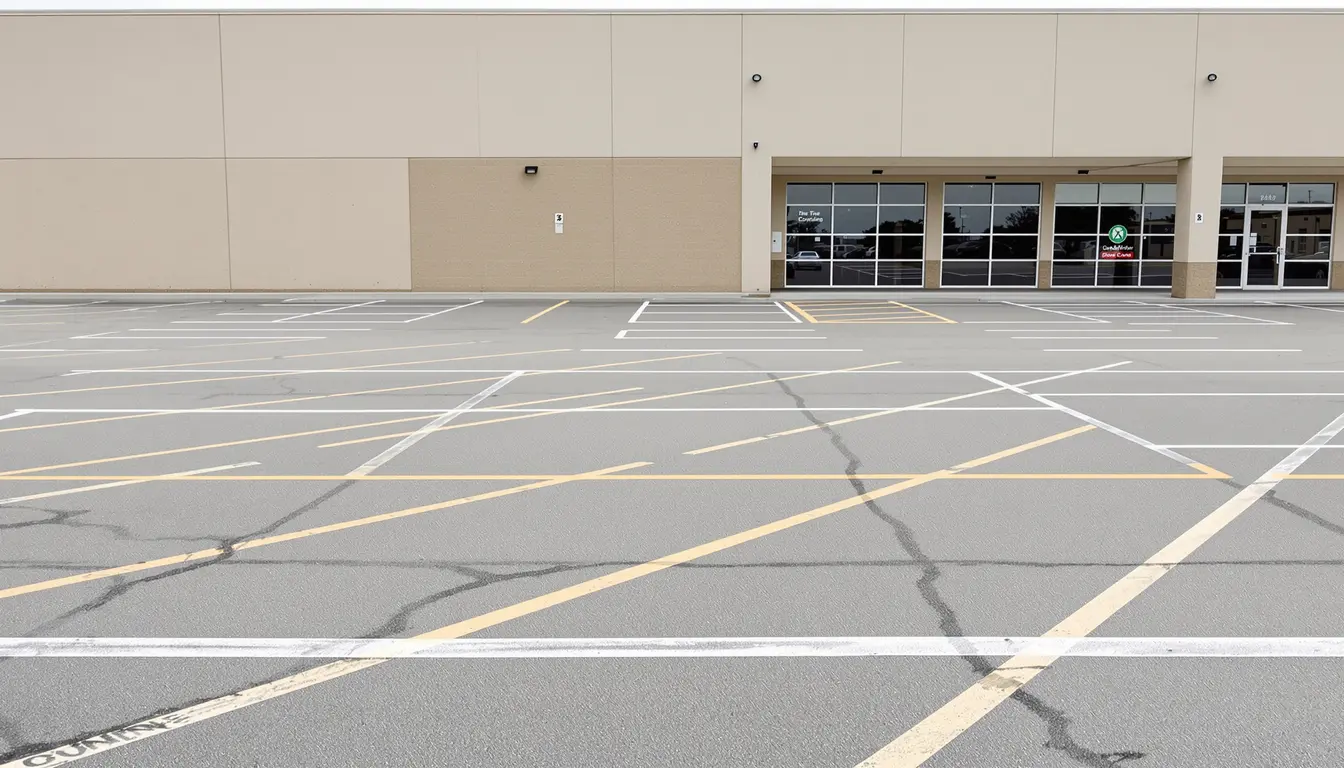
1980s and 90s commercial pavement at the end of its structural life, cracking in interconnected patterns rather than single lines.
Joints stepping under load
Adjacent panels move independently because there was no load transfer between them, and every crossing wheel makes it worse.
What sets Ford apart in Lansing
We plan the testing into the schedule
Flatness readings, RH probes, and submittals get sequenced before the pour, because most of them cannot be recovered afterward.
Built to somebody else's number
On institutional work the tolerance is not negotiable. We bid the floor that meets it rather than the floor that usually passes.
Moisture treated as a submittal
F2170 RH results on paper before a finish goes down — which on river-corridor ground is the difference between a coating that holds and one that does not.
Site rules are part of the job
Access control, escorts, and hard return-to-service dates on institutional campuses are constraints we plan around, not surprises.
Commercial work behind our Lansing crews
From your driveway to an Amazon warehouse — the same crew, the same standards, every project.
Taco Bell
New Construction
Overland Park, KS
Domino's Pizza
New Construction
Independence, MO
Freddy's
New Construction
Kansas City
Tidal Wave Car Wash
New Construction
Kansas City
Amazon
New Construction
Riverside, MO
Nortian Food Grade Protein Facility
New Construction
Springfield, MO
Book your Lansing Warehouse & Industrial Floors estimate
Or call us directly: (816) 721-1699
Warehouse & Industrial Floors in Lansing — FAQs
Do you do work on institutional and secure sites in Lansing?
Why does flatness have to be measured so fast after the pour?
Is the ground in Lansing a problem for floors?
Other concrete work we do in Lansing
Where else we pour near Lansing
Let's build your Lansing Warehouse & Industrial Floors
From call to concrete — the fastest in KC.
Get a free, no-obligation estimate for your concrete project. We serve the entire Kansas City metro — call (816) 721-1699 or request your estimate online.