
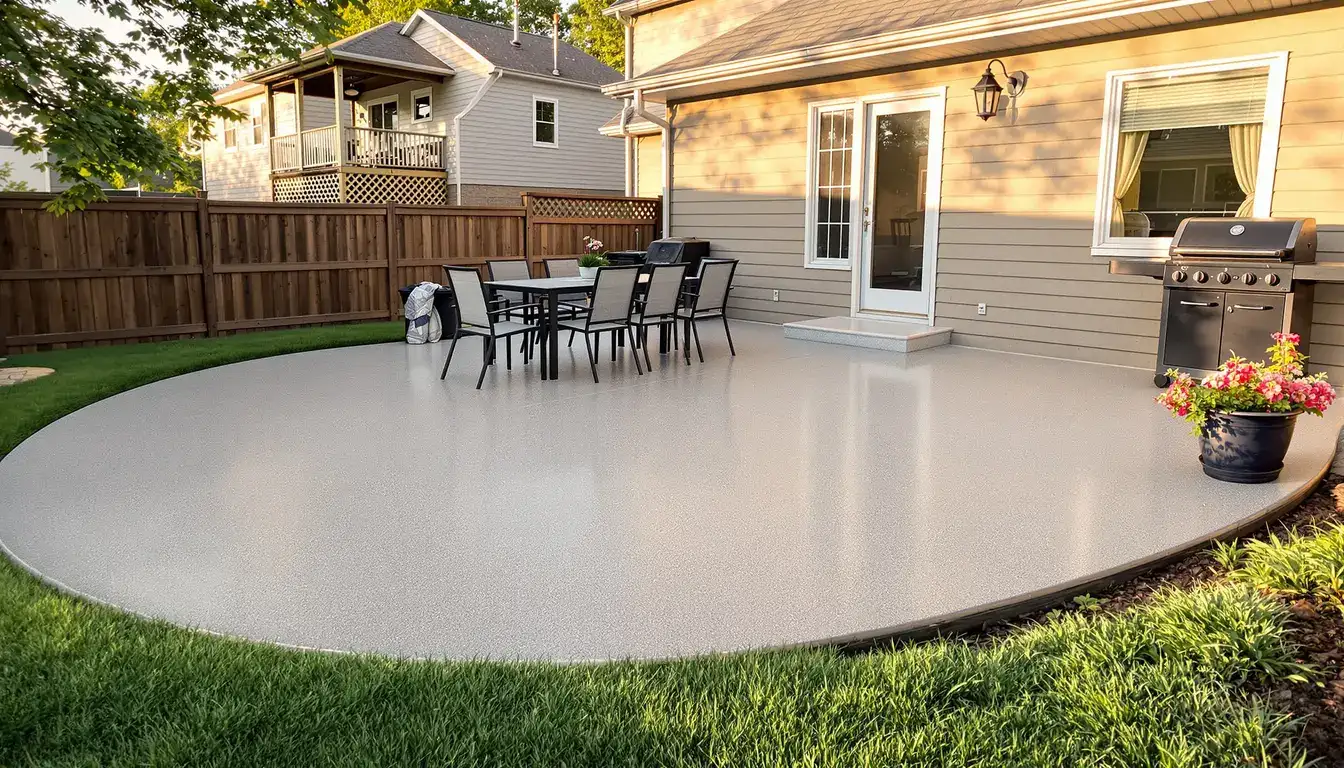
Concrete Patios & Outdoor Spaces in Raytown, MO
Concrete patios for Raytown — planned around tight built-out lots and poured on Jackson County expansive clay so the slab fits the yard and holds its line
Concrete Patios & Outdoor Spaces in Raytown
Custom concrete patio design and installation for backyards, outdoor living areas, and commercial courtyards. Ford Concrete serves Raytown, MO and the entire Kansas City metro with more than a decade of experience and a 5-star reputation.
Raytown at a Glance
- Population
- 28,406
- State
- Missouri
- County
- Jackson County
- Schools
- Raytown C-2 School District
Fitting a patio into a built-out Raytown lot
Raytown is a mid-century suburb that filled in decades ago — a tight grid of 1950s and '60s lots off Blue Ridge Boulevard and 63rd Street, most with narrow side yards, mature trees, and a house that long ago found its level. The first problem here usually isn't the concrete — it's getting to the back yard: how the crew, the base stone, and the wet concrete reach a slab tucked behind a built-out lot without tearing up the ground around it. We plan that access before we quote the pour, so the patio goes in clean.
Under all of it is Jackson County expansive clay — the same Wymore soil that swells wet and shrinks dry across the metro's east side. So a Raytown patio has two jobs: it has to be buildable on a cramped lot, and it has to be detailed for clay that moves with the seasons — a drained compacted base, a clean break from the house, and jointing that steers the cracks. The rest of this page is how we handle both.
Planning the pour on a cramped lot
Access is what separates a clean Raytown job from a torn-up yard. On a lot with a four-foot side yard and a fence line, we work out ahead of time how material moves — wheelbarrow and power buggy runs, or a concrete pump reaching over the house when there's no ground route at all — and we protect the lawn, the drive, and the neighbor's line as we go. Mature trees near the pad get worked around, not through: we route the excavation clear of the big structural roots rather than cutting an anchor root that's holding a tree up.
None of that changes the slab we build — it changes how we get it in without collateral damage. We set the pad's footprint to the space the lot actually gives, lock the perimeter with a thickened edge and a restraint point, and stage the work so a small yard doesn't become a construction zone for a week. Planning the access is the part a cramped lot rewards most.
A base and a clean break from the house
Once we can reach the yard, the build is about the clay. We strip the topsoil, cut to grade, and tamp a granular compacted base that spreads the load and gives water a path away from under the slab — because Wymore clay swells as it wets and shrinks as it dries, and a base that drains keeps that movement smaller and slower. On a lot where the house has sat still for sixty years, the patio is the new element, and it can't be tied rigidly to a foundation that isn't going anywhere.
So where the pad meets the house we set a full-depth isolation joint, letting the slab float free and move on its own without cracking against the wall. We pour a 4,000-PSI air-entrained mix rated for Jackson County freeze-thaw, so the surface sheds winter without flaking. It's the same base and separation thinking behind every patio we pour, whether it's a tight back yard or an open one.
Jointing for clay that moves
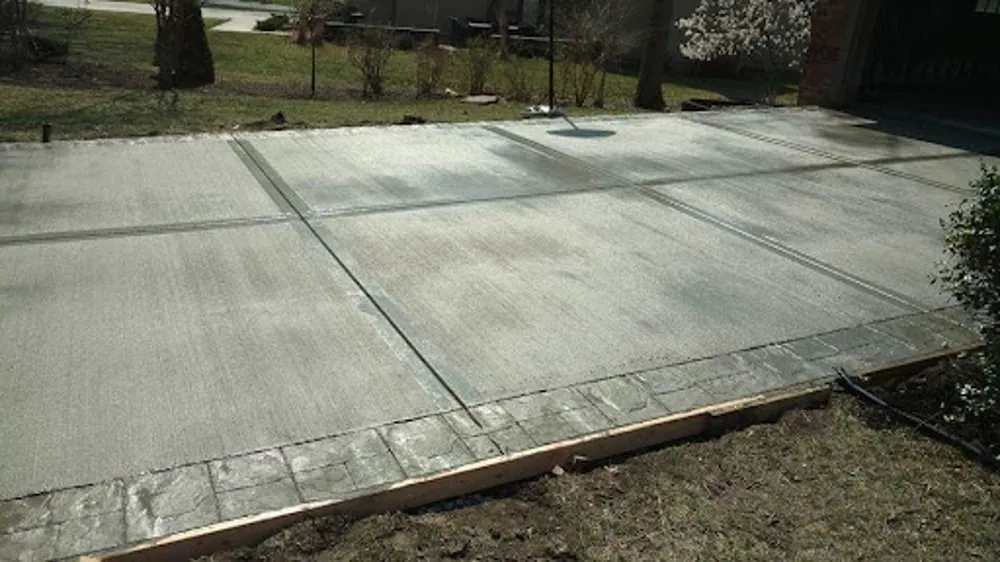
Expansive clay is a seasonal mover — it lifts and drops as it wets and dries — so a Raytown slab is jointed to crack on the lines instead of the field. We saw a contraction joint a quarter of the slab deep and keep the lines to two or three times the slab's thickness in feet, a cut every eight to twelve feet on a four-inch pad, so the slab releases where we cut it.
At any inside corner — common on the L-shaped pads that fit around a Raytown house — a re-entrant corner throws a crack off the point unless a control line runs to it, so we steer a joint into every one. On a wider slab we carry reinforcement through the concrete so the panels stay tied and level as the clay works underneath. Jointed and reinforced right, a patio on this ground ages with hairline lines where we placed them.
Draining a slab on a dense grid
Raytown's older plats sit close together, and on a tight grid water has nowhere to spread — it runs lot to lot, off the roof, and along the fence lines. A patio can't become a dam in the middle of that. Every pad we lay falls about a quarter-inch per foot, positive drainage that clears a downpour off the slab and sends it on its way instead of ponding against the house or the neighbor's line.
The grade starts at the door: we set the finished threshold elevation a safe step below the sill with the ground falling away, so runoff always heads out into the yard. We tie the downspouts into that fall too, because on expansive clay standing water is what feeds the swell-and-shrink cycle that moves a slab — keeping the roof's water off the pad keeps the clay under it steadier.
A finish that fits a settled yard
A Raytown patio finish should read right against an established mid-century home and yard. The everyday call is a broom vs stamped finish: a broom finish gives a clean, slip-honest surface, while stamped concrete patterns the pad to read like stone or brick for an outdoor room off the back of the house. On a larger pour we lay the control cuts out as a joint pattern continuity so the lines frame the space instead of crossing it at random.
Before any stamp or color goes down we pour a small mockup on site, so the texture and shade get judged against your own house in your own light. Our gallery shows stamped and colored patios we've poured around the metro, and the stained and colored options give another way to tie a new slab into a settled back yard.
Replacing a worn slab, and the permit
A lot of Raytown work is replacing the original patio — a thin, lightly jointed slab poured with the house in the 1950s or '60s, often mixed before air-entrainment was standard, now scaled on top and dropped at the corners. When a slab is flaking but still solid and level, a bonded overlay can renew the surface. When the base under it has failed or it's broken through, the honest move is to tear it out and rebuild — and rebuilding is also the moment to add the positive drainage and jointing the original never had. Our repair crew makes that call by what's under the wear.
Most residential patios in town fall under City of Raytown permitting, and we pull it and clear any setback check before we pour, working to Missouri (MoDNR) practice. We bring the same crew that pours heavy commercial flatwork onto a cramped back-yard lot — the range is honest, the base spec doesn't change. Nearby we build the same way in Independence, Grandview, and Blue Springs.
Planning a patio in Raytown?
From call to concrete — the fastest in KC.
On a built-out Raytown lot a patio comes down to two things: reaching the yard clean and detailing the slab for Jackson County clay. Ford plans both before the first shovel. Call (816) 721-1699 or request a free estimate and we'll walk your lot with you.
Why Raytown Concrete Patios & Outdoor Spaces is built this way
Read the lot and the access
We walk the yard, confirm the Jackson-clay base plan, and work out how the crew and concrete reach a built-out back lot without tearing up the ground around it.
Protect and stage the site
We lay out buggy runs or a pump route, protect the lawn, drive, and neighbor's line, and route the dig clear of the big tree roots holding the yard's canopy.
Cut and compact the base
We strip topsoil, cut to grade, and tamp a granular base that drains, thickening the perimeter into a restraint point so the edge holds on clay.
Isolate the slab and pour
We set a full-depth isolation joint along the house, then place a 4,000-PSI air-entrained slab with fiber or rebar so it floats free and sheds freeze-thaw.
Saw the joints
We cut contraction joints a quarter depth at two to three times the slab thickness and steer a control line into every inside corner so cracks land on the line.
Finish over a mockup
We lay the broom or stamped finish approved off a mockup poured in your own light, with the control cuts set as a pattern that frames the pad.
Seal and clear the permit
We seal the surface, pull the City of Raytown permit, clear any setback check, and walk the finished patio and the yard with you before we leave.
Signs your Raytown Concrete Patios & Outdoor Spaces needs attention
A crack tracing the house wall
A slab lifted or dropped at the corners
A crack breaking from an inside corner
Water pooling against the house or fence
A flaking, sheeting surface
A patio too broken to patch
The Ford difference on Raytown Concrete Patios & Outdoor Spaces
Access planned first
On a tight Raytown lot we work out how the crew and the concrete reach the back yard — buggy runs or a pump over the house — and protect the ground around it before a shovel moves.
Detailed for Jackson clay
Wymore clay swells and shrinks with the seasons, so we drain the base, isolate the slab from the house, and joint the pad to crack on the lines we cut, not in the field.
A finish for a settled yard
Broom or stamped, laid over a mockup poured in your own light, with the control joints set as a pattern that ties a new slab into an established back yard.
4.9 stars across 29 reviews
Ford Concrete has earned a 4.9-star average over 29 Google reviews from homeowners around the metro who point to clean work and a yard left in good shape.
Proof we pour at any scale
From your driveway to an Amazon warehouse — the same crew, the same standards, every project.
Taco Bell
New Construction
Overland Park, KS
Domino's Pizza
New Construction
Independence, MO
Freddy's
New Construction
Kansas City
Tidal Wave Car Wash
New Construction
Kansas City
Amazon
New Construction
Riverside, MO
Nortian Food Grade Protein Facility
New Construction
Springfield, MO
Price your Raytown Concrete Patios & Outdoor Spaces project
Or call us directly: (816) 721-1699
Concrete Patios & Outdoor Spaces in Raytown — FAQs
My back yard is hard to reach — can you still pour a patio?
Do I have to remove my trees to put in a patio?
Why does my patio keep cracking against the house?
Should I replace my old Raytown patio or resurface it?
How far apart should the joints be on my patio?
Do I need a permit for a patio in Raytown?
Related concrete services in Raytown
Concrete Patios & Outdoor Spaces in communities near Raytown
Start your Raytown concrete project
From call to concrete — the fastest in KC.
Get a free, no-obligation estimate for your concrete project. We serve the entire Kansas City metro — call (816) 721-1699 or request your estimate online.