
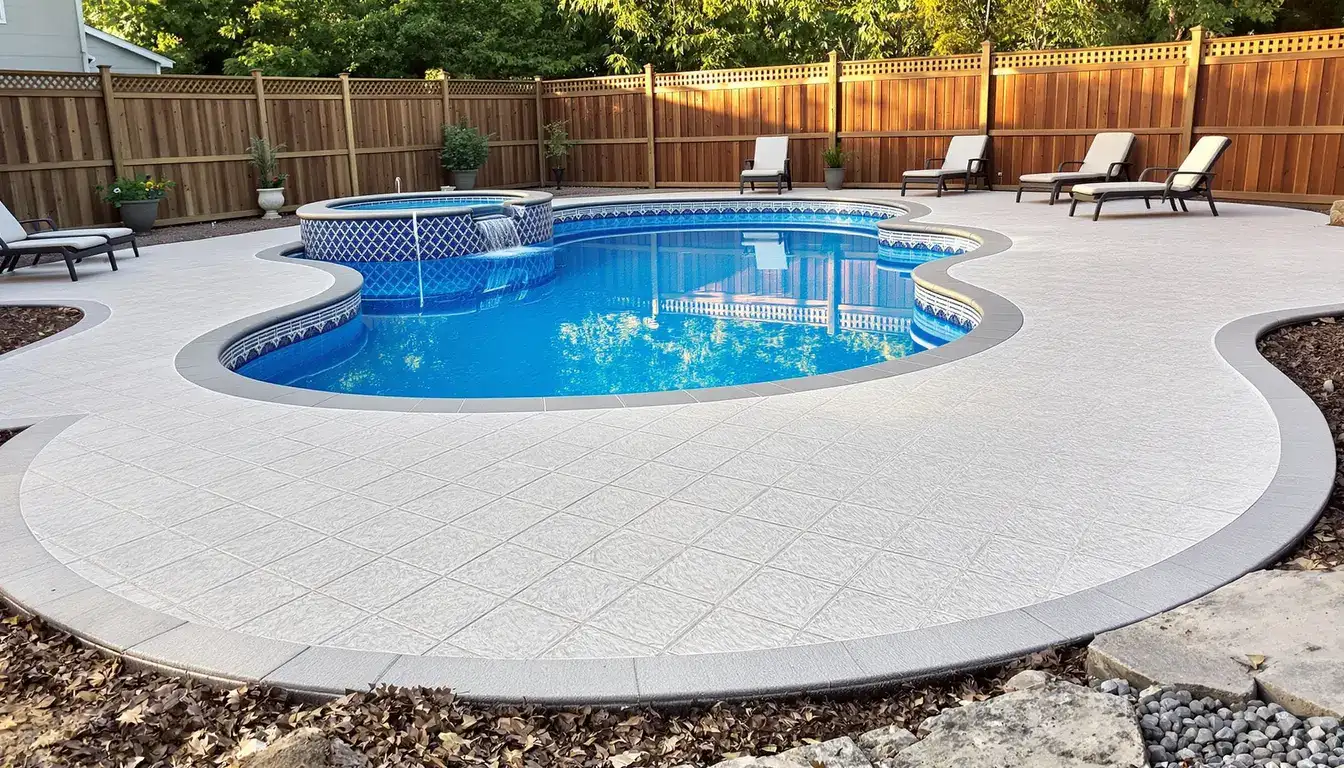
Concrete Pool Decks in Gardner, KS
Pool decks built for Gardner ground — the rolling south-Johnson County land off I-35 and US-56 where limestone sits only a few feet down. That rock is firm to build on, but water can't sink through it, so it perches and runs sideways under the slab. We drain it, pack a base that holds, and finish the deck to stay sure underfoot when it's wet.
Concrete Pool Decks in Gardner
Slip-resistant concrete pool deck installation and resurfacing for residential and commercial swimming pools. Ford Concrete serves Gardner, KS and the entire Kansas City metro with more than a decade of experience and a 5-star reputation.
Gardner at a Glance
- Population
- 24,479
- State
- Kansas
- County
- Johnson County
- Schools
- Gardner-Edgerton USD 231
What makes a Gardner pool deck last?
A Gardner pool deck lasts when the water that perches on the shallow limestone is drained away, the base is compacted to firm bearing, an isolation joint keeps the deck loose from the pool shell, and the surface is broomed for slip resistance. On south-Johnson County's rolling ground, the rock under the yard is the fact that shapes the whole job.
Gardner grew up around Gardner Junction, where the Santa Fe, Oregon, and California trails split, and today it is the residential backbone for the intermodal freight hubs along I-35. Its yards sit on clay-loam over limestone that comes up shallow — often three to eight feet down. That rock gives a deck good bearing, but it changes where the water goes.
The rock is close — good for bearing, tricky for water
Shallow limestone is a mixed blessing. It carries load well, so a deck built to it sits on solid ground. But water cannot drain down through solid rock, so rain and snowmelt that soak into the soil hit the limestone shelf and stop — then travel sideways along the top of it, straight under a pool deck. Left alone, that perched water saturates the base, builds hydrostatic pressure against the slab and behind the pool shell, and works into every joint. On a Gardner lot near Gardner Lake or the newer ground off 175th Street, finding where the rock sits and where the water runs on top of it is the first read we make.
Draining the water off the rock
Once we know the limestone shelf is holding water, the job is to give that water a way out before it reaches the deck. We cut a drainage path through the base — a free-draining stone layer with a perforated line that intercepts the perched water and carries it to daylight — so it leaves instead of ponding under the slab. That keeps hydrostatic pressure off the underside of the deck and out from behind the shell. On rolling Gardner ground, we also grade the surface so rain sheds to a fixed discharge point rather than soaking back down to the rock beside the pool.
A base that meets the limestone
Where the rock is close, the base is built to bridge cleanly from soil to stone so the deck doesn't sit half on rigid limestone and half on softer clay-loam that can settle. We cut to firm subgrade, rebuild the footing as compacted stone in stacked lifts, and pack each layer so the load spreads evenly across the transition. Grading answers to KDHE and the City of Gardner, and Johnson County's freeze-thaw winters mean the finished slab is sealed to keep water out of the surface.
Why the deck rides free of the pool
The pool shell is anchored in the ground while the deck moves with heat and frost. Poured as one unit, the shell/deck interface shears when the ground first freezes hard, splitting the deck at the edge. A continuous isolation joint around the pool lets each move without loading the other — small work at pour time, and the reason the edge holds where the ground stiffens over rock.
Sure footing when the deck is wet
A pool deck is walked wet and barefoot, so grip comes first. We drag a broom finish across the slab so a wet deck keeps its slip resistance instead of turning slick. Where a Gardner homeowner wants the deck to read as stone or plank, a stamped concrete sample panel goes down in the yard first, with enough texture left in it to stay safe, and a stain can tune the color to the house.
The edge, and sealing it for the winter
We form a cantilever coping over the bond beam, set loose so it moves with the deck and rounded to be easy on bare feet. Then the deck gets sealed against Johnson County winters — applied in the right conditions so it doesn't cloud into sealer blushing — with a reseal schedule so the surface keeps shedding water. If a Gardner deck is structurally sound but tired on top, a bonded overlay can renew it without a teardown.
Permits and the bonding grid
A new or rebuilt deck is permitted through the City of Gardner, and the electrical sign-off has to confirm equipotential bonding — the grounding grid that ties the deck into one electrical potential around the water so the pool is safe to stand beside. We call it in before the pour so nothing is covered until it is signed off. Gardner shares its shallow-limestone ground with neighbors we pour in often — Olathe, Spring Hill, and Edgerton — and the flatwork discipline our crew carries onto a commercial slab is the one it brings to a backyard deck.
Ready to build your Gardner pool deck?
From call to concrete — the fastest in KC.
In Gardner, the shallow rock sets the plan — drain the water that perches on the limestone, bridge the base evenly from soil to stone, and seal it for the winters. We read your lot, tell you straight what the ground needs, and put a real number on paper. Call (816) 721-1699 for a look at your yard, usually inside a day.
Our Concrete Pool Decks method for Gardner sites
Find the rock and the water
We check how shallow the limestone sits under your Gardner lot and trace where water perches and runs on top of it.
Cut the drainage path
We build a free-draining stone layer and a perforated line to intercept perched water and carry it to daylight.
Build the base to the rock
We cut to firm subgrade and pack a compacted stone footing that bridges evenly from soil to stone.
Break the deck from the shell
We hold an isolation joint the whole way around the pool so the deck and shell never load each other.
Place, joint, and finish
We place 4,000-PSI concrete, tool the contraction joints, and bring up the broom, stamped, or stained finish.
Form the coping and cure
We set the cantilever coping over the bond beam, kept loose to the deck, and cure the slab slow to build strength.
Bond, seal, and walk it
We schedule the bonding inspection, seal the deck for the winters, and walk the finished work together.
When Concrete Pool Decks in Gardner is ready to replace
Water seeping up beside the deck
Damp ground or seepage at the slab edge after rain is perched water running along the limestone shelf under the yard with nowhere to drain.
The deck lifting along the panels
A slab that rises or cracks along its joints is hydrostatic pressure from water trapped on the rock, pushing up on the underside.
One end settling, one end firm
A deck that drops on one side often sits half on shallow rock and half on softer clay-loam that compressed — an uneven base under it.
A crack tracing the waterline
When a crack traces the waterline, the deck was tied to the shell with nothing between them, and a cold snap split them along that line.
Surface flaking off the top
Flaking that lifts the top layer is freeze-thaw scaling, the usual sign of a deck poured without a sealer to shut water out.
A slick top when wet
A wet deck that slides underfoot has lost the tooth a broom finish gives it, or was floated too smooth to start with.
Why Gardner homeowners call Ford
Water drained off the rock
Water perches on Gardner's shallow limestone and runs sideways under a deck. We cut a drainage path so it leaves before it saturates the base.
A base that bridges soil to stone
Where rock is close, half a deck can sit on rigid limestone and half on softer clay. We build the base to spread the load evenly across that line.
Sealed for a Johnson County winter
Freeze-thaw scales an unsealed deck. We seal the slab, apply it right to avoid blushing, and set a reseal schedule so it keeps shedding water.
One honest read of your lot
We find where the rock sits and where the water runs on it, build the base the ground needs, and put a written price on paper first.
The projects behind our name
From your driveway to an Amazon warehouse — the same crew, the same standards, every project.
Taco Bell
New Construction
Overland Park, KS
Domino's Pizza
New Construction
Independence, MO
Freddy's
New Construction
Kansas City
Tidal Wave Car Wash
New Construction
Kansas City
Amazon
New Construction
Riverside, MO
Nortian Food Grade Protein Facility
New Construction
Springfield, MO
Start with a free Gardner estimate
Or call us directly: (816) 721-1699
Concrete Pool Decks in Gardner — FAQs
Why does shallow limestone change how you build a Gardner pool deck?
My yard drains slowly after rain — is that the rock?
Why can't the deck be poured against the pool?
Is a broom-finished deck actually safe when wet?
Do I need a permit for a pool deck in Gardner?
More Gardner concrete services
Gardner and neighboring communities
Get your Gardner project moving
From call to concrete — the fastest in KC.
Get a free, no-obligation estimate for your concrete project. We serve the entire Kansas City metro — call (816) 721-1699 or request your estimate online.