
Warehouse & Industrial Floors in Grain Valley, MO
Industrial floor additions along the Buckner-Tarsney corridor — poured to meet the floor you already have, not the one on the drawing.
Warehouse & Industrial Floors in Grain Valley
High-performance industrial concrete floor installation for warehouses, distribution centers, and manufacturing facilities. Ford Concrete serves Grain Valley, MO and the entire Kansas City metro with more than a decade of experience and a 5-star reputation.
Grain Valley at a Glance
- Population
- 16,450
- State
- Missouri
- County
- Jackson County
- Schools
- Grain Valley R-V School District
Grain Valley's buildings are growing, and the new floor has to meet the old one
When a Grain Valley building adds a bay, the hard part is not the new slab. It is the seam where it meets a twenty-year-old floor. Those two slabs will move differently for the rest of their lives. We survey the existing floor first, then decide whether that seam gets doweled or deliberately left free.
The industrial ground north of Buckner-Tarsney Road has been filling in since roughly 2015, so buildings that went up as a first phase are now adding a second — and downtown, the Main Street redevelopment is doing the same to older stock. Both produce one problem: a new floor tied to a floor somebody else poured.
The instinct is to butt new concrete against the old slab and call it done. That produces a crack in the first winter. The old slab has done its shrinking; the new one has not. Tie them rigidly and the new slab drags on the old until something gives — usually a ragged break a foot off the seam that no joint filler will make right, alongside edges the old slab's curling has already lifted.
Survey the old slab before you design the new one
Four things get established before we design the new pour, and every one is measurable rather than assumed.
Its elevation, across the whole tie line — not at one spot. Old floors are rarely flat and almost never level. Design the new slab to the drawing instead of to the actual floor and the seam ends up with a lip, and a lip in a forklift path is a maintenance item forever.
Its thickness, and what is under it. We core it. A 1990s slab here might be five inches on native clay or six on rock, and that changes the entire tie detail.
Its joint layout. New panels continue the old grid wherever we can. Joints that line up across the seam move together; joints that miss by two feet create a stub panel that cracks, every time.
How the old floor is behaving now. If its edges are already lifted, doweling into it just transfers that problem into new concrete.
Then the call: a dowel basket where we want the two slabs sharing load and moving together, or a clean isolation joint where we want them independent. Sharing load is better for wheels; independence is better when the old slab is unreliable. That decision deserves a core report rather than a preference.
Wymore clay under the Buckner-Tarsney corridor
Grain Valley sits on Jackson County's Wymore expansive clay — ground that swells as it takes on water and shrinks as it dries, the same clay running under Independence and Blue Springs. Under a heated, roofed building it mostly stops cycling; at the perimeter and the dock aprons, where it still sees weather, it does not. Frost depth here runs about 36 inches, so new footings and any exterior thickened edge go below that line.
Much of the ground north of I-70 is newly developed, meaning engineered fill over that clay. Fill placed for a first phase and fill placed for an addition five years later are not the same material at the same age, so we ask for compaction records on the original pad and proof-roll the new one ourselves.
The vapor retarder goes under the new slab regardless of what the old one has — most floors of that vintage have none, which is precisely why their coatings failed. Where new meets old, we read the new slab with F2170 RH probes and treat the two floors as separate moisture problems, because that is what they are.
What it takes to build an addition in Grain Valley
Grain Valley reviews permits through its Planning and Zoning department, and the city inspects actively — a consequence of growing this fast. Downtown work now falls under the Main Street overlay standards, which reach further into finishes and site detail than most small-city codes. Stormwater on the Missouri side answers to MoDNR.
We are twelve minutes east of our Independence shop, straight out I-70. That matters more on an addition than it sounds: tie-in work runs in short, sequenced pours, and being close means we schedule them around your operation instead of the other way around. More than a decade across the KC metro is the record behind our crews. Our commercial new construction — Amazon in Riverside, the Nortian food-grade protein facility in Springfield — shows the scale we work at; neither is a Grain Valley job. KC-metro clients rate us 4.9 stars across 29 reviews.
See the gallery, our commercial concrete work, and how we run jobs for general contractors, plus our Kansas City soil conditions guide. We also pour warehouse floors in Blue Springs, Oak Grove industrial slabs, and Buckner floors. Service page: warehouse and industrial floors.
Adding a bay in Grain Valley?
From call to concrete — the fastest in KC.
We will core the existing floor, survey the tie line, and tell you what the seam actually needs before anyone pours anything. Twelve minutes out I-70. Free estimate.
The Grain Valley Warehouse & Industrial Floors process, start to finish
Survey the existing floor
Elevation across the whole tie line, not one spot. This is the number the new slab gets designed to.
Core it and find out what is really there
Thickness and base material under the old slab. A five-inch slab on clay and a six-inch on rock get different tie details.
Map the old joint grid
New panels continue the existing layout wherever geometry allows, so joints move together across the seam instead of fighting.
Choose the tie and prep the ground
Dowel basket or isolation joint, decided on the core report. Then the new pad gets proof-rolled and the fill records get checked.
Vapor retarder, place, and cut
The sheet goes under the new slab regardless of what the old one has. Then continuous placement and saw cuts on schedule.
Test the new slab on its own terms
RH probes read the new floor before coating. The old floor is a separate moisture question and gets answered separately.
Is your Grain Valley Warehouse & Industrial Floors failing?
A crack running parallel to your last addition
A break a foot or so off the seam means the two slabs were tied rigidly and the new one shrank against the old. That is a detail problem, not a concrete problem.
A lip at the seam that catches pallet jacks
The addition was built to the drawing instead of to the actual floor elevation. Once it is poured, the fix is grinding or a ramp.
Stub panels cracking near the tie line
When new joints miss the old grid by a foot or two, the leftover panel is the wrong shape and it cracks. Continuing the grid prevents it.
Coating peeling on the old side, holding on the new
Two floors, two moisture stories. The older slab likely has no vapor retarder under it and is pushing moisture up through the finish.
The Ford difference on Grain Valley Warehouse & Industrial Floors
We core the old floor first
Thickness, base, and elevation across the tie line are facts we measure. Designing an addition off the original drawing is how seams end up with a lip.
Doweled or isolated is a decision, not a habit
We tell you which one your seam is getting and why. Sharing load and moving independently are both right answers, for different old slabs.
Twelve minutes from the shop
Tie-in work runs in short pours around your schedule. Being just east on I-70 means we can sequence it to your operation rather than ours.
The new slab gets what the old one never had
Most floors out here from the 1990s have no vapor retarder under them. That is why their coatings failed. Yours will have one.
Where our Warehouse & Industrial Floors crews have delivered
From your driveway to an Amazon warehouse — the same crew, the same standards, every project.
Taco Bell
New Construction
Overland Park, KS
Domino's Pizza
New Construction
Independence, MO
Freddy's
New Construction
Kansas City
Tidal Wave Car Wash
New Construction
Kansas City
Amazon
New Construction
Riverside, MO
Nortian Food Grade Protein Facility
New Construction
Springfield, MO
Get your free Warehouse & Industrial Floors estimate in Grain Valley
Or call us directly: (816) 721-1699
Warehouse & Industrial Floors in Grain Valley — FAQs
Can you just pour the new floor up against the existing slab?
Why core the old floor? We have the original drawings.
Does the addition need a vapor retarder if the existing floor does not have one?
Other concrete work we do in Grain Valley
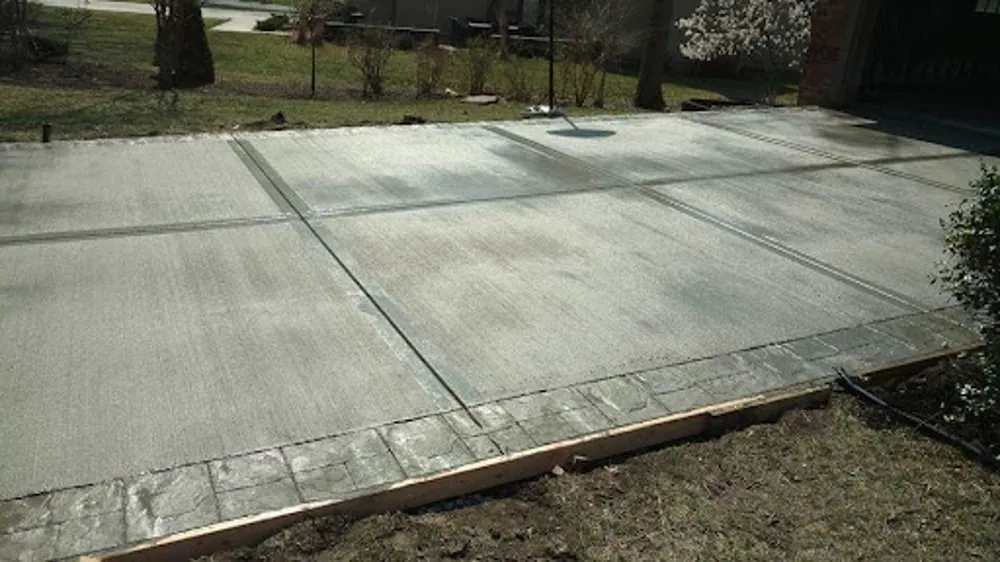
Warehouse & Industrial Floors across the Jackson County area
Ready to pour in Grain Valley?
From call to concrete — the fastest in KC.
Get a free, no-obligation estimate for your concrete project. We serve the entire Kansas City metro — call (816) 721-1699 or request your estimate online.