
Warehouse & Industrial Floors in Buckner, MO
Industrial slabs off the MO-24 corridor, rated for the axles that actually park on them — not for a number somebody guessed.
Warehouse & Industrial Floors in Buckner
High-performance industrial concrete floor installation for warehouses, distribution centers, and manufacturing facilities. Ford Concrete serves Buckner, MO and the entire Kansas City metro with more than a decade of experience and a 5-star reputation.
Buckner at a Glance
- Population
- 3,014
- State
- Missouri
- County
- Jackson County
- Schools
- Fort Osage R-I School District
Every floor in Buckner already has a load rating — most owners just don't know theirs
A Buckner warehouse floor's capacity is decided by what sits under it — subbase, thickness, and joint design — not by the strength printed on the concrete ticket. We core the slab, test the ground beneath it, and rate the floor against the axles MO-24 actually sends, then build to that number instead of a hope.
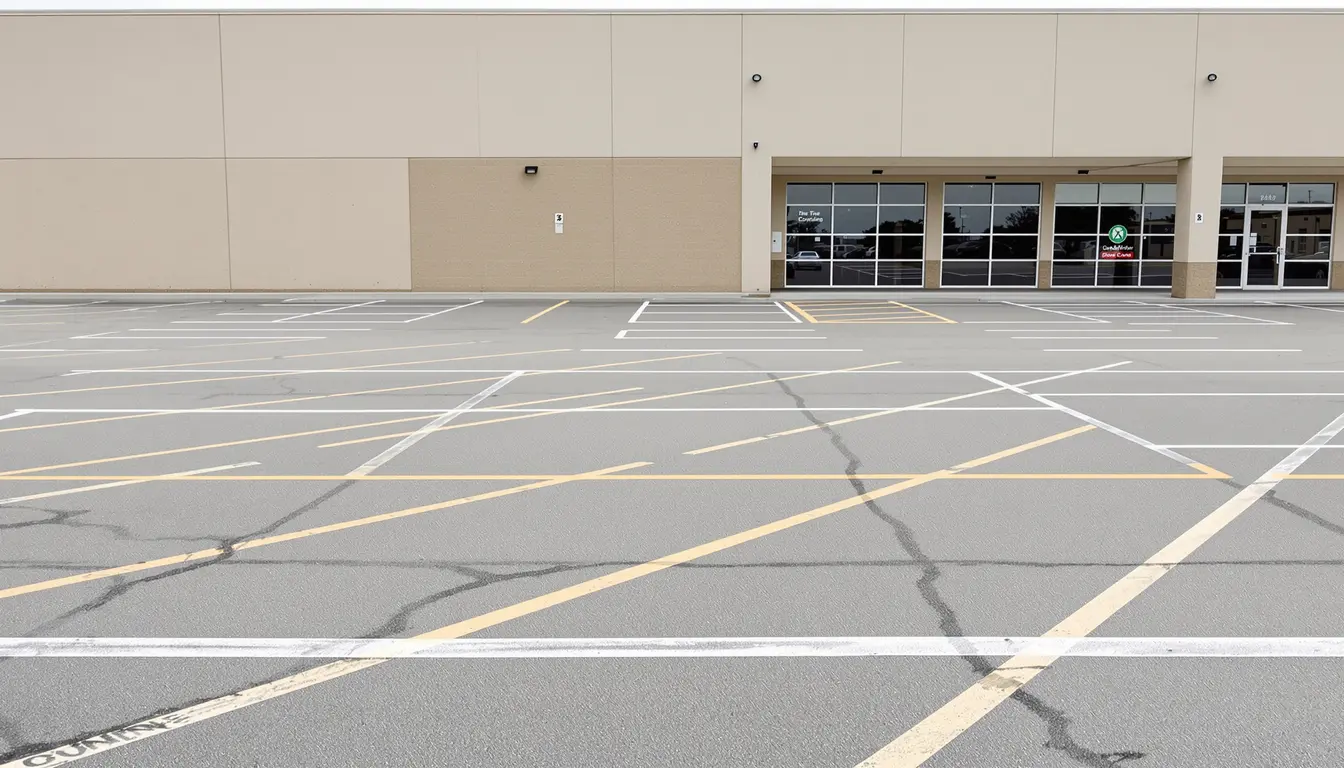
Buckner already has a public example of what happens when nobody does that. The city's southwest parking lot carries a posted 10,000-pound weight restriction — not because anyone wanted a rule, but because the pavement could no longer be trusted with anything heavier. That is a capacity discovered after the fact, and by then the only lever left is a sign.
Interior floors work the same way. The slab in a Buckner Industrial Park building has a real number attached to it whether or not anybody ever calculated it, and the day a heavier truck rolls through the door is the day the number gets tested. Rack load is the part owners think about. A loaded delivery axle parked across an unsupported saw cut is the part that actually breaks floors.
What a grain truck does to a slab that a forklift never will
Jefferson Street carries agricultural and logistics traffic most metro warehouse floors never see, and it does not arrive evenly through the year. It concentrates. For a few weeks the same dock takes loaded trucks all day, and then it goes quiet until next season.
That duty cycle matters more than the peak weight on the scale. A forklift is a heavy load on a small contact patch that keeps moving — it beats up joint edges, and it does its damage at the armored joint or the unprotected saw cut. A loaded tandem axle is a different animal: more total weight, spread wider, but it sits. Stationary load with duration is what consolidates a subbase, and a subbase that consolidates unevenly under a parked trailer leaves a dished slab that never comes back up.
So the honest question for a Buckner floor is not how heavy. It is how heavy, how often, and how long in one spot. Those three answers size the base course, and the base course is most of the floor.
Finding out what your slab can actually take
When an owner asks whether the floor will hold a new machine, a taller rack, or a heavier truck, there is no way to answer that from the surface. Four things tell us, in this order:
- Core the slab. Actual thickness is rarely what the drawing said, and the core also shows whether there is a compacted base under the concrete or just clay.
- Test the subgrade. A slab's stiffness comes from the ground it sits on. Without a measured modulus of subgrade reaction, any rating is arithmetic performed on a guess.
- Walk it loaded. We watch the joints while a real truck crosses them. Movement across a joint means the panels are not sharing load, which is a dowel basket problem rather than a concrete problem.
- Map the joints and the damage. Where edges have broken down, the answer is a joint filler and armoring. Where whole panels have dished, the answer is underneath them.
Then the part nobody enjoys hearing. A topping does not raise a floor's rating. A bonded overlay restores a worn surface and buys back abrasion resistance, and it is a good tool for that job. It adds nothing structural to a slab that is too thin or sitting on a base that was never compacted. Two inches poured over a failing floor buys a season. If the number has to go up, the floor comes out.
Permits, and the crews behind a Buckner floor
Buckner runs permits through City Hall, and city code now requires permanent all-weather surfacing for commercial parking — so the site work around a building often lands in the same scope as the floor inside it. Site disturbance on the Missouri side falls under MoDNR. Under all of it is eastern Jackson County's Wymore and Ladoga clay, which swells and shrinks with moisture. Inside a heated building that cycling mostly stops, but the vapor retarder and the base course under the slab are what keep the clay's water out of the concrete, and neither is an optional line item here.
We are a short run east of our Independence shop, which matters when a pour has to land between trucks during a busy season. More than a decade across the KC metro is the record behind our crews. Our commercial new-construction work — Amazon in Riverside, the Nortian food-grade protein facility in Springfield — shows the scale we handle. Neither is a Buckner job, and we would rather say so than blur it. KC-metro clients rate us 4.9 stars across 29 reviews.
See the gallery, our commercial concrete work, and how we run jobs for general contractors, plus our Kansas City soil conditions guide. We also pour warehouse floors in Independence, Grain Valley industrial slabs, and Oak Grove floors. Service page: warehouse and industrial floors.
Not sure what your Buckner floor can take?
From call to concrete — the fastest in KC.
Tell us the heaviest thing you want to park on it. We will core it, test the ground under it, and give you a number instead of an opinion. Free estimate.
What Buckner Warehouse & Industrial Floors projects require
Core it and test the ground
Cores for thickness and base, then a subgrade test. The rating starts from facts, not from the original drawing.
Walk it under load
We watch the joints while a real truck crosses them. Deflection tells us whether the panels are working together.
Define the actual duty
How heavy, how often, how long in one spot. The busy weeks count for more than the yearly average.
Build the base to the number
Compacted lifts, proof-rolled, with the vapor retarder tight under the slab before any concrete is ordered.
Cut, fill, and armor what takes the beating
Saw cuts on time, dowel baskets where panels must share load, and filler once the slab has done its shrinking.
Signs your Buckner Warehouse & Industrial Floors needs attention
A dished spot where the trailers park
Stationary axle load with duration consolidates the subbase underneath it. The concrete is usually fine — the ground gave up.
Joints that move when a truck crosses
If the panels deflect independently, they are not sharing load. That is a load-transfer problem at the joint, not a strength problem.
Broken-down edges along the saw cuts
Hard wheels hammering an unfilled joint edge. Left alone it widens until the panel corners break off.
A posted weight limit nobody can explain
A restriction is what you get when capacity was never designed. The sign is a symptom, not a solution.
What sets Ford apart in Buckner
We rate the floor before we promise it
A core, a subgrade test, and a loaded walk. Numbers first, then a recommendation you can hold us to.
We will not sell a topping as a fix
An overlay restores a surface. It does not make a thin slab thicker or a bad base good. If the rating has to go up, we say so.
We build for the weeks that matter
Your floor's real duty is the busy season, not the annual average. We size the base to the loads that actually park on it.
A short run from Independence
Close enough to pour between trucks and finish inside whatever window your operation can give us.
Proof we pour at any scale
From your driveway to an Amazon warehouse — the same crew, the same standards, every project.
Taco Bell
New Construction
Overland Park, KS
Domino's Pizza
New Construction
Independence, MO
Freddy's
New Construction
Kansas City
Tidal Wave Car Wash
New Construction
Kansas City
Amazon
New Construction
Riverside, MO
Nortian Food Grade Protein Facility
New Construction
Springfield, MO
Price your Buckner Warehouse & Industrial Floors project
Or call us directly: (816) 721-1699
Warehouse & Industrial Floors in Buckner — FAQs
Can you tell me how much weight my existing floor will hold?
Will a two-inch topping let us run heavier trucks on the floor?
Why does the floor sink where the trailers sit but hold up fine where the forklifts run?
Other concrete work we do in Buckner
Where else we pour near Buckner
Start your Buckner concrete project
From call to concrete — the fastest in KC.
Get a free, no-obligation estimate for your concrete project. We serve the entire Kansas City metro — call (816) 721-1699 or request your estimate online.