
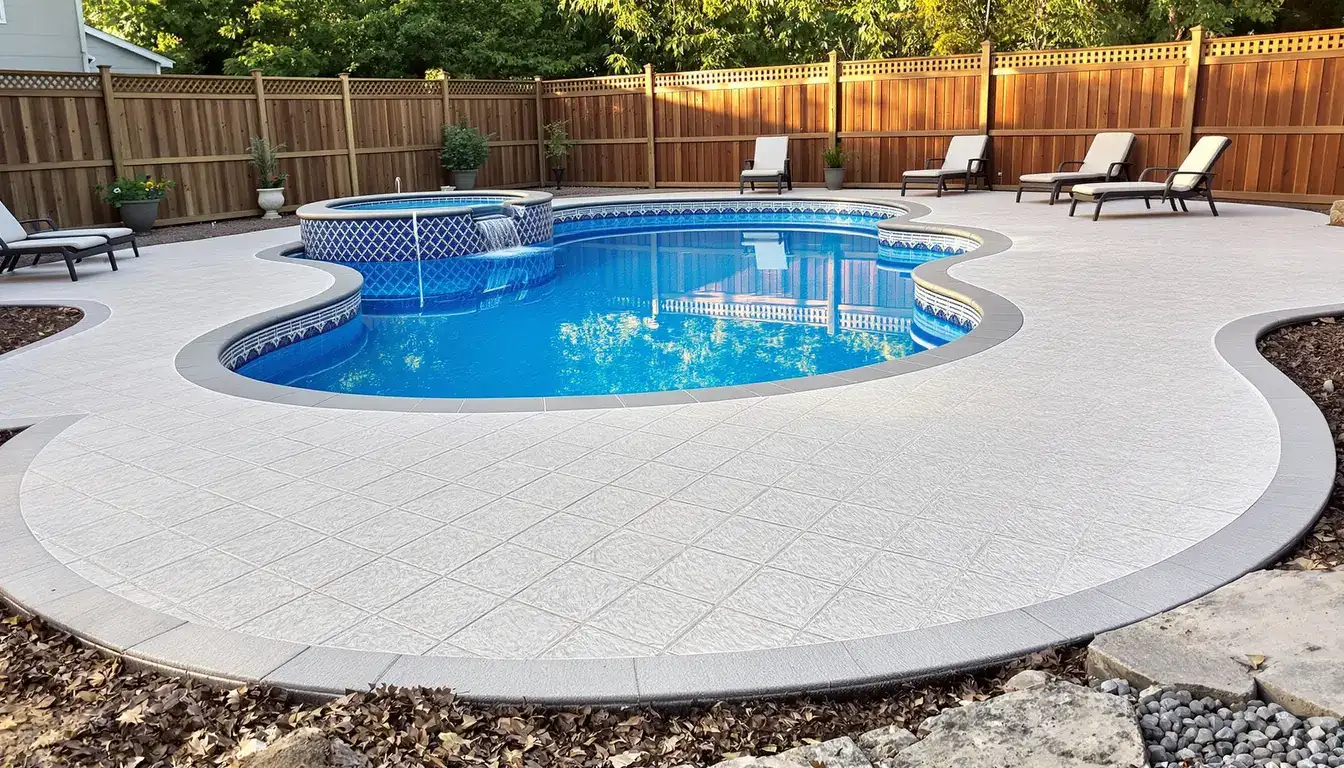
Concrete Pool Decks in Lawrence, KS
Pool decks built for Lawrence ground — the Douglas County clay-loam that heaves in the Wakarusa valley and rides firmer up on the hill neighborhoods. From Old West Lawrence to the lots off K-10, we set a base that holds and finish it to suit a Mass Street town.
Concrete Pool Decks in Lawrence
Slip-resistant concrete pool deck installation and resurfacing for residential and commercial swimming pools. Ford Concrete serves Lawrence, KS and the entire Kansas City metro with more than a decade of experience and a 5-star reputation.
Lawrence at a Glance
- Population
- 97,411
- State
- Kansas
- County
- Douglas County
- Schools
- Lawrence Public Schools (USD 497)
What makes a Lawrence pool deck last?
A Lawrence pool deck holds up when the base is built to stop the ground from heaving, the yard is graded to move water away from the shell, an isolation joint keeps the deck loose from the pool, and the surface is broomed for slip resistance. On Douglas County ground — especially the low land near the Wakarusa — how the base handles moisture and frost is what decides whether the deck stays flat.
Lawrence is a college town with a design standard to match: Massachusetts Street, the historic homes of Old West Lawrence, and the hill neighborhoods below the University of Kansas. It is also built on ground that moves. The clay-loam heaves when it takes on water and freezes, most sharply in the low areas near the Wakarusa River valley, where the city's own records note concrete lifting and cracking. A deck here has to be engineered against that heave first and finished to a high bar second — and we do both.
Why a Lawrence deck heaves — and the base that stops it
Heave is the opposite of settling: the ground lifts. Douglas County clay-loam swells as it draws in water, and when a wet layer freezes it expands again, pushing up on anything above it. In the low, damp ground near the Wakarusa valley that push is strongest, which is why decks and walks in those areas rise and crack. The answer is to break the moisture-and-frost chain under the slab. We cut out the reactive soil, rebuild the footing as compacted stone in stacked lifts, and keep the base draining freely so water can't pool, saturate, and freeze against the concrete. A deck set on a dry, packed stone base has nothing under it to heave.
Grading the water away before it can freeze
Drainage and heave are the same problem seen twice — the less water reaches the soil, the less it can lift the deck. We grade the deck and the surrounding yard to a discharge point that carries runoff clear of the slab, so water never stands against the coping and builds hydrostatic pressure under the shell or soaks the ground beside it. On a hill lot in Sunset Hill or Indian Hills the fall does much of the work; on flatter ground near Brook Creek we build the pitch in deliberately. Either way the drainage plan is drawn before the pour, not chased after the first frost.
Why the deck rides free of the pool
The pool shell sits locked in the ground while the deck above it moves with heat, frost, and the heave the clay-loam wants to hand it. Cast the two as one piece and the shell/deck interface shears the first time they move apart, splitting the slab along the waterline. We hold a full-perimeter isolation joint between deck and shell so each travels on its own, and we form a cantilever coping over the bond beam, set loose so it moves with the deck. It is the detail that keeps the edge tight on ground that never fully sits still.
A finish that fits a Mass Street town
Lawrence holds its properties to a look — the brick and stone of Mass Street, the restored homes of Old West Lawrence — and a pool deck can meet that bar without giving up grip. The finish is a real choice, and here is how we walk homeowners through it:
- Broom finish — the workhorse: a light-brushed texture that grips wet, wears for decades, and costs the least. Best when the deck is the setting rather than the show.
- Stamped concrete — pressed to read as stone or plank; we set a sample panel in the yard so the pattern and color get approved before the pour. Best for a deck that ties into a period home.
- Stained and sealed — a color coat over a broomed texture, tuned to the house. Best when you want color without a heavy pattern.
Whatever the surface, we broom in enough tooth that a wet deck stays sure underfoot — a Lawrence look you can still cross barefoot.
Built for the way Lawrence uses a backyard
A Lawrence pool deck earns its keep on game days and long summer evenings, so we build it to be used — a broad, flat surface with room to gather, joints laid where the deck naturally breaks, and a slope you feel only as sure footing. We size the deck to the lot and the household rather than to a stock template, and we walk the finished slab with you before we leave. The goal is a deck that looks right on a Lawrence street and holds up to a KU crowd.
Resurfacing, permits, and the bonding grid
An older deck behind a home in Old West Lawrence may only need a bonded overlay to reset a tired surface, if the slab beneath is still solid; where the base has failed on the moving clay-loam, we say plainly that a rebuild is the honest spend rather than a coat over a failure. A new or rebuilt deck is permitted through the City of Lawrence, grading falls under KDHE guidance, and the electrical sign-off has to confirm equipotential bonding — the grounding grid that ties the deck into one electrical potential around the water. We schedule that inspection ahead of the pour so nothing gets closed in before it passes. It is the discipline our crew carries from the commercial slabs we pour across the metro, brought to a Lawrence backyard.
Ready to build your Lawrence pool deck?
From call to concrete — the fastest in KC.
In Lawrence, we build against the heave first — cut the reactive clay, set a compacted base, and route the water away — then finish the deck to suit your home, from a Mass Street classic to a Sunset Hill backyard. Call (816) 721-1699 for a site visit, usually within a day.
How we pour Concrete Pool Decks in Lawrence
Read the ground and the grade
We study how your Lawrence lot drains, find the low side, and gauge how reactive the clay-loam is where the deck will sit.
Route the water first
We set a discharge point that carries runoff clear of the slab so the clay stays as dry as the lot allows.
Cut the soil, build the base
We remove the reactive layer and stack a compacted stone footing in lifts, giving the deck a base that won't heave.
Break the deck from the shell
We set an isolation joint around the full pool perimeter so the deck and shell move independently without shearing.
Place, joint, and finish
We pour 4,000-PSI concrete, cut the contraction joints, and lay the finish you approved — broom, stamped, or stained.
Form the coping and cure
We form the cantilever coping over the bond beam, hold it loose to the deck, and cure the slab slow for strength.
Bond, seal, and walk it
We schedule the equipotential bonding inspection, seal the deck against freeze-thaw, and walk the finished work with you.
Warning signs on Lawrence Concrete Pool Decks
Panels lifting at the joints
Deck sections rising at the seams is heave — the clay-loam under them swelled or froze and pushed up, usually because water reached the base.
Cracks worst near the low ground
Cracking that clusters toward the Wakarusa-valley side of a lot points to the wetter, more reactive soil there working against an untreated base.
A split along the waterline
A crack tracing the coping means the deck was cast tight to the shell with no isolation joint, so the two sheared as they moved.
Surface flaking after winter
Thin chips lifting off the top is freeze-thaw scaling, almost always because the deck was never sealed against Lawrence winters.
Water standing on the deck
Ponding after rain means the slab wasn't pitched to a discharge point, so water sits, soaks the clay, and feeds the next heave.
A slick surface when wet
A deck that turns slippery underfoot has lost its broom tooth or was troweled too smooth — a hazard around a pool used by kids.
How Ford earns Lawrence work
A base against heave
Douglas County clay-loam lifts when it takes on water and frost. We cut the reactive soil and rebuild on compacted stone in lifts, so the deck has nothing under it to heave.
Drainage drawn first
The less water reaches the clay, the less it can lift the slab. We grade the deck and yard to a discharge point before a single yard of concrete is poured.
A finish for a Mass Street town
Broom, stamped, or stained — we match the deck to the house and the neighborhood, and set a sample panel so you approve the look before the pour.
An estimate in writing
We read the lot, draw the deck to scale, and hand you a written scope and price. No moving numbers, no pressure at the table.
The projects behind our name
From your driveway to an Amazon warehouse — the same crew, the same standards, every project.
Taco Bell
New Construction
Overland Park, KS
Domino's Pizza
New Construction
Independence, MO
Freddy's
New Construction
Kansas City
Tidal Wave Car Wash
New Construction
Kansas City
Amazon
New Construction
Riverside, MO
Nortian Food Grade Protein Facility
New Construction
Springfield, MO
Start with a free Lawrence estimate
Or call us directly: (816) 721-1699
Concrete Pool Decks in Lawrence — FAQs
Why do decks and walks heave in Lawrence?
Does my neighborhood change how you build the deck?
What finish should I choose for my deck?
Why can't the deck be poured against the pool?
Can you resurface my older Lawrence deck?
Do I need a permit for a pool deck in Lawrence?
Related concrete services in Lawrence
Lawrence and neighboring communities
Get your Lawrence project moving
From call to concrete — the fastest in KC.
Get a free, no-obligation estimate for your concrete project. We serve the entire Kansas City metro — call (816) 721-1699 or request your estimate online.