
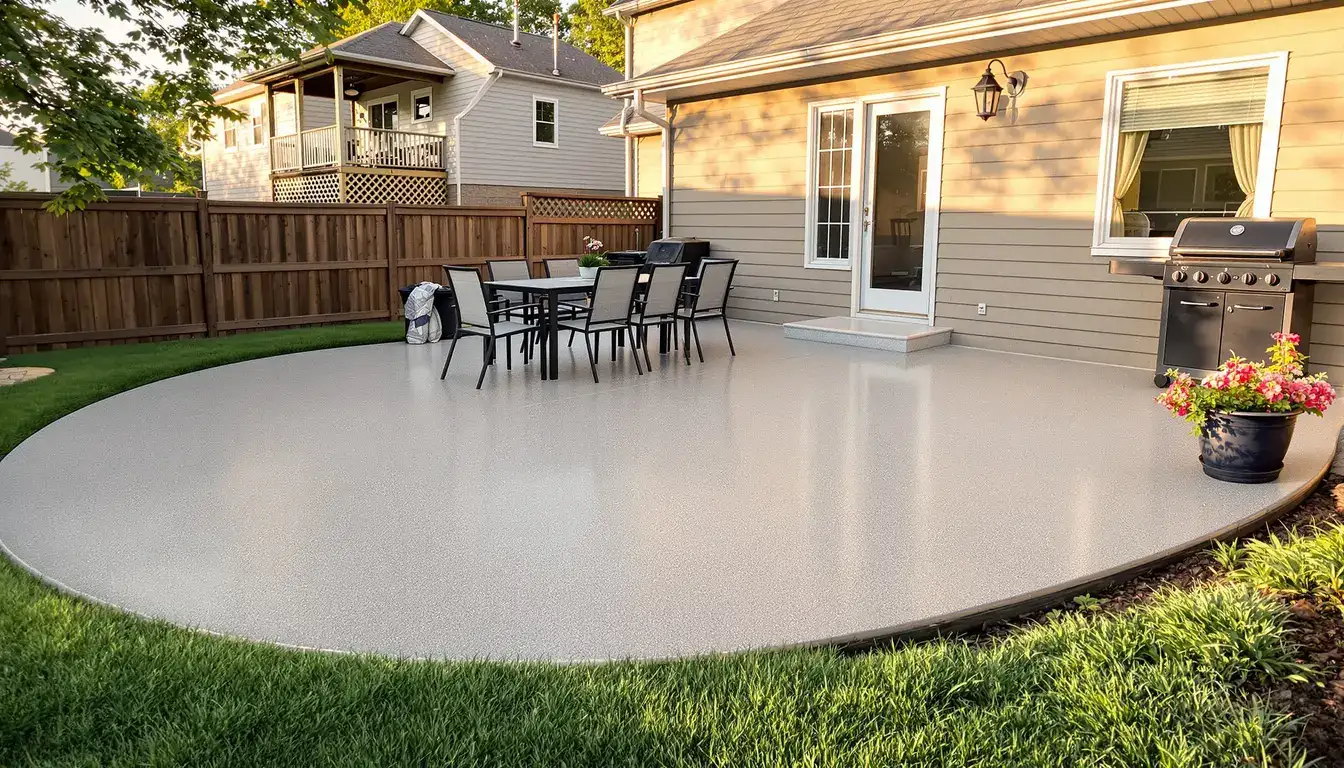
Concrete Patios & Outdoor Spaces in Peculiar, MO
Concrete patios for Peculiar — built for the new I-49 subdivisions on Cass County Grundy silt, where getting the joints cut early and deep is what keeps a young slab from cracking
Concrete Patios & Outdoor Spaces in Peculiar
Custom concrete patio design and installation for backyards, outdoor living areas, and commercial courtyards. Ford Concrete serves Peculiar, MO and the entire Kansas City metro with more than a decade of experience and a 5-star reputation.
Peculiar at a Glance
- Population
- 6,251
- State
- Missouri
- County
- Cass County
- Schools
- Raymore-Peculiar R-II School District
Why a new Peculiar patio needs the joints cut early
A new patio in Peculiar sits on Cass County Grundy silty clay — ground that holds a slab well once it's based right, but that moves enough with moisture to crack a young pour if the joints aren't cut early and deep. On a fresh slab the first months are when shrinkage is strongest, so the timing of the saw cuts decides whether a patio here cracks clean along a line or wanders across the field.
Peculiar has grown fast — an I-49 commuter town that rebuilt itself around new subdivisions like Prairie Meadows and Timber Creek, with Peculiar Way and the Ray-Pec schools anchoring the growth. Most back yards getting a patio here are on lots graded in the last decade, which is exactly the situation where contraction joint timing matters most. Build the base, then cut the joints on a tight window. The rest of this page is how we do it.
A base built for graded subdivision ground
New subdivisions are cut and filled to make level lots, so the first job on a Peculiar patio is knowing what's actually under it. We strip the topsoil, cut to grade, and build the pad up on a tamped granular base placed in lifts, so the slab bears on stone we compacted rather than loose fill a grader left behind. On Grundy silt that base spreads the load and gives water a path to drain instead of pooling under the concrete.
We lock the perimeter with a thickened edge and a restraint point so the slab holds its line, and we pour a 4,000-PSI air-entrained mix so the surface stands up to freeze-thaw. On a young lot the base discipline matters more, not less — a slab poured on fill that wasn't compacted is the one that drops in its first couple of seasons, so we build the base to hold from the start.
Cutting the joints before the slab cracks itself
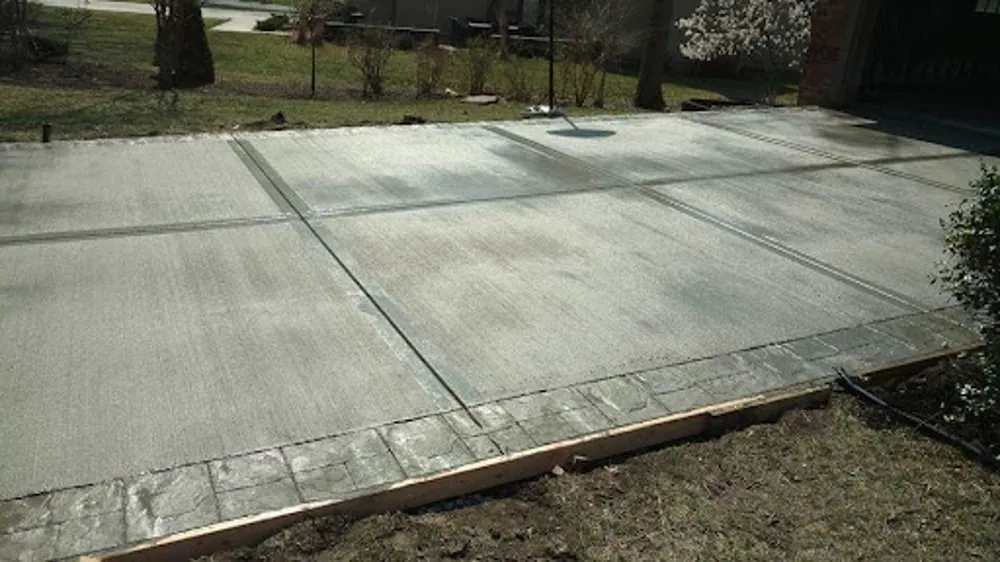
The heart of the job on a young slab is joint timing. Concrete shrinks hard as it cures, and if the saw cuts come too late the slab has already relieved that stress with its own random crack. We saw the contraction joint lines about a quarter of the slab's depth deep, on a tight window while the concrete is still green, and space them two to three times the slab thickness apart in feet — a four-inch pad gets a line every eight to twelve feet. Cut on time, the slab cracks where we planned, out of sight along the joint.
Where the patio meets the house we set a full-depth isolation joint so the slab floats free of the foundation, and at any inside corner a re-entrant corner pulls a crack off the point unless a control line runs to it. On Grundy silt that moves with the seasons, planned joints are what keep a new patio looking new. The same care goes into pours down in Raymore and Harrisonville.
Draining a patio on a flat new lot
Graded subdivision lots often come out close to flat, which looks tidy but gives water nowhere to go. We pitch every pad about a quarter-inch per foot toward open ground — positive drainage that runs a downpour off fast, before it can stand and soak into the silt underneath, where trapped water softens the base and drives the seasonal movement.
The door sets the top of the grade. At a back slider or walkout, we drop the finished threshold elevation a safe step under the sill and pull the grade away from the wall, so runoff can't track back to the house — all the more important on a flat builder's lot that gives water no natural push. Roof water gets its own path: we run the downspouts out to daylight past the pad rather than let it puddle at the edge and creep beneath a young slab.
Finishing a new Peculiar outdoor room
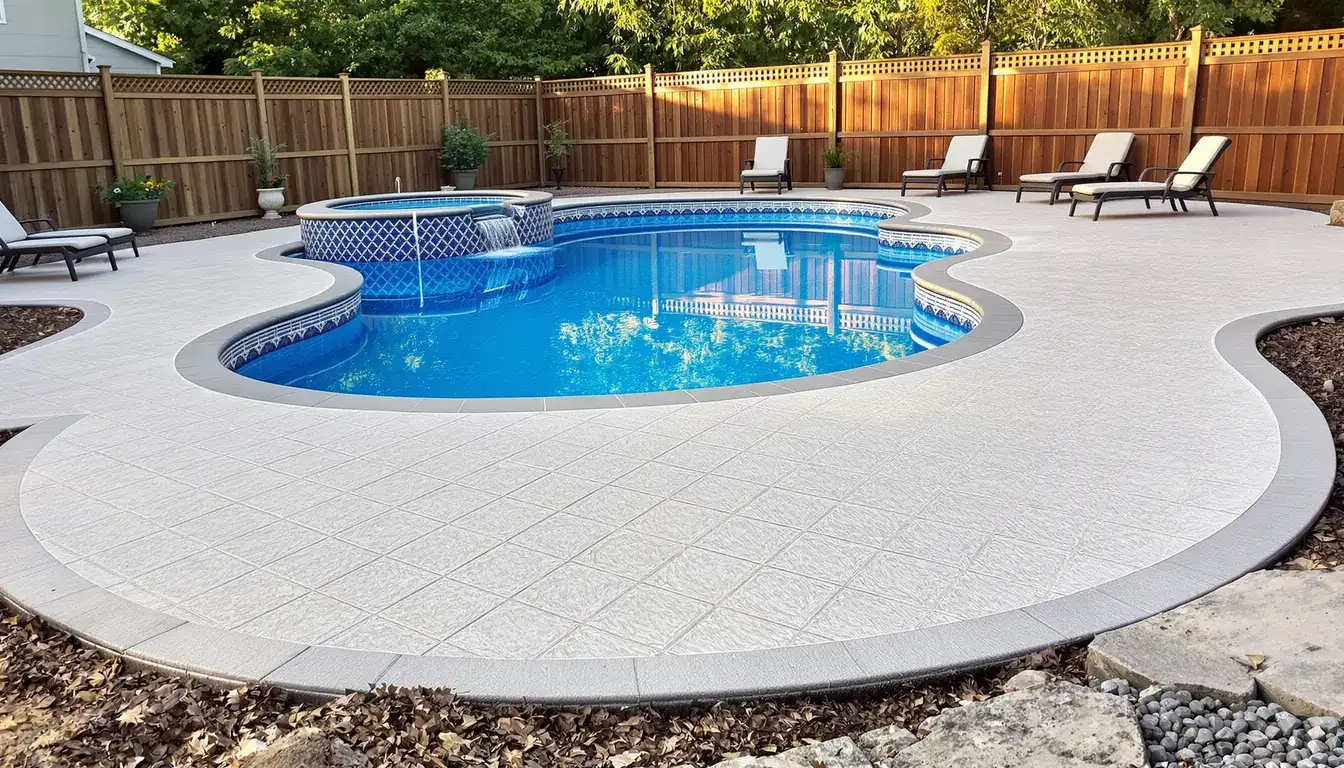
A new home usually means a blank back yard, so the patio is the first real outdoor space — and the finish sets its character. The everyday call is a broom vs stamped finish decision: a broom finish gives a clean, slip-steady surface that suits a family yard, while stamped concrete can pattern the pad to read like stone or plank for a finished outdoor room. On a larger pour we lay the control cuts out as a joint pattern continuity so the joints frame the space instead of crossing it at random.
Before any stamp or color goes down we pour a small mockup so you approve the exact texture and shade against your own house, not off a sample card — and if your subdivision has appearance standards, that's the step where we confirm the look clears them. Our gallery shows stamped and colored patios we've poured around the metro, and the stained and colored options add another way to match the pad to a new home.
Replacing an older slab in downtown Peculiar
Not all of Peculiar is new — the Downtown Overlay and the older streets have back-yard slabs that have been down for decades, thin and lightly jointed, that have cracked or scaled as the Grundy silt worked under them. Whether one gets resurfaced or rebuilt comes down to the base beneath it: a pad that's firm underfoot but tired on top is a candidate for a bonded overlay, while one that rocks, has sunk, or has cracked into pieces has lost its base and needs to be torn out.
When we rebuild one, it's the chance to put in a compacted base, the on-time jointing, and the drainage the original pour skipped — the details that let a new slab hold on Cass County silt where the old one couldn't. We give you the honest read after we walk it, not a blanket tear-out.
Permits and Peculiar's ground
Most patios in Peculiar need a permit through the city, and a roofed or attached cover gets a closer look against setbacks and lot coverage — worth checking early in a subdivision with its own plat rules. We pull the permit, lay the drainage out to clear it, and keep the work inside code.
Peculiar sits in Cass County on the I-49 corridor, which puts it under Missouri's soil and frost rules — MoDNR guidance and a 36-inch frost line that the footings and the compacted base both reach past. It's a straight run south for us, and it's ground we know from pouring patios all through Cass County. Easy to get out, read your lot, and hand you a written number before anything starts. Ford Concrete holds a 4.9-star average across 29 Google reviews from homeowners around the metro.
Planning a patio in Peculiar?
From call to concrete — the fastest in KC.
On a new subdivision lot a patio lasts when the base is compacted in lifts, the joints are cut early and deep, and the water is graded off the flat. Ford builds all three and hands you a written number before anything starts. Call (816) 721-1699 to set up a site visit.
Our Concrete Patios & Outdoor Spaces method for Peculiar sites
Visit the lot and dig to check
We come out to your Peculiar lot, dig to see what a graded builder's pad is really sitting on, and fix the grade and door height before work starts.
Compact the base in layers
We clear the topsoil to firm ground and compact granular stone in lifts, so the pad rests on base we packed rather than fill left loose.
Lock the edge and isolate the house
We thicken and lock the outer edge as a restraint point and place a full-depth isolation joint along the house.
Pour the reinforced slab
We pour a 4,000-PSI air-entrained slab carrying fiber or rebar, so a fresh pad rides the silt's seasonal movement without tearing.
Saw the joints while green
We cut the contraction joints early, inside the green window, to a quarter of the slab's depth and aim a line into every inside corner.
Finish it and cure it even
We apply the broom or stamped finish you signed off from a mockup, seal the pad, and keep the cure even.
Clear the permit
We handle the city permit and any plat or setback check, then walk the finished patio with you.
When Concrete Patios & Outdoor Spaces in Peculiar is ready to replace
A crack across a slab only a few years old
When a young pour splits across its face, the saw cuts came in late or too shallow, so the concrete relieved its shrinkage on its own before the joints could take it.
A corner of the patio dropped
A single low corner points to fill beneath that spot that never got compacted, consolidating under the weight of the pad through its first wet seasons.
Water pooling on a graded lot
Puddles that linger on a builder's flat lot show a pad with no fall built into it — pitched dead level, or worse, tipped back toward the house.
A split that starts at an interior corner
A crack breaking from an inside corner marks a re-entrant corner left without a control line aimed into it to absorb the stress off the point.
A separation along the house line
A gap opening where the slab meets the wall is the patio and the foundation each moving on their own, with no isolation joint dividing them.
A top layer peeling away in flakes
A surface shedding in thin sheets was poured from a mix with no entrained air, so freeze-thaw and road salt lift the face right off it.
Why Ford for your Peculiar Concrete Patios & Outdoor Spaces
Joints cut on the right window
On a young slab, timing is everything. We saw the contraction joints early and deep while the concrete is green, so a new Peculiar patio cracks clean along a line instead of wandering across the field.
Built for graded new-build ground
We read what's under a new-subdivision lot before we pour — stripping to firm ground and tamping the base in lifts, so the slab bears on compacted stone instead of loose builder's fill that drops in its first seasons.
A straight run south on I-49
Peculiar sits in Cass County along I-49, a quick trip for us to walk your lot, read the grade, and hand you a written estimate before anything starts.
4.9 stars across 29 reviews
Ford Concrete has earned a 4.9-star average over 29 Google reviews from homeowners around the metro who cite clean work and straight answers.
The projects behind our name
From your driveway to an Amazon warehouse — the same crew, the same standards, every project.
Taco Bell
New Construction
Overland Park, KS
Domino's Pizza
New Construction
Independence, MO
Freddy's
New Construction
Kansas City
Tidal Wave Car Wash
New Construction
Kansas City
Amazon
New Construction
Riverside, MO
Nortian Food Grade Protein Facility
New Construction
Springfield, MO
Start with a free Peculiar estimate
Or call us directly: (816) 721-1699
Concrete Patios & Outdoor Spaces in Peculiar — FAQs
My subdivision is only a few years old — is that a problem for a patio?
Why does joint timing matter so much on a new slab?
How far apart do you space the joints?
Can you match a stamped patio to my new home?
Can you resurface my old downtown Peculiar patio?
Do I need a permit for a patio in Peculiar?
Beyond Concrete Patios & Outdoor Spaces: our Peculiar work
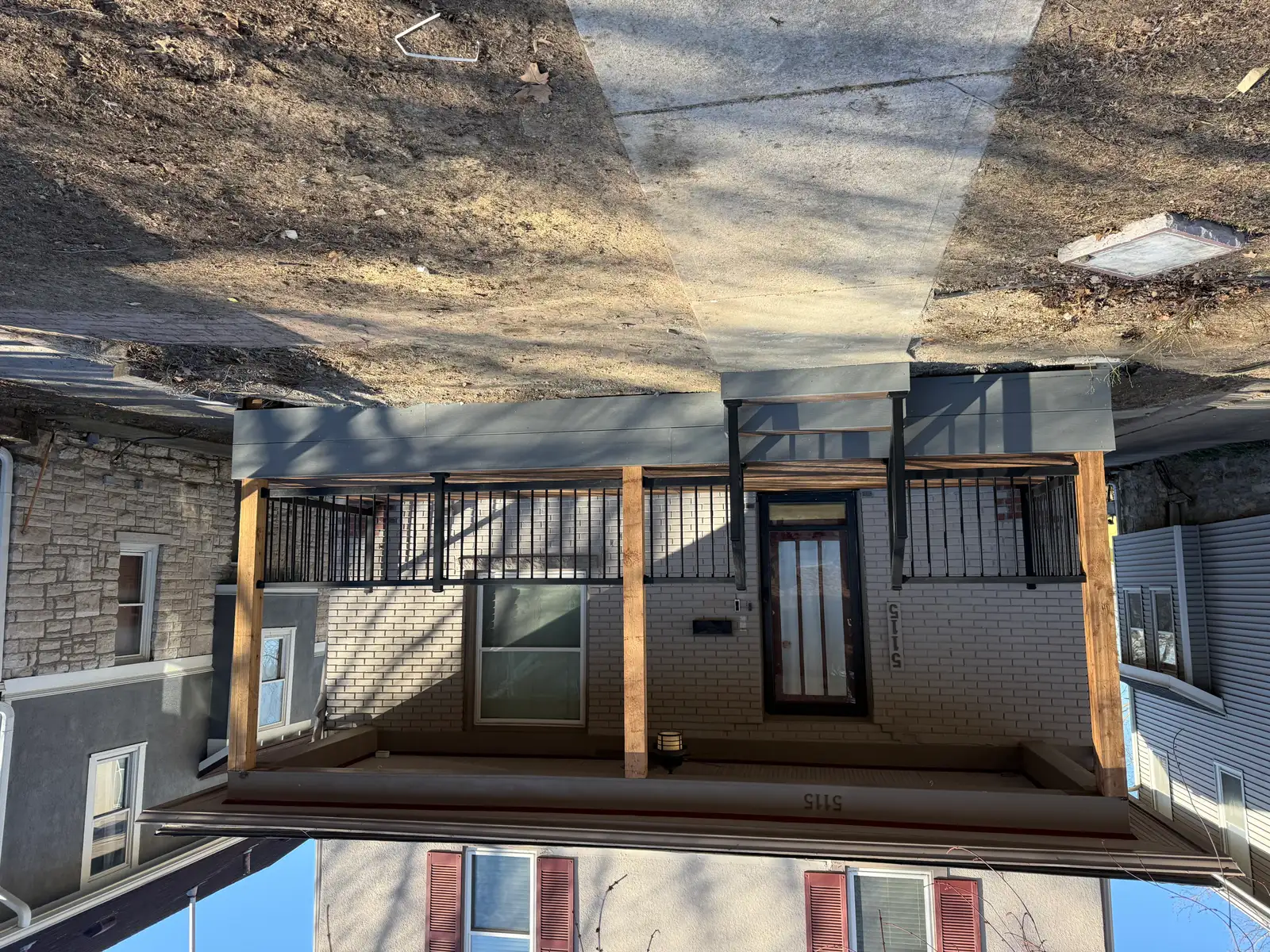
Concrete Patios & Outdoor Spaces across the Cass County area
Get your Peculiar project moving
From call to concrete — the fastest in KC.
Get a free, no-obligation estimate for your concrete project. We serve the entire Kansas City metro — call (816) 721-1699 or request your estimate online.