
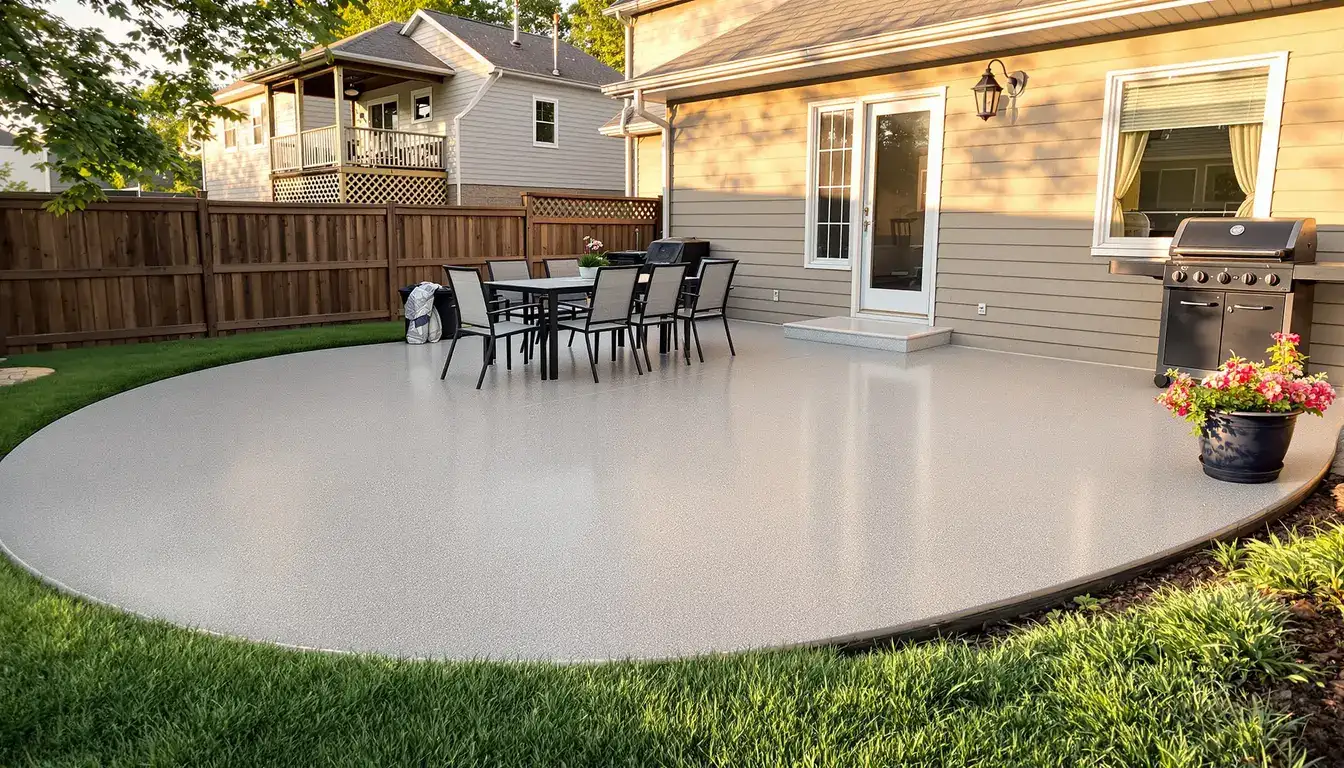
Concrete Patios & Outdoor Spaces in Buckner, MO
Concrete patios for Buckner — from a shaded lot near Heisler Park to a mid-century slab downtown, built around mature roots and Jackson County clay
Concrete Patios & Outdoor Spaces in Buckner
Custom concrete patio design and installation for backyards, outdoor living areas, and commercial courtyards. Ford Concrete serves Buckner, MO and the entire Kansas City metro with more than a decade of experience and a 5-star reputation.
Buckner at a Glance
- Population
- 3,014
- State
- Missouri
- County
- Jackson County
- Schools
- Fort Osage R-I School District
Putting a patio into a settled Buckner yard
Buckner has been around a long time, and it shows in the back yards — mature shade trees, ground that found its grade decades ago, and roots run out under most of the lot. Set a patio into a yard like that, on the Wymore-series clay that runs under eastern Jackson County, and two things are working on the slab at once: the tree roots underneath it and the clay's seasonal move.
A patio built for one of these lots gets set around the yard it goes into. We excavate clear of the big structural roots where we can, lay a compacted base that carries the expansive clay, and joint the slab so root lift and the clay's swing open planned lines instead of cracking wherever. Build a pad the way you would on a bare new-construction lot and you'll fight both the roots and the clay. Do it for the yard that's actually there and a concrete patio sits flat for decades under the same trees.
A base that works around roots and clay
The support under a Buckner slab has two jobs the base on an open lot never has: it has to bridge the clay's movement and stay clear of the roots that are already there. We cut to firm subgrade and build the base up in thin, tamped lifts, and where a large root crosses the footprint we work around it rather than cutting through the tree's anchor — a severed structural root can cost you the tree and leave a void the slab later drops into.
The perimeter is thickened and locked with a restraint point so the edge carries its own weight when the clay shrinks back from it in a dry spell. The slab itself is 4,000 PSI with air entrainment for Missouri freeze-thaw, with fiber or rebar carrying tension across the panels. The same Wymore clay runs under our patios west in Independence and Grain Valley, and east along I-70 in Oak Grove — the difference in Buckner is how often we're threading a new pad through an old, rooted yard.
Where a Buckner patio cracks, and how we stop it
On an established lot the cracks come from two directions. From below, a shallow root that thickens over the years can lift a corner of a slab and open it; from the sides, the Wymore clay swells wet and shrinks dry and drags on anything rigid tied to it. Both are manageable if the slab is jointed to move.
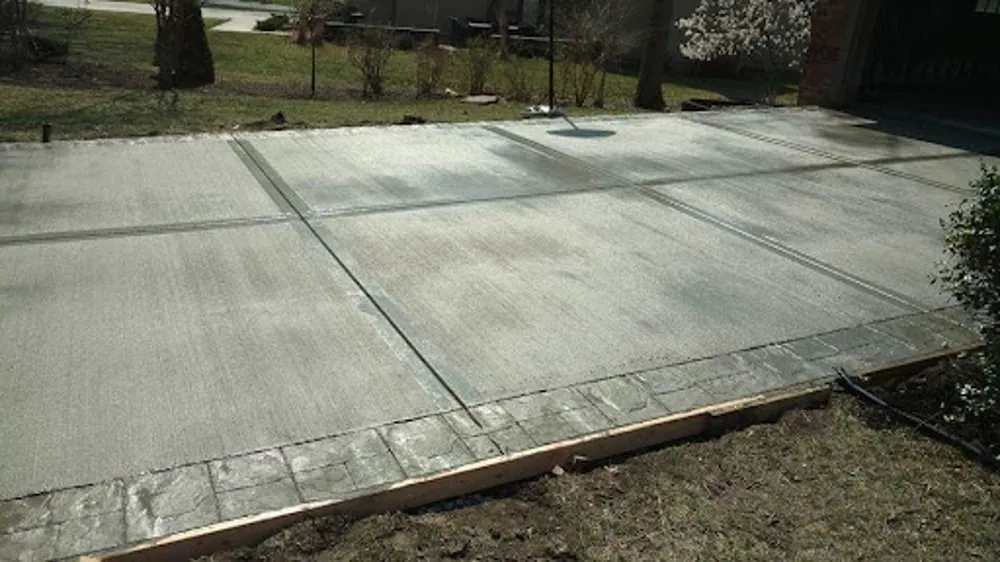
We saw contraction joint lines a quarter of the slab's depth deep, spaced no more than about two to three times the slab thickness apart in feet — a four-inch patio gets a line every eight to twelve feet — so a panel is never big enough to crack itself. Where the pad meets the house an isolation joint keeps the clay from dragging the slab against the foundation, and at any inside corner a re-entrant corner will run a crack off the point unless a control line is aimed through it. Over a known root run we'll set the joint there and, where it makes sense, add steel so a slow lift shows up as a clean line instead of a break.
Draining a patio on a mature lot
A settled yard drains the way it has for years, and a new slab has to fit that without sending water at the house or letting it pool on the clay. Every pad we pour falls about a quarter-inch per foot away from the foundation — positive drainage that carries a downpour to the yard instead of standing on the surface or soaking the clay against the wall, where saturated soil swells hardest.
The door sets the rest. On a back slider or a walkout the finished threshold elevation sits a safe step below the sill with the grade running away from it. On the flatter lots near Heisler Park or downtown, where the yard has little natural fall, we'll tie a downspout into the grading or cut a shallow swale so the runoff has a clear route out. Keeping water moving and off the foundation is what keeps the clay from working the slab from the edges.
Finishing a patio for a shaded back yard
A lot of Buckner's outdoor space sits under a canopy, and a shaded slab behaves a little differently — it dries slower and holds moisture longer — so the finish and the sealer matter. The everyday call is a broom vs stamped finish decision: a broom finish gives a clean, slip-steady surface that stays sure-footed when the shade keeps it damp, while stamped concrete patterns a pad to read like stone or plank for a higher-end look. On a wraparound or a bigger pour we lay the control lines out so the joints look designed rather than dropped in wherever a crew found it easy.
Before any stamp or color goes down we pour a small mockup so you approve the exact texture and shade in your own yard's light; you can browse finishes from past pours in our gallery to start. On a shaded pad we'll also spec a sealer with the right sealer vapor transmission so moisture rising through the slab doesn't cloud or peel the coating — a detail that's easy to skip on a slab poured in open sun and one that shows up later under the trees.
Replacing a mid-century slab downtown
Much of Buckner's housing stock is mid-century, and a lot of those first patios are long past their run — thin, lightly jointed slabs around Downtown Buckner and off Sibley Street that have scaled, cracked, or lifted on the clay and the roots. The question on one of them is resurface or rebuild, and it comes down to what's under the wear. If the slab is solid underfoot and only the surface has dulled or flaked, a bonded overlay can give it a fresh face. If it rocks, pumps at the cracks, or a root has heaved a panel into a trip edge, the base is gone and the slab has to come out.
When we rebuild one we put back the compacted base, the drainage, and the joints the first pour skipped — and we route the new pad clear of the roots that took the old one. That's the difference between a replacement that rides the clay and the canopy for another few decades and one that follows the old slab down in a handful of seasons.
Permits and inspection in Buckner
Most patios in Buckner need a permit. Inside the city the City of Buckner issues it, and on the acreage and rural lots out toward Fort Osage and Sibley, Jackson County does; a roofed or attached patio draws a closer look than an open slab, and setbacks and lot coverage get checked against your plat. We sort out which office applies, file the paperwork, and carry the job through inspection.
Buckner sits in Jackson County, so the ground and frost rules are Missouri's — MoDNR guidance and a 36-inch frost depth we carry the footings and the compacted base below. We're a short run east of Independence off MO-24, which makes it easy for us to walk your lot, read the trees and the grade, and give you a written number before anything starts.
Building or replacing a patio in Buckner?
From call to concrete — the fastest in KC.
From a shaded new pour near Heisler Park to a worn mid-century slab downtown, a Buckner patio lasts when it's built around the yard it goes into — clear of the roots, based for the clay, and jointed for both. Ford does the work and hands you a written number. Call (816) 721-1699 to set up a site visit.
What Buckner Concrete Patios & Outdoor Spaces projects require
Walk the lot and read the trees
We look at how your Buckner yard drains, where the mature roots run, and how much the clay is likely to move through the seasons.
Lay out the footprint and joints
We set the shape to work around the big structural roots, mark the door threshold, and plan the isolation break at the house and the control lines.
Excavate and build the base
We cut to firm subgrade, work around the anchor roots, and build a compacted base in thin, tamped lifts, thickening the perimeter to carry the clay.
Form and set the edge restraint
We form the pad, lock the perimeter restraint, and grade the pitch away from the house so water leaves and the foundation stays dry.
Place the slab
We place a 4,000-PSI air-entrained slab with fiber or rebar, floating in the broom or stamped finish you approved off the mockup.
Cut the joints on time
We saw the contraction joints a quarter of the slab deep on a tight window, so the pad opens along planned lines as the roots and clay move.
Seal, cure, and walk it
We finish an even cure, seal the surface for a shaded lot, and walk the patio with you, going over how the base and joints hold it flat.
Signs your Buckner Concrete Patios & Outdoor Spaces needs attention
A corner lifted over a root
A patio corner pushed up out of level is usually a shade-tree root thickening under the slab — an established-lot problem a new pad has to be routed and jointed around.
A gap opening at the house
A separation at the foundation that widens through the season is the Wymore clay swelling and shrinking and dragging on a slab that was never isolated from the wall.
Cracks with no planned line
Random cracks wandering across a pad mean it was poured without contraction joints close enough to control where the clay and roots make it move.
Water pooling against the foundation
Rain that sits along the house instead of running to the yard soaks the clay right where it swells hardest, and tells you no fall was built into the slab.
A flaking, scaling surface
Concrete shedding in thin sheets is an older slab poured without an air-entrained mix, losing its skin to Missouri freeze-thaw.
A slab that rocks or pumps
A pad that moves underfoot or squeezes water at the cracks has lost its base to a void — often where a root was cut or the clay pulled away — and is past resurfacing.
What sets Ford apart in Buckner
Built around your yard, not a blank lot
We route your Buckner patio clear of the shade-tree roots and set the base to carry Jackson County clay, so a new pad doesn't fight the yard it's poured into.
A quick trip east on MO-24
Buckner is a short run east of Independence, so walking your lot, reading the trees and grade, pulling the permit, and pouring the slab is an easy call for us.
Warehouse standards, backyard scale
The crew that screeds flat commercial floors and truck courts brings the same base work and finish to a Buckner patio, from the ground up.
4.9 stars, 29 reviews
Homeowners around the Kansas City metro have held Ford Concrete to a 4.9-star average across 29 Google reviews.
Proof we pour at any scale
From your driveway to an Amazon warehouse — the same crew, the same standards, every project.
Taco Bell
New Construction
Overland Park, KS
Domino's Pizza
New Construction
Independence, MO
Freddy's
New Construction
Kansas City
Tidal Wave Car Wash
New Construction
Kansas City
Amazon
New Construction
Riverside, MO
Nortian Food Grade Protein Facility
New Construction
Springfield, MO
Price your Buckner Concrete Patios & Outdoor Spaces project
Or call us directly: (816) 721-1699
Concrete Patios & Outdoor Spaces in Buckner — FAQs
Do I have to take out my shade trees to put in a patio?
Why does an older lot need a different approach than a new build?
How thick should a patio be on Buckner's clay?
Can you resurface my old patio instead of replacing it?
Do I need a permit for a patio in Buckner?
How do I keep a shaded patio from staining or peeling?
Other concrete work we do in Buckner
Where else we pour near Buckner
Start your Buckner concrete project
From call to concrete — the fastest in KC.
Get a free, no-obligation estimate for your concrete project. We serve the entire Kansas City metro — call (816) 721-1699 or request your estimate online.