Concrete Overlays & Resurfacing in Greenwood, MO
Concrete overlays and resurfacing for Greenwood — from the newer retail pads at the MO-150 and US-71 junction to the older Main Street storefront lots
Concrete Overlays & Resurfacing in Greenwood
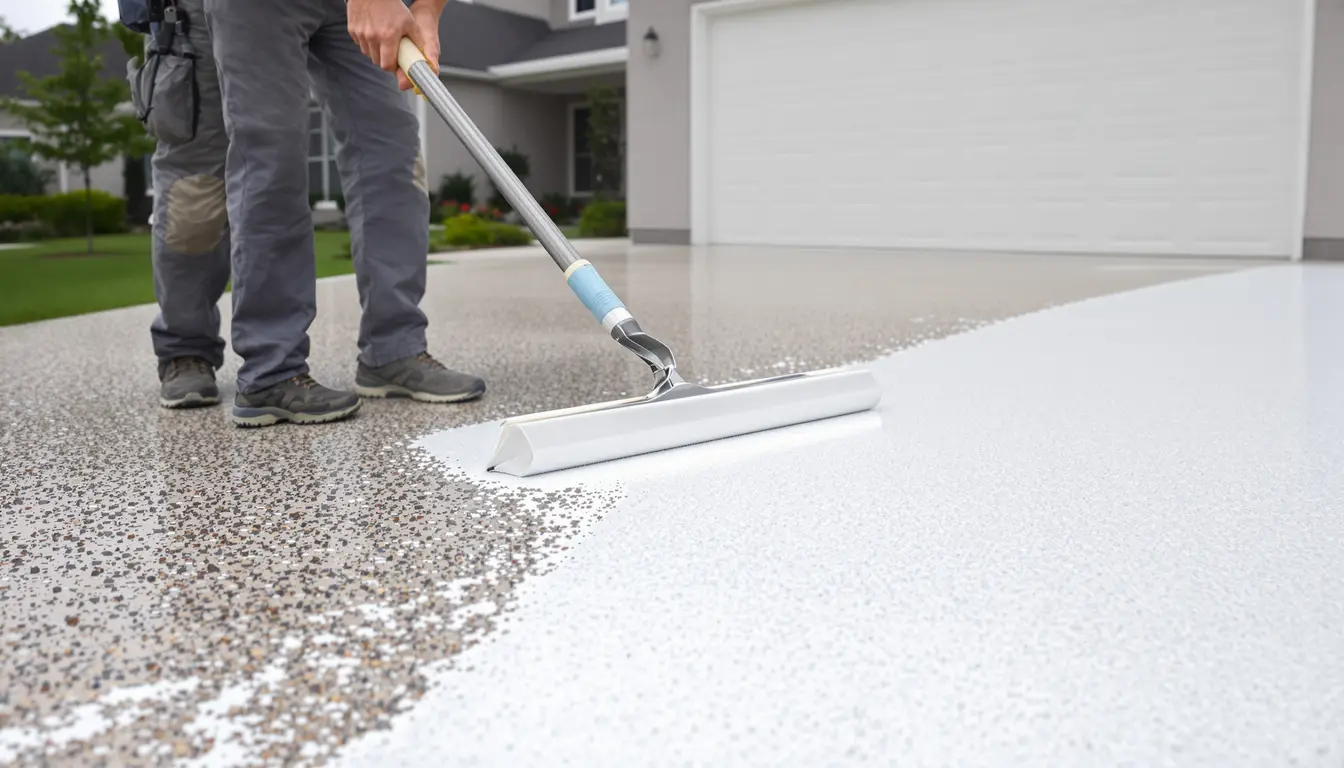
Concrete overlay and resurfacing solutions that restore and transform existing concrete surfaces without full replacement. Ford Concrete serves Greenwood, MO and the entire Kansas City metro with more than a decade of experience and a 5-star reputation.
Greenwood at a Glance
- Population
- 6,125
- State
- Missouri
- County
- Jackson County
- Schools
- Lee's Summit R-VII School District
Can you overlay a lot with curled, lifting joint edges in Greenwood, MO?
Yes, once the curl is dealt with. On Greenwood's newer pads the slab edges dome upward at the joints — curling — and an overlay placed over a lifted edge cracks and spalls where the concrete rises. The fix is to grind the curled edges back to plane, then honor the joints through a textured bonded overlay.
That's a different read than a worn or oxidized lot, and it's common on the fast-built retail concrete near the MO-150 and US-71 junction. Owners comparing options can see how we handle nearby-city slabs in Lee's Summit and Belton, or start with our concrete overlays and resurfacing overview.
What curling is, and why it decides the overlay
Curling is the slab's edges and corners lifting away from the base as the top of the concrete dries and shrinks faster than the bottom. You feel it as a lip at the joints and hear it as a hollow tap near the edge — the slab has literally arched off its support there. It's most common on Greenwood's younger pads, where fast placement and thin sections leave the concrete prone to it.
It matters for resurfacing because a topping is only as flat and supported as what's under it. Overlay a curled edge and the new surface has no bearing beneath the lifted lip; traffic flexes it, and it cracks and spalls at the joint. So we read the curl first — grind the high edges to a true plane, confirm the slab’s substrate soundness, and only then resurface. A lot that's curled and also delaminating under the lift is a different conversation.
Grinding to plane, then honoring the joints
Once we've mapped the curled edges we grind them down to a flat, continuous plane so the overlay bears evenly across every panel. Then the joints get respected, not buried: every control and expansion joint carries up through the new surface as a tooled or saw-cut joint. Bury a moving joint under a topping and it comes back as reflective cracking along the exact old line — the one flaw that makes an overlay look like a failure.
That's why joint honoring is non-negotiable on Greenwood's jointed retail pads. We match the new joint layout to the slab's real movement pattern, not to a convenient grid, so the surface can expand and contract without tearing itself along a seam.
Wymore clay under a young Greenwood pad
Greenwood sits on Jackson County's Wymore and Ladoga expansive clay, per MoDNR mapping — ground that heaves wet and settles dry. On a young pad, that clay is doing two things at once: driving the curl at the surface as moisture gradients shift, and threatening support from below if the lot drains poorly. A slab over wet clay also pushes moisture vapor upward, which can debond a topping placed without a vapor check.
So the ground gets read alongside the curl. We look at where water sits around the pad, whether the base is holding, and what the slab's moisture reads before any overlay goes down. Getting the clay and drainage right is what separates a topping that lasts from one that lifts.
Prep is what makes it bond
After grinding the curl, the whole surface still needs full prep. We strip the surface laitance and any weathered skin, then scarification opens the pad to the coarse CSP profile the overlay system calls for. A ground-flat but glassy surface won't hold a topping any better than a curled one — the profile is what the new layer grabs.
Then a bonding primer coat ties the overlay to the prepared slab, and we screed to full thickness. On the higher-load junction pads we can confirm the bond with a pull-off strength test before the lot goes back into service.
Minimum thickness, and what a Greenwood resurface runs
An overlay has to hold its minimum thickness across the pad to carry retail and delivery traffic — thinning it to a feather at the edges is where jobs crack apart first. On a lot that's been ground to correct curl, holding that depth uniformly is what keeps the fix permanent rather than cosmetic.
A resurface on a sound, ground-flat Greenwood pad costs a fraction of tearing it out, and it keeps a junction retail lot open. When curling comes paired with a delaminating or settled base, we tell you plainly and point you to full replacement instead of selling a topping that can't succeed. Our finished work is in the gallery, and commercial permitting is in our permits and regulations guide. For KC-metro property owners, Ford's 4.9-star rating across 29 reviews stands behind the read.
Joint edges curling on a Greenwood pad?
From call to concrete — the fastest in KC.
A curled-but-sound slab resurfaces once we grind the lift flat and honor the joints — a curled, failing one gets replaced. We read it and hand you a written answer, usually within 24 hours. Call (816) 721-1699.
What makes a Greenwood Concrete Overlays & Resurfacing job different
Map the curl
Grind to plane
Profile the surface
Overlay and re-joint
Verify the bond
Is your Greenwood Concrete Overlays & Resurfacing failing?
A lip you can feel at the joints
Spalling right at the joint edge
A hollow tap near the slab edge
Cracks along old joint lines
The Ford difference on Greenwood Concrete Overlays & Resurfacing
Curl gets ground first
A topping over a lifted joint edge cracks and spalls. We grind curled edges to a true plane before any overlay goes down.
Joints get honored, not buried
Every moving joint carries up through the surface. Bury one and it returns as reflective cracking along the old line.
Young pad, live clay
Wymore clay drives the curl and threatens support. We read drainage and moisture before resurfacing a Greenwood pad.
Sound curl resurfaces; failing curl doesn’t
A curled-but-sound slab resurfaces after grinding. One curled over a delaminating base is a replacement, and we say so.
Commercial work behind our Greenwood crews
From your driveway to an Amazon warehouse — the same crew, the same standards, every project.
Taco Bell
New Construction
Overland Park, KS
Domino's Pizza
New Construction
Independence, MO
Freddy's
New Construction
Kansas City
Tidal Wave Car Wash
New Construction
Kansas City
Amazon
New Construction
Riverside, MO
Nortian Food Grade Protein Facility
New Construction
Springfield, MO
Book your Greenwood Concrete Overlays & Resurfacing estimate
Or call us directly: (816) 721-1699
Concrete Overlays & Resurfacing in Greenwood — FAQs
What is curling, and can you still resurface a curled Greenwood lot?
Why do Greenwood’s newer pads curl?
Will the curl come back through a new overlay?
How do you keep the joints from cracking through?
Is a curled slab always resurfaceable in Greenwood?
Related concrete services in Greenwood
Nearby Greenwood-area projects
Let's build your Greenwood Concrete Overlays & Resurfacing
From call to concrete — the fastest in KC.
Get a free, no-obligation estimate for your concrete project. We serve the entire Kansas City metro — call (816) 721-1699 or request your estimate online.