Commercial Foundation Contractor in Kansas City
The same crew that poured the Amazon warehouse foundation in Riverside pours yours. Excavation through final backfill — one contractor, zero handoffs.
What Are Commercial Foundations?
Definition
Commercial foundations are the engineered concrete structures that transfer building loads to the soil — including spread footings, continuous footings, grade beams, mat foundations, pier systems, foundation walls, and equipment pads. In Kansas City's expansive Wymore-Ladoga clay soils, commercial foundation design must account for seasonal shrink-swell cycles of up to 4 inches and bearing capacities that vary dramatically by depth and moisture content.
We have poured commercial foundations for Amazon in Riverside, Taco Bell in Overland Park, Domino's in Independence, Freddy's, Tidal Wave Car Wash, and the Nortian food-grade protein facility in Springfield. Those six projects span every foundation type in this page — from massive mat foundations to precision equipment pads with anchor bolt templates machined to sixteenth-inch tolerances. The common thread across all of them: one contractor controlled the scope from raw excavation through finished concrete, with zero handoffs between trades.
That full-scope capability is what separates this operation from a foundation-only subcontractor. We do not show up after someone else digs the hole, and we do not leave after the foundation is stripped. We handle the complete sitework sequence — excavation, grading, sub-base preparation — then form and pour the foundation, then continue into slab-on-grade, parking lots, curbs and gutters, and every other concrete element on the project. One crew. One invoice. One phone call when something needs to change.
Commercial Foundation Types We Pour
Five foundation systems — spread footings, grade beams, mat foundations, foundation walls, and specialty pads — all formed and poured in-house by the same crew that handles your sitework and flatwork.
01 — Foundation Type
Spread Footings & Continuous Footings
Spread footings are the most common commercial foundation element in Kansas City — and the one most likely to fail when the bearing depth is wrong.
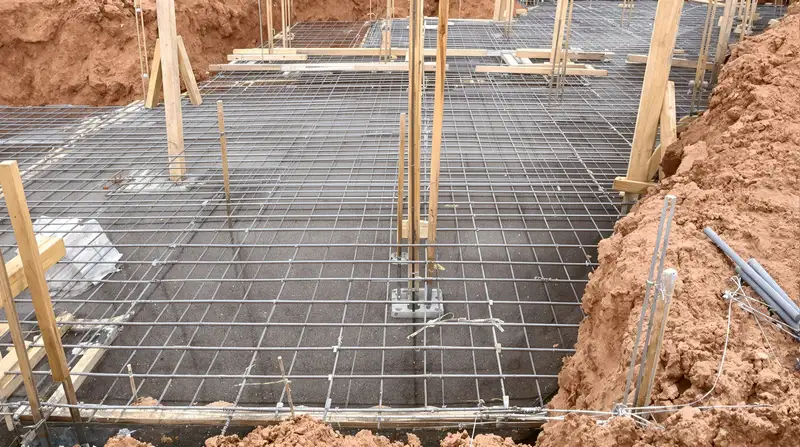
Isolated spread footings transfer individual column loads to the soil through a widened concrete base. Continuous footings run the length of a load-bearing wall. Both are reinforced with a dense rebar grid — typically #5 bars at 12-inch spacing in both directions — and poured against formwork set to the exact elevation the structural engineer specified. Dowels extend from the footing into the column or wall above, tying the two elements together as a single structural unit.
In Kansas City's Wymore-Ladoga clay, spread footing design starts with bearing depth. The geotech report will typically call for 24 to 36 inches minimum below existing grade to reach stable bearing — deeper if the upper clay is saturated or recently disturbed. Over-excavation and replacement with structural fill is common on Jackson and Clay County sites where the surface material tests below the required bearing capacity. We form, place rebar, and pour footings in the same sequence we have run on every commercial project for eleven years — because the footing is the first concrete element, and everything built on top of it depends on getting this step right.
- ▶ Isolated column footings sized to structural load
- ▶ Continuous wall footings with keyway formation
- ▶ Stepped footings for grade changes
- ▶ Dowel placement for column and wall connections
- ▶ Spread footing rebar layout per structural drawings
- ▶ Over-excavation and structural fill in weak soils
02 — Foundation Type
Grade Beam Pier Cap Connections
Grade beams bridge between drilled piers to create a continuous foundation system that bypasses Kansas City's unstable surface soils entirely.
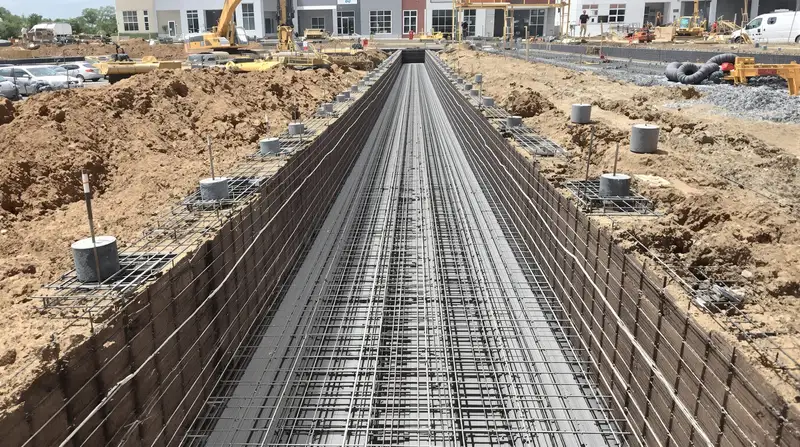
A grade beam is a reinforced concrete beam that sits at or below grade and transfers building loads to deep foundation elements — typically drilled piers or caissons. The beam spans between pier caps, carrying wall loads and distributing them to the piers below. The rebar cage inside a grade beam is engineered for both flexural and shear loading, with stirrups spaced tightly at the pier cap connections where shear forces concentrate.
In Jackson and Clay counties, grade beams on drilled piers are the standard solution when geotech reports show the upper 6 to 10 feet of clay cannot reliably support spread footings. The piers are drilled through the unstable surface material and socketed into limestone or competent bearing strata below. Void forms — corrugated cardboard tubes placed beneath the grade beam — allow the expansive clay to swell without pushing the beam upward. We coordinate with the drilled shaft contractor on pier locations, then form, cage, and pour the grade beams once pier caps are set and inspected.
- ▶ Reinforced grade beams spanning between piers
- ▶ Grade beam pier cap connection detailing
- ▶ Deep foundation integration with drilled shafts
- ▶ Void form systems for expansive clay protection
- ▶ Heavy rebar cages with engineered stirrup spacing
- ▶ Coordination with geotech and drilled pier contractors
03 — Foundation Type
Mat Foundations & Mass Concrete Management
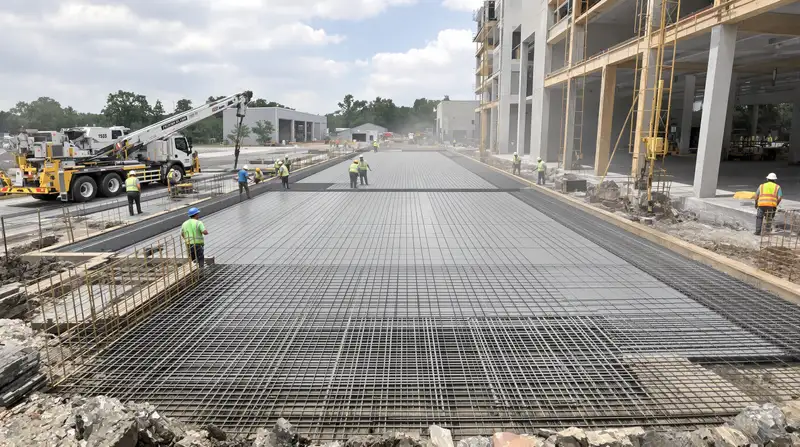
Mat foundations spread building loads across the entire footprint — and pouring one is the highest-volume, highest-stakes concrete day on any commercial project.
A mat foundation is a single continuous slab that covers the entire building footprint, distributing loads uniformly across the soil rather than concentrating them at individual footings. Mat foundations are specified when column loads are heavy enough that individual spread footings would overlap, when soil bearing capacity is marginal, or when differential settlement must be controlled to tight tolerances. The rebar mat inside a commercial mat foundation is typically two layers — top and bottom — with bars as large as #8 or #9 at tight spacing.
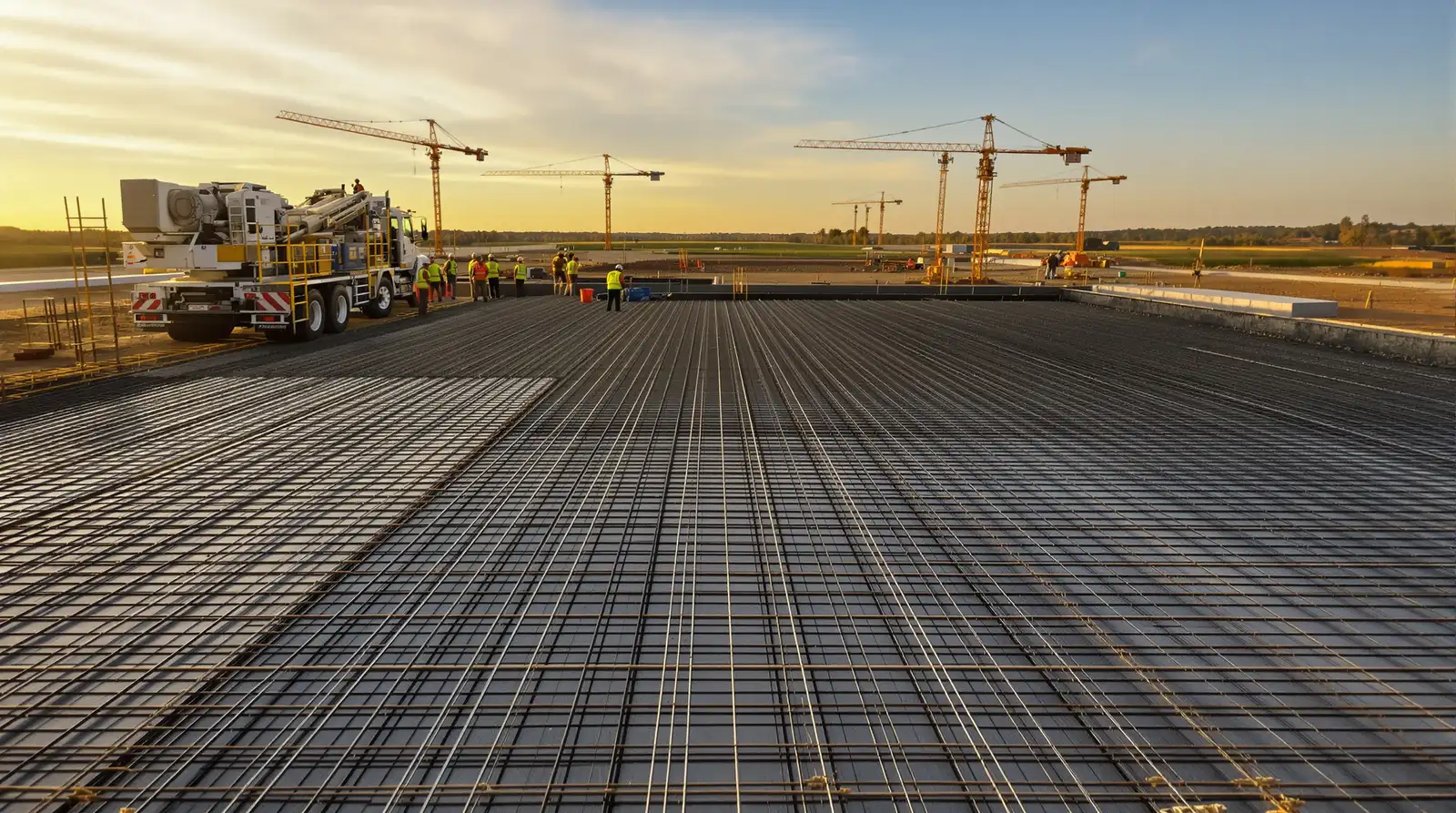
We poured the mat foundation for the Amazon warehouse facility in Riverside — a single continuous pour that required coordinating multiple concrete trucks, pump placement, vibration, and screeding across a massive footprint without cold joints. Mat foundation mass concrete generates significant heat of hydration. Thermal control plans, including insulated curing blankets and temperature monitoring, prevent thermal cracking that would compromise the structural integrity of the slab. Post-tensioning is specified on some commercial mats to add compression that counteracts tensile cracking from soil movement — a real concern in Kansas City's shrink-swell clay environment.
- ▶ Uniform and variable-thickness mat foundations
- ▶ Mat foundation mass concrete thermal management
- ▶ Two-layer rebar mats with engineered spacing
- ▶ Post-tensioned slab foundation options
- ▶ Waterproofing integration below mat
- ▶ Continuous pour logistics and cold joint prevention
04 — Foundation Type
Foundation Walls & Snap Tie Forming Systems
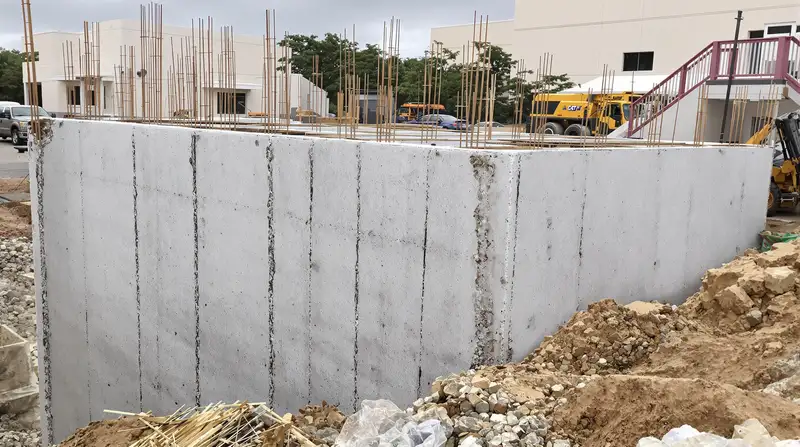
Foundation walls transfer the building load from the superstructure down to the footings below — and the forming, pouring, and waterproofing sequence has to be right the first time.
Poured-in-place concrete foundation walls are formed with steel or aluminum panel systems held together by foundation wall snap ties that maintain wall thickness and resist the hydrostatic pressure of wet concrete. Walls are typically 8 to 12 inches thick on commercial work, reinforced with horizontal and vertical rebar per the structural drawings. Blockouts for windows, doors, utility penetrations, and anchor bolt plates are set in the forms before the pour and must hit their locations within a quarter inch.
After stripping, waterproofing goes on immediately — typically a spray-applied or sheet membrane on the exterior face, with drainage board over it to protect the membrane during backfill. We sequence the strip-and-waterproof operation so backfill can begin as soon as the membrane cures, keeping the schedule tight. On projects that connect to our retaining wall scope, the same crew handles both — foundation walls and site retaining walls are formed and poured with identical methods.
- ▶ Poured-in-place foundation walls 8–12" thick
- ▶ Foundation wall snap tie forming systems
- ▶ Stem walls on spread or continuous footings
- ▶ Waterproofing membrane and drainage board
- ▶ Blockouts, anchor bolts, and embedded plates
- ▶ Strip, waterproof, and backfill sequencing
05 — Foundation Type
Equipment Pad Anchor Bolt Templates & Specialty Foundations
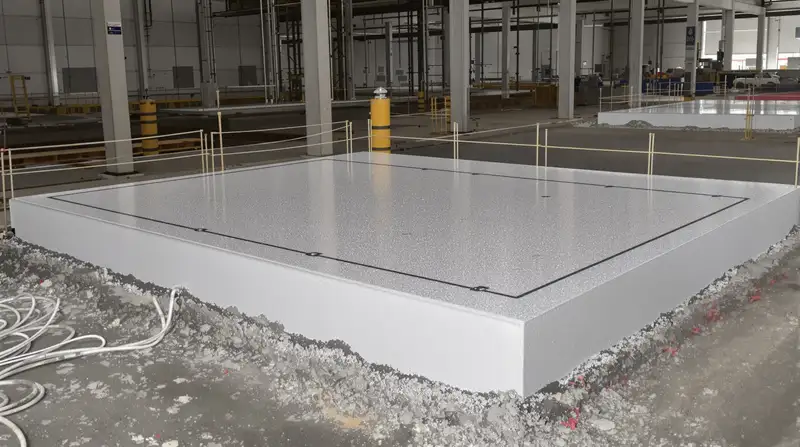
Specialty foundations demand tolerances measured in sixteenths of an inch — because the equipment bolted to them costs more than the foundation underneath.
Machine foundations with vibration isolation pads, elevator pits with waterproofing, loading dock pits, and equipment pads with embedded anchor bolt templates are all specialty foundation elements that require precision forming and placement. An equipment pad anchor bolt template is a steel frame that holds J-bolts or L-bolts in their exact engineered positions while the concrete is placed and finished around them. If the template shifts during the pour, the equipment does not bolt down — and the correction costs more than the original pad.
We poured the specialty foundations at the Nortian food-grade protein facility in Springfield, including equipment pads with embedded conduit, floor drains set to food-grade slope requirements, and anchor bolt templates for processing equipment. Elevator pit waterproofing is another specialty scope we handle — the pit is formed and poured as a monolithic structure, waterproofed on the exterior, and tested before backfill. Every embedded item — conduit stubs, sleeves, plates, and anchor bolts — is verified against the mechanical and electrical drawings before concrete is placed.
- ▶ Equipment pad anchor bolt template installation
- ▶ Machine foundations with vibration isolation
- ▶ Elevator pit waterproofing and forming
- ▶ Loading dock pit construction
- ▶ Embedded conduit and sleeve placement
- ▶ Food-grade floor drain integration
Why GCs Choose a Concrete Contractor for Foundations — Not Just a Foundation Sub
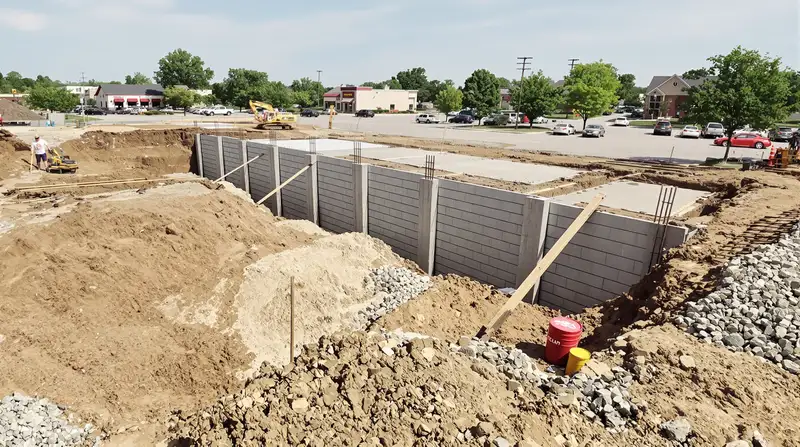
Most foundation subcontractors show up after someone else digs the hole and leave before anyone pours the slab. That creates two handoffs — two mobilization costs, two schedules to coordinate, and two contractors pointing fingers when something does not line up. We eliminate both handoffs because we control the entire concrete sequence on your project.
Pre-Foundation: Sitework — excavation to bearing depth, grading, sub-base compaction, proof rolling. The crew that digs the hole is the crew that forms the footing inside it.
Foundation: Spread footings, grade beams, mat foundations, foundation walls, equipment pads — everything covered on this page. One forming crew, one concrete crew, one inspection sequence.
Post-Foundation: Slab-on-grade, parking lots, curbs and gutters, warehouse floors — same crew, same week, no re-mobilization.
- ▶Single invoice from excavation through finished slab
- ▶Zero schedule gaps between sitework and concrete
- ▶One point of accountability — Aaron Ford answers the phone
- ▶No re-mobilization cost between foundation and flatwork
- ▶Structural fill bearing capacity verified by the same crew pouring on it
- ▶Modified proctor compaction verification before every pour
Commercial Foundations We've Poured
Six commercial foundation projects across the Kansas City metro and beyond — restaurants, warehouses, car washes, and industrial facilities.
Amazon Warehouse
Riverside, MO
Mat Foundation
Massive mat foundation pour with continuous placement logistics, thermal monitoring, and post-pour curing management across the full warehouse footprint.
Taco Bell
Overland Park, KS
Spread Footings & Foundation Walls
New construction spread footings, stem walls, and slab-on-grade for a quick-service restaurant with drive-through lane integration.
Domino's Pizza
Independence, MO
Spread Footings & Slab
Commercial foundation and flatwork package for new restaurant construction — footings through finished floor, single contractor.
Freddy's
Kansas City
Continuous Footings & Stem Walls
Foundation walls, continuous footings, and interior slab with embedded plumbing coordination for restaurant kitchen layout.
Tidal Wave Car Wash
Kansas City
Grade Beams & Equipment Pads
Grade beam foundation system with precision equipment pads for car wash machinery, embedded anchor bolts, and trench drains.
Nortian Food Grade Protein Facility
Springfield, MO
Specialty Foundations & Equipment Pads
Food-grade equipment foundations with vibration isolation, precision anchor bolt templates, embedded conduit, and floor drains meeting sanitary slope requirements.
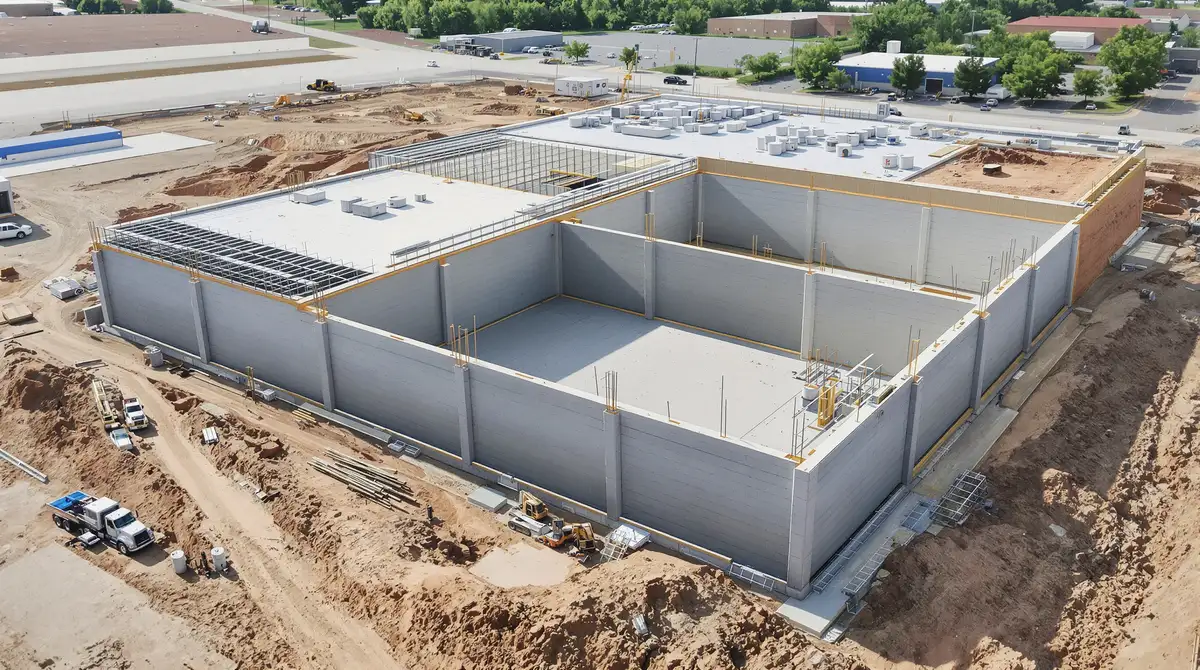
Foundation Engineering in Kansas City's Challenging Soils
Kansas City sits on some of the most challenging foundation soils in the Midwest. The Wymore-Ladoga clay complex that dominates Jackson, Johnson, and Clay counties is classified as a high-plasticity fat clay (CH under USCS, A-7-6 under AASHTO) with a liquid limit above 50 and a plasticity index above 30. That means it swells when wet and shrinks when dry — and the seasonal cycle can move finished grades by two to four inches if the foundation system does not account for it.
Every foundation type on this page is designed to work within those constraints. Spread footings go deeper to reach stable bearing below the active zone. Grade beams ride on void forms that let the clay swell without pushing the structure up. Mat foundations distribute loads uniformly so differential settlement stays within tolerance. For the full soil breakdown by county, bearing capacity data, and Atterberg limits testing detail, see our Kansas City soil conditions guide.
| Soil Condition | Where in KC | Foundation Impact |
|---|---|---|
| Wymore-Ladoga clay (CH) | Jackson, Johnson, Clay counties | High shrink-swell, deeper footings, void forms under grade beams, moisture control during construction |
| Shallow limestone | Southern Johnson County | Rock sockets for drilled piers, excellent bearing capacity, rock excavation pricing |
| Alluvial deposits | Missouri River corridors | Variable bearing capacity, dewatering requirements, deeper foundations to competent strata |
| Loess silt | Leavenworth, Missouri River bluffs | Over-excavation required, structural fill replacement, collapse potential when saturated |
| Frost depth 30–36" | Entire KC metro | All exterior footings placed below frost line minimum — no exceptions |
Our Commercial Foundation Process
Eight steps from bid review through handoff to flatwork. Step eight is where most foundation contractors stop. We keep going — same crew, through the slab.
Bid Review & Scope Confirmation
We review the structural drawings, geotech report, and civil plan with the GC. Foundation type, bearing requirements, rebar schedule, and embedded items are confirmed before we price the job. No assumptions, no allowances hiding scope gaps.
Excavation to Bearing
We excavate to the bearing depth specified in the geotech report. Over-excavation and structural fill placement happen here if the existing soil does not meet the required bearing capacity. Proof rolling confirms the sub-grade before any forms go in.
Formwork & Layout
Steel or wood forms are set to the exact dimensions and elevations on the structural plan. Control points are shot from the surveyor's benchmarks. Every blockout, sleeve, and anchor bolt location is marked and verified before rebar placement begins.
Rebar Placement & Inspection
Rebar is placed per the structural schedule — bar size, spacing, lap lengths, chairs, and tie wire are all checked against the drawings. The special inspector signs off on the rebar before concrete is placed. No pour happens without a passing inspection.
Concrete Placement & Finishing
Concrete is placed by pump or direct chute, vibrated to consolidate around rebar and embedded items, and screeded to elevation. On mat foundations and large pours, thermal monitoring begins immediately to track heat of hydration.
Curing & Protection
Curing compound or wet cure blankets go on within the specified window. In cold weather, insulated blankets and temperature monitoring prevent freeze damage. The concrete reaches design strength before any load is applied.
Strip, Waterproof & Backfill
Forms are stripped at the specified strength. Waterproofing is applied to foundation walls and any below-grade surfaces. Backfill is placed in lifts and compacted to the geotech specification — not dumped in one pass.
Handoff & Transition to Flatwork
Foundation is complete. The same crew transitions directly to slab-on-grade, parking lots, curbs, or any other concrete scope on the project. No sub-contractor handoff. No re-mobilization. No schedule gap.
This is where most foundation subs stop. We keep going — same crew, through the pour.
Ready to Bid Your Next Foundation Project?
General Contractors
Send us the structural drawings and geotech report. We will return a detailed bid with a schedule, not a per-square-foot guess.
Or call Aaron directly: (816) 721-1699
Developers & Owners
Planning a new build? We handle full-scope concrete from excavation through finished flatwork — one bid, one contractor, one point of contact.
Or call Aaron directly: (816) 721-1699
Commercial Foundations in Kansas City — FAQs
How much does a commercial foundation cost in Kansas City?
Commercial foundation costs vary significantly by type, size, soil conditions, and structural requirements. A spread footing system for a small restaurant runs considerably less than a mat foundation for a warehouse. Every project gets a detailed bid based on the structural drawings and geotech report — not a per-square-foot guess. Call (816) 721-1699 or request a bid online and we will price your specific scope.
How long does a commercial foundation take to pour?
Timeline depends on foundation type and complexity. Spread footings for a restaurant can be formed, poured, and stripped in one to two weeks. A large mat foundation requires a single continuous pour day but weeks of preparation. Grade beam systems with drilled piers take longer due to pier installation. We provide a detailed schedule during the bid process that accounts for forming, rebar, inspection, pour, cure, strip, and waterproofing.
What type of foundation does a warehouse need?
Most warehouses in Kansas City use either a mat foundation or a system of spread footings with a structural slab-on-grade. The choice depends on column loads, soil bearing capacity, and settlement tolerance. The Amazon warehouse we poured in Riverside used a mat foundation due to the heavy rack loads and the need for uniform settlement control. Lighter warehouses can often use spread footings with a thickened-edge slab.
Do I need a geotech report for a commercial foundation in KC?
Yes. Every commercial building permit in the Kansas City metro requires a geotechnical investigation. The geotech report identifies soil type, bearing capacity, groundwater depth, and any problematic conditions like expansive clay or fill material. The structural engineer uses the geotech data to design the foundation system. We review the geotech report during bidding to price excavation, over-excavation, and any soil remediation accurately.
What is the frost depth for commercial footings in Kansas City?
The frost depth for commercial footings in Kansas City is 30 to 36 inches below finished grade. All exterior footings must be placed below the frost line to prevent heaving from freeze-thaw cycles. Interior footings in heated buildings are exempt from frost depth requirements. The International Building Code and local amendments govern the specific requirement for each jurisdiction in the KC metro.
Can one contractor handle sitework and foundation?
Yes — and that is exactly what we do. We handle full-scope sitework including excavation, grading, and sub-base preparation, then transition directly into foundation forming, rebar, and concrete placement with the same crew. Eliminating the handoff between the sitework contractor and the foundation contractor removes the coordination failures, schedule gaps, and finger-pointing that cost general contractors time and money.
What foundation type works best in Kansas City's clay soil?
It depends on the building loads and the specific soil conditions at your site. Spread footings work well when bearing depth is reachable within 24 to 36 inches. Grade beams on drilled piers are specified when the surface clay is too unstable or too deep to support spread footings. Mat foundations are used when loads are heavy or differential settlement must be tightly controlled. Void forms are commonly specified under grade beams in KC to allow the clay to swell without lifting the structure.
How deep do commercial footings need to be in KC?
Minimum depth is the frost line — 30 to 36 inches below finished grade for exterior footings. But geotech reports in the KC metro frequently require deeper footings to reach competent bearing in the Wymore-Ladoga clay complex. Depths of 4 to 6 feet are not uncommon in Jackson and Clay counties where the upper clay is saturated or recently disturbed. The geotech report and structural engineer dictate the actual depth for each project.
What is a grade beam foundation?
A grade beam is a reinforced concrete beam that sits at or just below grade level and spans between deep foundation elements such as drilled piers or caissons. It transfers wall and column loads down to the piers, which are socketed into competent bearing strata below the surface. Grade beam foundations are common in Kansas City when expansive clay soils make shallow spread footings unreliable. Void forms beneath the beams accommodate clay swelling without transmitting uplift force to the structure.
Do you pour foundations in winter in Kansas City?
Yes. Cold-weather concrete is a well-established practice and we pour foundations year-round in KC. We use accelerated admixtures, insulated curing blankets, and temperature monitoring to protect the concrete during curing. The concrete must reach a minimum compressive strength before it is exposed to freezing temperatures. Interior foundation work inside enclosed buildings is largely unaffected by weather. Schedule your project early — winter is a great time to get foundation work done before the spring construction surge.
Commercial Foundation Service Area
Break Ground with Confidence
From spread footings to mat foundations, from restaurants to warehouses — we pour commercial foundations across the Kansas City metro with the same crew that handles your sitework, slab, and flatwork. No handoffs. No excuses.
Or call Aaron directly: (816) 721-1699
Ready to Get Started?
From call to concrete — the fastest in KC.
Get a free, no-obligation estimate for your concrete project. We serve the entire Kansas City metro — call (816) 721-1699 or request your estimate online.