
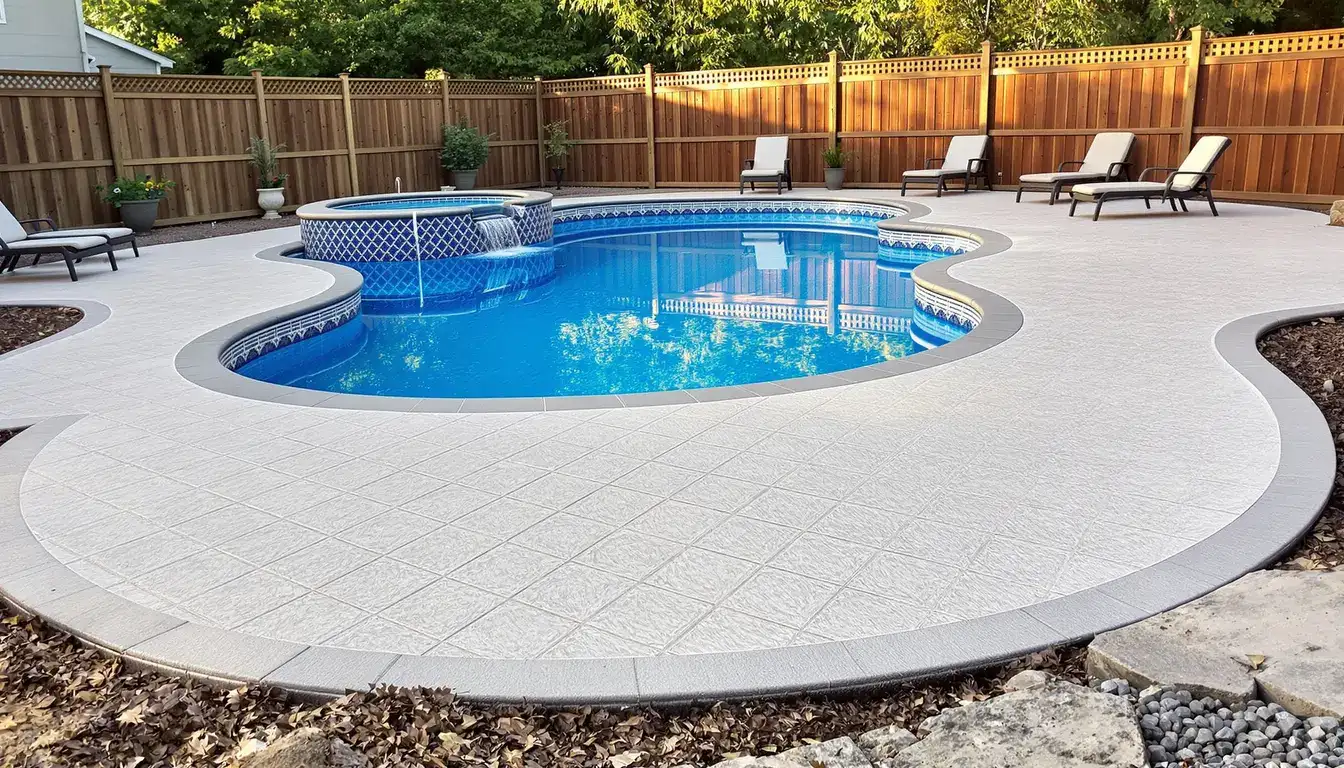
Concrete Pool Decks in Lansing, KS
Pool decks built for Lansing ground — the old Missouri River terrace the K-7 corridor climbs above, where the water table rises with the spring and drops through the summer. On lots around the Towne Center and Kenneth W. Bernard Community Park, we drain the base so that seasonal swing never reaches the slab, then pour and finish a deck that holds flat.
Concrete Pool Decks in Lansing
Slip-resistant concrete pool deck installation and resurfacing for residential and commercial swimming pools. Ford Concrete serves Lansing, KS and the entire Kansas City metro with more than a decade of experience and a 5-star reputation.
Lansing at a Glance
- Population
- 11,201
- State
- Kansas
- County
- Leavenworth County
- Schools
- Lansing USD 469
What makes a Lansing pool deck last?
A Lansing pool deck lasts when the base drains freely on ground where the river-terrace water table rises each spring, an isolation joint keeps the slab loose from the pool shell, and the surface is broomed for slip resistance. On a lot off the K-7 (Main Street) corridor, moving water away from the subgrade is the detail that carries the job through a Leavenworth County winter.
Lansing sits on the terrace deposits above the Missouri River — the same corridor that runs through Leavenworth to the north and down toward Bonner Springs. That ground is silt and fine sand over deeper alluvium, and its moisture rises and falls with the river season. A deck built for it has to answer water that comes up from below as much as rain that lands on top, which is why we start every Lansing job by reading where the water sits and where it goes.
The river-terrace ground under a Lansing lot
Most of Lansing's neighborhoods — Cedar Creek, Eagles Landing, Lansing Meadows, High Point — sit on old river-terrace ground: silt and fine sand laid down when the Missouri ran wider, now capping the deeper alluvium. It drains reasonably when it's dry, but it holds moisture through the wet months, and fine terrace soil that stays damp loses bearing strength. A slab poured straight onto it with no drainage layer sits on ground that firms up in August and softens in April.
That seasonal swing is the difference between Lansing and the clay ground across most of the metro. Clay moves by swelling and shrinking; terrace silt moves by getting wet and losing its grip. The fix for each is different, and the mistake we correct most often on older Lansing decks is a base built as if the ground never changed through the year.
A water table that rises with the season
Near the river terrace, the water table is not fixed — it climbs in spring melt and heavy rain, then recedes. When it climbs close to the underside of a slab, moisture wicks up through fine soil by capillary action and keeps the subgrade damp long after the surface dries. That standing dampness is what softens the bearing under a Lansing deck and lets one corner settle while the rest holds.
We plan for the high-water season, not the dry one. That means setting the deck's grade so surface water sheds away from the pool and the house, and building a drainage layer under the slab that gives rising moisture somewhere to go sideways instead of up into the concrete. Reading the wet-season table is the whole reason a Lansing base costs what it does — and why it holds when a cheaper one drops.
Draining the base sideways before it wicks up
The base under a Lansing deck does two jobs: it carries the load, and it breaks the capillary path so the seasonal water table can't reach the slab. We compact a layer of clean, free-draining aggregate — the kind of stone that lets water move through it rather than hold it — and grade it so any moisture that collects runs out to daylight or a drain line instead of pooling under the concrete.
On lots where the ground stays wet longer, we'll run a perforated line at the base perimeter to carry water off. The point is the same everywhere in Lansing: keep the bottom of the slab dry and firmly supported year-round. A deck built on drained stone doesn't care that the April table is high, because the water never gets to the concrete or the ground right beneath it.
Why the deck rides free of the pool
A pool shell and the deck around it move on different schedules. The shell is anchored deep and largely still; the deck rides the top few feet of terrace ground that shifts with the seasonal moisture. Pour them tight together and the ground's movement cracks the slab right at the pool edge — usually the first place a Lansing deck fails. We separate them with an isolation joint at the shell/deck interface, a clean break that lets each ride on its own.
The band of ground right around the pool is also the youngest on the lot — it was dug out and backfilled when the pool went in. We compact that backfill consolidation zone in lifts so the coping and the first few feet of deck sit on ground as firm as the rest, not on loose fill that settles a season later.
A surface you can cross wet
A pool deck spends its life as a wet deck, and terrace-town summers around Lansing put bare feet on it all season. We finish the surface for traction — a broom texture drawn across the fresh concrete for everyday slip resistance, or a stamped or textured decorative finish when the look matters more, tuned so it still grips wet. The finish gets chosen for how the deck is used, not picked off a board.
Homeowners who want more than a plain gray slab can add color and pattern — a stamped concrete texture or an integral stained tone that reads warmer underfoot. We'll pour a small mockup so you approve the exact finish and color before the full deck goes down.
The edge, and the seal that protects it
The coping is the capped edge where deck meets water, and it takes the hardest wear — every entry and exit, every splash, every freeze. We set the coping to shed water back toward the deck drains, not into the joint, and on a clean-lined build a cantilever coping pours the deck edge right over the pool's bond beam for a clean, unbroken edge with no separate cap to loosen.
Then we seal it. A quality sealer keeps water and winter chlorides out of the surface, holds the color, and slows freeze-thaw scaling. We apply it at the right rate and let it cure so it doesn't cloud — sealer blushing comes from sealing too heavy or over trapped moisture, and it's avoidable. For a saltwater pool, we plan the finish and sealer for ongoing salt exposure so the edge doesn't pit.
Permits, bonding, and a crew for any size pour
Pool-deck work in Lansing follows City and Leavenworth County requirements, and pool electrical has to be tied into the deck correctly — the reinforcing steel is bonded into the pool's equipotential bonding grid so the whole wet area sits at one electrical potential. We build to that, and we coordinate with your inspection so it passes. Environmental rules here run through KDHE, the Kansas agency — never Missouri's.
Ford Concrete works across the KC metro, from backyard decks to commercial slabs, and that range shows up in the base and joint work on a residential deck. KC-metro homeowners rate us 5.0 across our Google reviews, and you can see the finished work or the scale of our commercial pours. Nearby, we build the same way in Leavenworth, Basehor, and Bonner Springs.
Ready to build your Lansing pool deck?
From call to concrete — the fastest in KC.
In Lansing, the river-terrace water table sets the plan — drain the base, isolate the deck from the shell, and finish it for wet feet. We read your lot, tell you straight what the ground needs, and put a real number on paper. Call (816) 721-1699 to book a site visit, usually within a day.
Getting Concrete Pool Decks right in Lansing
Read the ground and the water
We check how the terrace soil under your Lansing lot behaves and how high the water table climbs in the wet season.
Set the grade and drainage
We plan the deck's slope to shed surface water away from the pool and house, and lay out any perimeter drainage.
Build a drained, compacted base
We compact clean free-draining aggregate that carries the load and breaks the capillary path from the rising table.
Form, isolate, and reinforce
We form the deck, set the isolation joint at the shell, place reinforcing steel, and tie it into the pool's bonding grid.
Pour and finish
We place 4,000 PSI concrete and finish it — broom for traction or a stamped or stained decorative surface you've approved on a mockup.
Cut the joints and set the coping
We saw contraction joints at planned spacing to control cracking and set the coping to shed water back to the deck drains.
Seal and walk it with you
We seal the deck at the right rate to avoid blushing, then walk the finished job with you before we leave.
Signs your Lansing Concrete Pool Decks needs attention
A corner that settles in spring
A deck corner that drops when the ground is wet is terrace silt losing bearing as the seasonal water table rises — a drainage problem under the slab, not just a surface crack.
Cracking right at the pool edge
A crack that follows the coping line means the deck was poured tight to the shell with no isolation joint, so ground movement tears them apart at the interface.
A slick surface when wet
A troweled-smooth or worn deck loses traction wet. A broom or textured finish restores slip resistance without changing the look much.
Coping loose or lifting
Coping that rocks or separates usually means water got under it and froze, or the edge wasn't set to shed water away from the joint.
A cloudy, blotchy sealer
Sealer blushing — a milky haze — comes from sealing too heavy or over damp concrete. It can be corrected and re-applied at the right rate.
Pitting on a saltwater deck
Surface pitting near the water line is salt exposure working on an unprotected finish. The fix is a finish and sealer chosen for saltwater.
What sets Ford apart in Lansing
Base drained for the wet season
Lansing's river-terrace table rises each spring. We build a free-draining base and break the capillary path so seasonal moisture never softens the ground under the slab.
Deck isolated from the shell
An isolation joint at the shell/deck interface lets the pool and the deck move on their own, so the ground's seasonal shift doesn't crack the edge.
A surface that grips wet
Broom-textured or textured decorative finishes give real slip resistance on a deck that's wet all summer.
Built to code, bonded correctly
We tie the deck steel into the pool's equipotential bonding grid and coordinate City and Leavenworth County inspection under KDHE.
Commercial work behind our Lansing crews
From your driveway to an Amazon warehouse — the same crew, the same standards, every project.
Taco Bell
New Construction
Overland Park, KS
Domino's Pizza
New Construction
Independence, MO
Freddy's
New Construction
Kansas City
Tidal Wave Car Wash
New Construction
Kansas City
Amazon
New Construction
Riverside, MO
Nortian Food Grade Protein Facility
New Construction
Springfield, MO
Book your Lansing Concrete Pool Decks estimate
Or call us directly: (816) 721-1699
Concrete Pool Decks in Lansing — FAQs
Why does the water table matter so much for a Lansing pool deck?
How do you keep a pool deck from cracking at the edge?
Can you make the deck slip-resistant?
Do you handle the permit and the pool bonding?
We have a saltwater pool — does that change the deck?
Does Ford Concrete work on more than backyard decks?
Other concrete work we do in Lansing
Where else we pour near Lansing
Let's build your Lansing Concrete Pool Decks
From call to concrete — the fastest in KC.
Get a free, no-obligation estimate for your concrete project. We serve the entire Kansas City metro — call (816) 721-1699 or request your estimate online.