
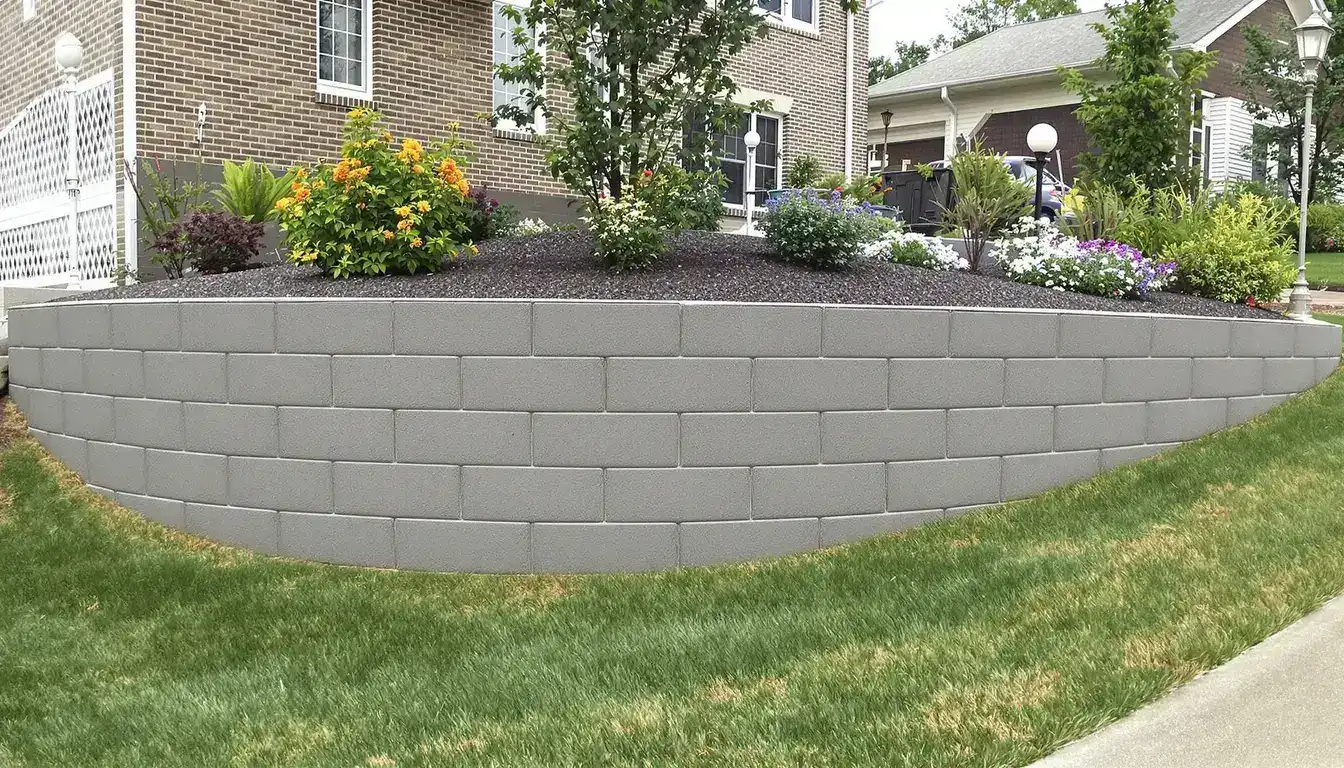
Retaining Walls in Lawrence, KS
Engineered concrete retaining walls for Lawrence — footings matched to river-bottom and Oread-hill ground, with the drainage that holds a wall on Douglas County soil
Retaining Walls in Lawrence
Structural and decorative concrete retaining wall construction for erosion control, landscaping, and property grading. Ford Concrete serves Lawrence, KS and the entire Kansas City metro with more than a decade of experience and a 5-star reputation.
Lawrence at a Glance
- Population
- 97,411
- State
- Kansas
- County
- Douglas County
- Schools
- Lawrence Public Schools (USD 497)
What holds a retaining wall up on Lawrence’s two kinds of ground?
A retaining wall in Lawrence holds when its footing reaches firm bearing below the 36-inch frost line, its stem is sized for the lateral earth pressure behind it, and clean drainage keeps water from stacking against the back face. What changes across Lawrence is the ground that footing lands on.
North Lawrence sits in the Kansas River bottoms — soft alluvial soil with a high water table — while the older city and the University of Kansas climb Mount Oread and the hills south of the river, where glacial loess sits over a shelf of native limestone. A concrete retaining wall off Massachusetts Street is a different structure from one in the bottoms near the river, and matching the base to the ground is the whole job.
North Lawrence bottoms and the hills: two footings for two grounds
In the Kansas River bottoms north of the river, the soil is deep alluvium — sand, silt, and soft clay dropped by the Kaw — with a water table that can sit close to the surface. Soft ground like that doesn’t give a footing much to push against, so a wall here needs a wider footing to spread its load, and sometimes a deeper reach to find bearing the soft soil above can’t provide.
Up on the Oread hills and through Old West Lawrence, the ground firms up fast — loess and glacial till over rock — but the grades get steep, and a wall cut into a hillside has to resist both the earth behind it and the pull of the slope itself. We read which Lawrence you’re building in before we size anything.
The Oread limestone bench under the hill
The hill the university sits on gave its name to a rock: the Oread Limestone, a formation that runs through the bluffs of eastern Kansas and surfaces across Douglas County. Where that limestone bench sits within a few feet of the surface — common on the upland lots south and west of downtown — it’s a gift for a wall. Rock is the firmest bearing a footing can land on, and it won’t settle the way soft soil does.
It comes with one catch: water can’t drain down through rock, so it perches on the shelf and runs sideways toward the low side of your lot. A wall built on the bench has to carry that water away deliberately, because the rock that gives it a solid base also traps the water behind it.
Why water is the real load on a Lawrence wall
Whether a wall stands in the bottoms or on the bench, water is what pushes it over. Saturated backfill builds hydrostatic pressure against the back face, adding a water load on top of the earth pressure the wall was already holding. In the river bottoms the high water table feeds that pressure directly; on the hills, perched water off the limestone does it.
We answer it the same way every time: clean drainage aggregate against the stem, a perforated drain wrapped in filter fabric at the base, and weep outlets that let the water leave. Give the water a path and it never becomes the wall’s load.
How a Lawrence wall resists sliding and overturning
Earth pressure works on a wall two ways. It tries to tip the wall out at the top — overturning — and it tries to shove the whole wall forward off its base — sliding. The base is what answers both. A footing wide enough, with a heel that reaches back under the retained soil, lets that soil’s own weight hold the wall down and resist tipping.
Against sliding, friction under the footing does part of the work, but on wet ground that friction drops — so where the load calls for it we cast a shear key, a downward lip that keys into firm soil below the base. On the steep grades around Mount Oread, we also look at the slope as a whole, because a tall or tiered wall can be stable in itself yet sit on ground that wants to move — that’s global stability, and it’s an engineer’s question, not a guess.
Lawrence permits and walls over four feet
The City of Lawrence requires a permit for most retaining walls, and a wall over four feet measured from the bottom of the footing generally needs engineered plans stamped by a licensed professional. A surcharge — a driveway, a parking pad, or a slope loading the ground above the wall — raises the design load and can push a shorter wall over that line too.
We pull the permit, bring stamped plans where the height or load calls for them, and follow KDHE guidance for grading and drainage so the site sheds water the way the plan intends. Around the University and the historic districts, older walls often need repair or replacement to current standards, and we build those to today’s requirements rather than patching yesterday’s.
The crew that pours your Lawrence wall
The same crew that builds retaining walls across the Kansas City metro pours them in Lawrence, and it’s the same crew behind our commercial work in Johnson County — including the new Taco Bell we built in Overland Park. Ford Concrete has worked on Kansas ground since 2013, and KC-metro property owners rate the company 4.9 on Google across 29 reviews.
We build these walls east toward Eudora and De Soto and north into Leavenworth, and finished work is in our project gallery. Our Kansas City soil-conditions guide walks through how the region’s soils behave under a footing.
Planning a retaining wall in Lawrence?
From call to concrete — the fastest in KC.
From the river bottoms to the Oread hills, a Lawrence wall holds on the footing under it and the drainage behind it. Ford matches the base to your ground and builds the drainage that keeps water off the wall. Call (816) 721-1699 for a site evaluation.
How we pour Retaining Walls in Lawrence
Read the ground and grade
We check whether you’re on river-bottom alluvium or the Oread bench, measure the grade change, and note any surcharge above.
Probe for bearing
We locate firm bearing below frost — soft and deep in the bottoms, often shallow rock on the hills.
Engineer the base
We size footing, heel, and shear key to the load and bring stamped plans where the height calls for them.
Excavate below frost
We dig to firm, consistent ground below the 36-inch frost line so the footing won’t heave or settle.
Form, reinforce, pour
We set forms, tie steel, and cast footing, key, and stem so the wall works as one structure at 4,000 PSI.
Build the drainage column
We place drainage aggregate, a perforated drain in filter fabric, and weep outlets before any soil goes back.
Backfill in lifts
We backfill in tight compacted lifts so the wall loads evenly and the ground behind it stays firm.
Warning signs on Lawrence Retaining Walls
A wall leaning toward the low side
A stem tipping outward is losing to earth pressure the footing or steel was never sized to carry.
A bulge in the wall face
A wall bowing outward usually means water is building hydrostatic pressure behind it with nowhere to drain.
A wall sliding forward
A wall creeping toward the downhill side is losing the fight against sliding — often a missing shear key.
Settling on soft bottom ground
A wall dropping or cracking in North Lawrence can mean the footing never reached firm bearing below the soft alluvium.
Water weeping through the face
Water seeping through a wall means it’s saturated behind — drainage that should be carrying it away has failed or was never built.
Cracks stair-stepping up the wall
Diagonal cracks climbing a block or poured wall point to uneven settlement or a base overloaded beyond its design.
How Ford earns Lawrence work
Two grounds, two footings
North Lawrence sits in the Kansas River bottoms and the Oread hills sit on rock. We match the footing to the ground under your lot instead of pouring one wall everywhere.
Drainage built in
Every wall gets drainage aggregate, a perforated drain in filter fabric, and weep outlets so hydrostatic pressure never lands on the back face.
A base that holds
We size the footing, heel, and — where the load calls for it — a shear key so the wall resists both sliding and overturning.
4.9 stars, 29 Google reviews
KC-metro property owners rate Ford 4.9 on Google across 29 reviews. Aaron Ford founded the company in 2013.
The projects behind our name
From your driveway to an Amazon warehouse — the same crew, the same standards, every project.
Taco Bell
New Construction
Overland Park, KS
Domino's Pizza
New Construction
Independence, MO
Freddy's
New Construction
Kansas City
Tidal Wave Car Wash
New Construction
Kansas City
Amazon
New Construction
Riverside, MO
Nortian Food Grade Protein Facility
New Construction
Springfield, MO
Start with a free Lawrence estimate
Or call us directly: (816) 721-1699
Retaining Walls in Lawrence — FAQs
Does it matter if my wall is in North Lawrence or up on the hill?
How deep does a footing go in Lawrence?
Do I need a permit for a retaining wall in Lawrence?
Why does my wall need drainage if the ground looks dry?
Can you replace a failing wall near campus or downtown?
Related concrete services in Lawrence
Lawrence and neighboring communities
Get your Lawrence project moving
From call to concrete — the fastest in KC.
Get a free, no-obligation estimate for your concrete project. We serve the entire Kansas City metro — call (816) 721-1699 or request your estimate online.