
Warehouse & Industrial Floors in Odessa, MO
Distribution, industrial park and shop floors off I-70 — laid out so the lines where each day's pour stopped are not sitting under your forklift route.
Warehouse & Industrial Floors in Odessa
High-performance industrial concrete floor installation for warehouses, distribution centers, and manufacturing facilities. Ford Concrete serves Odessa, MO and the entire Kansas City metro with more than a decade of experience and a 5-star reputation.
Odessa at a Glance
- Population
- 5,593
- State
- Missouri
- County
- Lafayette County
- Schools
- Odessa R-VII School District
Nobody pours an Odessa warehouse floor in one day
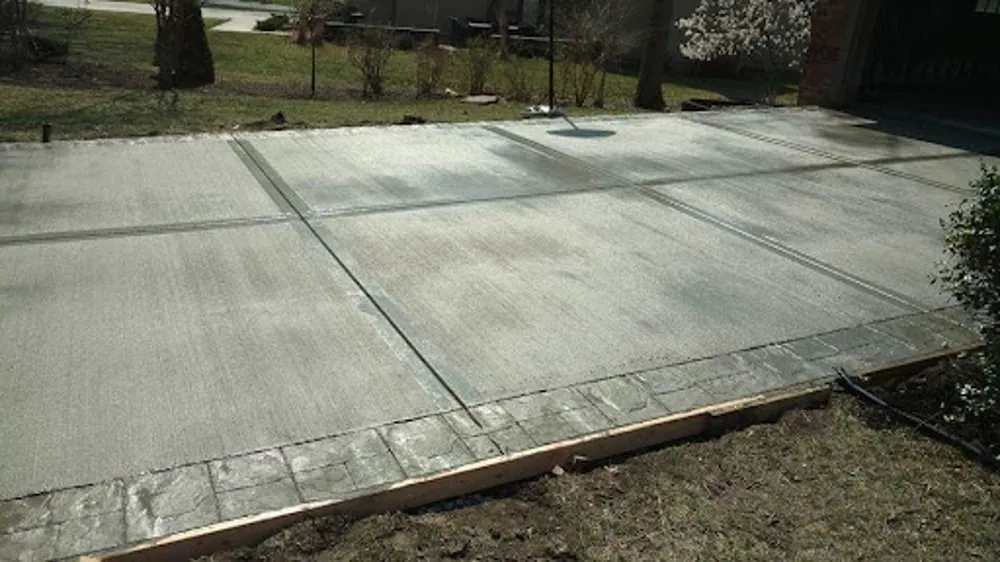
A floor of any size gets placed in pieces, over separate days, and the line where each day's work stopped is permanent. Those are construction joints, and where they land is a decision. When nobody makes that decision on paper, the floor ends up divided by whatever happened to be convenient for the crew at four in the afternoon.
That matters more here than in most of the metro. I-70 runs heavy logistics straight through this town, MO-131 carries loaded trucks between the interstate and the agricultural hubs south of it, and the buildings in the Odessa Industrial Park and out at the I-70 and MO-131 interchange see the traffic that goes with that. Every one of those floors has lines in it that will never be as strong as the concrete on either side. The only question is whether anyone chose where.
Our industrial floor work starts by dividing the pour on a drawing — how many days, where each one stops, and what happens at the stop — before a single truck is scheduled. That sequence is a permanent property of the finished floor, in a way that almost nothing else about the pour day is.
The three joints in your floor, and only one of them is a crack you chose
Three different things get called joints and they do unrelated jobs. An isolation joint separates the slab from something that moves on its own — a column, a wall, a footing, a machine base — so the two are not fighting each other. A contraction joint is the saw cut: a groove tooled into the slab so that the crack concrete was always going to make happens on a line you picked instead of a line it picked. That is a crack you chose, and it is fine.
A construction joint is neither. It is where the placement stopped, and it is a full-depth discontinuity between concrete that is days old and concrete that is fresh. Here is the part owners are rarely told: under a saw cut, the slab is still connected. The cut only goes a quarter of the way down, and the ragged crack below it locks together well enough to hand load across. A construction joint has none of that. It is a clean vertical face against a clean vertical face, and nothing crosses it except what you deliberately put there.
Which is why a keyway is not the answer people think it is. A formed key looks like it should transfer load, and under repeated hard-wheel traffic the top of the key breaks down and the joint starts working. A dowel basket across that line is what actually moves load from one slab to the next, and where the traffic is worst, an armored joint puts steel on the two edges that take the beating.
Strips or checkerboard: how the days get divided
There are two ways to break a floor into days. Checkerboard placement pours alternating panels and comes back later to fill the gaps. It is still around, and we do not use it. It turns every single panel edge into a construction joint, which is the joint you least want more of; it doubles the formwork; and the infill panels are cast tight between neighbors that have already done their shrinking, so the new concrete pulls against fixed restraint on all four sides.
Strip placement runs long strips in sequence. You get fewer construction joints, they run straight, they can be properly doweled, and — this is the part that pays — you can aim them. The strips get oriented so the stop lines run parallel to the main traffic rather than across it, because a wheel that crosses a joint at right angles hits every joint on the route, and a wheel running alongside one never touches it. Where the rack load lands gets checked against those lines too, since a rack post sitting on a construction joint is a problem you build in on day one and discover in year three.
The sequence also has a shrinkage cost that comes with it. Each new strip shrinks against a neighbor that already finished shrinking, so the joint between a three-day-old strip and fresh concrete is a restraint point. It gets planned for in the panel widths and the cut timing rather than discovered afterward.
I-70, MO-131, and where we would rather your joints land
The retail and industrial stock along the I-70 frontage mostly dates to the 1980s through the 2000s, which puts a lot of it at the point where rehabilitation stops being optional. When we look at those floors, the failures are rarely in the middle of a panel. They are on the lines — joints spalling and breaking down under the axle loads that MO-131 and the interstate deliver all day. That is not bad concrete. That is a floor whose stop lines were put where the trucks drive.
Honest about scale: Odessa is 5,593 people, and the work here runs from industrial park buildings and distribution space down to shops and back-of-house behind the Downtown Square. What runs on most of those floors is random traffic, and an honest overall flatness number covers it — a VNA tolerance would be money set on fire and we will say so. The ground here is upland Lafayette County, which holds water rather than shedding it, so the base gets built in compacted lifts and the site gets graded to drain away from the building. Our excavation approach covers that end.
City Hall reads the plans and ground disturbance falls under MoDNR's stormwater rules. Our large-format industrial floors are Amazon's new construction in Riverside and a food-grade protein facility for Nortian in Springfield — neither is an Odessa job, and we would rather say so plainly. Up and down I-70 we pour the same floors in Oak Grove, Grain Valley and Lexington. We are at 4.9 stars across 29 reviews, and the gallery is what we would rather be judged on.
Planning an industrial floor off I-70 in Odessa?
From call to concrete — the fastest in KC.
Send us the traffic and rack layout and we will show you where the pour should stop. Call (816) 721-1699 or request a free estimate.
Building Warehouse & Industrial Floors for Odessa conditions
Get the traffic and rack plan first
Where the forklifts run, where the racks land, and where the trucks come in. None of the joint layout can be drawn without those three answers.
Draw the pour sequence
Strips sized to a day's placement, oriented along the traffic rather than across it, with each stop line chosen instead of inherited.
Build the base and set the barrier
Compacted lifts on upland Lafayette County ground that holds water, vapor retarder directly under the slab, lapped and terminated.
Steel across every stop
Dowel baskets aligned at the construction joints, and armored edges where the traffic count justifies them. A keyway alone does not get used.
Place, cut and cure in sequence
Each strip placed continuously, saw cuts in on the concrete's schedule, and the shrinkage against the older neighbor planned for in the panel widths.
Fill the joints on their own timeline
A semi-rigid joint filler supports the edges, and it goes in after the slab has done most of its shrinking rather than on the day it is convenient.
Signs your Odessa Warehouse & Industrial Floors needs attention
Long straight lines of spalling
Break-down running dead straight across the floor is almost always a construction joint under traffic it was never given the steel to handle.
One joint that is louder than the others
A forklift banging over the same line all day means the two slabs are moving independently. The load transfer across that joint is gone or was never there.
Cracks running off a panel corner
Infill panels cast tight between slabs that already shrank pull against restraint on every side. Checkerboard placement is the usual history.
Damage concentrated on the truck route
Where the joints run across the traffic instead of along it, every wheel hits every line. The pattern of the damage tells you the pour sequence.
What sets Ford apart in Odessa
We divide the pour on paper first
How many days, where each one stops, and what crosses the stop. That drawing is a permanent feature of your floor, so it gets made deliberately.
We aim the joints away from the traffic
Stop lines run parallel to the main route where the layout allows. A wheel that never crosses a joint never works it loose.
Dowels, not just a keyway
A formed key breaks down under hard wheels. Where load has to cross a construction joint, there is steel doing it.
We check the rack lines against the joints
A rack post landing on a construction joint is a problem built in on day one and found in year three. It is free to avoid on a drawing.
The projects behind our name
From your driveway to an Amazon warehouse — the same crew, the same standards, every project.
Taco Bell
New Construction
Overland Park, KS
Domino's Pizza
New Construction
Independence, MO
Freddy's
New Construction
Kansas City
Tidal Wave Car Wash
New Construction
Kansas City
Amazon
New Construction
Riverside, MO
Nortian Food Grade Protein Facility
New Construction
Springfield, MO
Warehouse & Industrial Floors in Odessa — FAQs
What is the difference between a saw cut and a construction joint?
Our last floor had a keyway at the joints. Is that a problem?
Does the pour sequence really matter that much on a smaller building?
What else we build in Odessa
Serving Odessa and the surrounding metro
Get your Odessa project moving
From call to concrete — the fastest in KC.
Get a free, no-obligation estimate for your concrete project. We serve the entire Kansas City metro — call (816) 721-1699 or request your estimate online.