
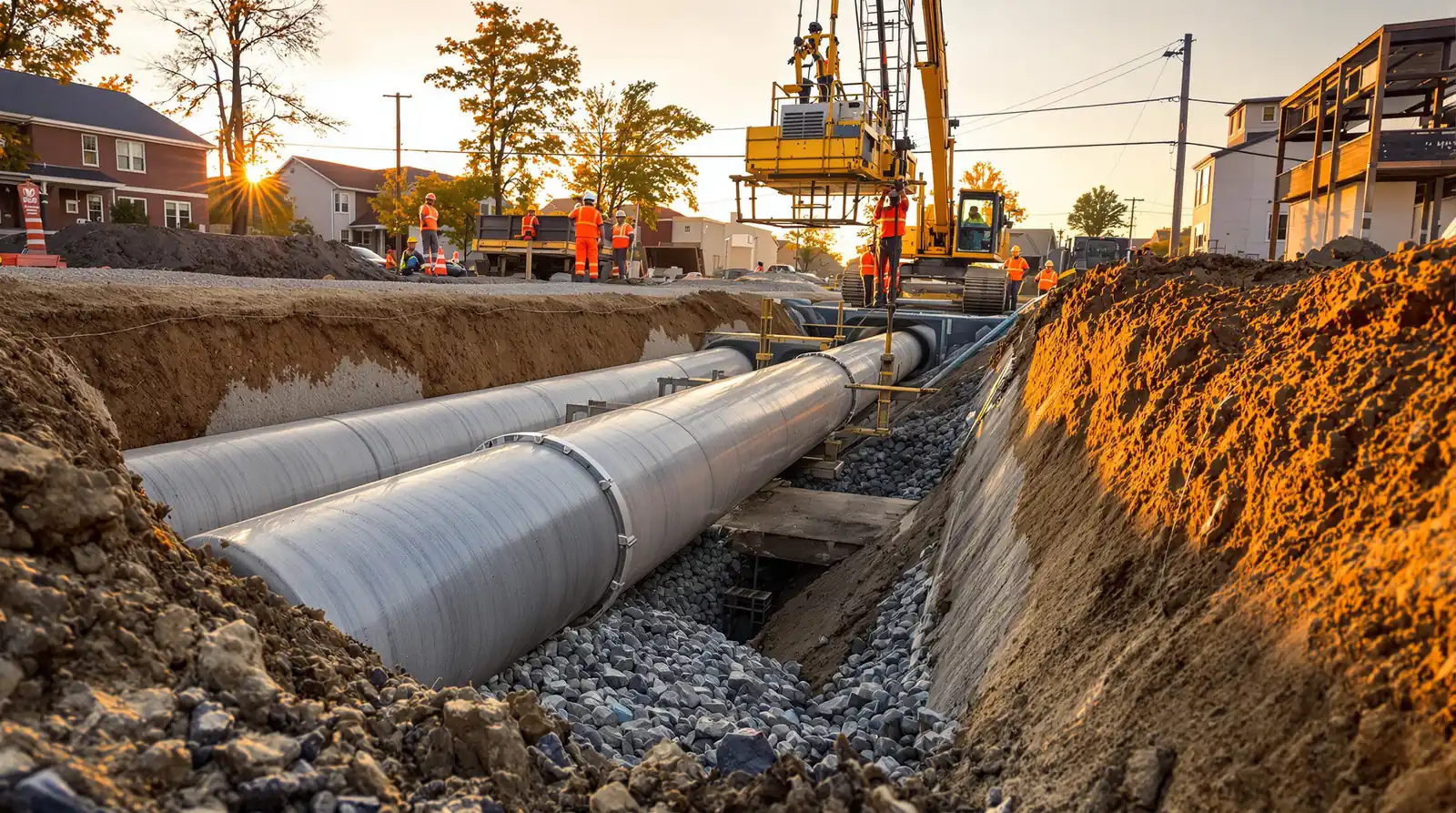
Storm Drainage Installation in Kansas City
Reinforced concrete pipe RCP, HDPE corrugated drainage pipe, catch basin inlet boxes, detention basins, French drain aggregate, and swale construction — installed and integrated with the concrete curbs and gutters we also self-perform.
What Is Storm Drainage?
Definition
Storm drainage is the network of pipe, inlets, structures, and basins that captures surface runoff from a developed commercial site, conveys it underground through reinforced concrete pipe RCP or HDPE corrugated drainage pipe to a catch basin inlet box, and releases it through a detention or retention basin at a rate the downstream system can handle.
Storm drainage is where every KC metro commercial project either lasts or fails. When the system works, nobody notices. When it does not, the parking lot floods every summer, curbs get undercut, pavement cracks from the underside, and tenants complain. We install the full private scope — pipe runs, catch basin inlet boxes, detention basin excavation, French drain aggregate, and swale construction — across the Kansas City metro, and we install it with the same crew that pours the curbs and gutters the water runs into.
The integration matters. Curbs and gutters collect surface runoff and feed catch basins. Catch basins drop into storm pipe. Storm pipe discharges into detention. When one contractor installs the curb and a different contractor installs the drainage, the pipe invert elevation at the catch basin almost never matches the curb line perfectly, and water runs behind the pavement. When the same crew does both, the curb inlet and the catch basin are built to the same elevation at the same time. See our concrete curbs and gutters page for the surface side of the same system.
Storm Drainage Capabilities
Four capability blocks — pipe installation, catch basin inlet box setting, detention vs retention basin construction, and French drain aggregate sub-surface drainage — all handled in-house by the same crew that pours your concrete curbs.
01 — Capability
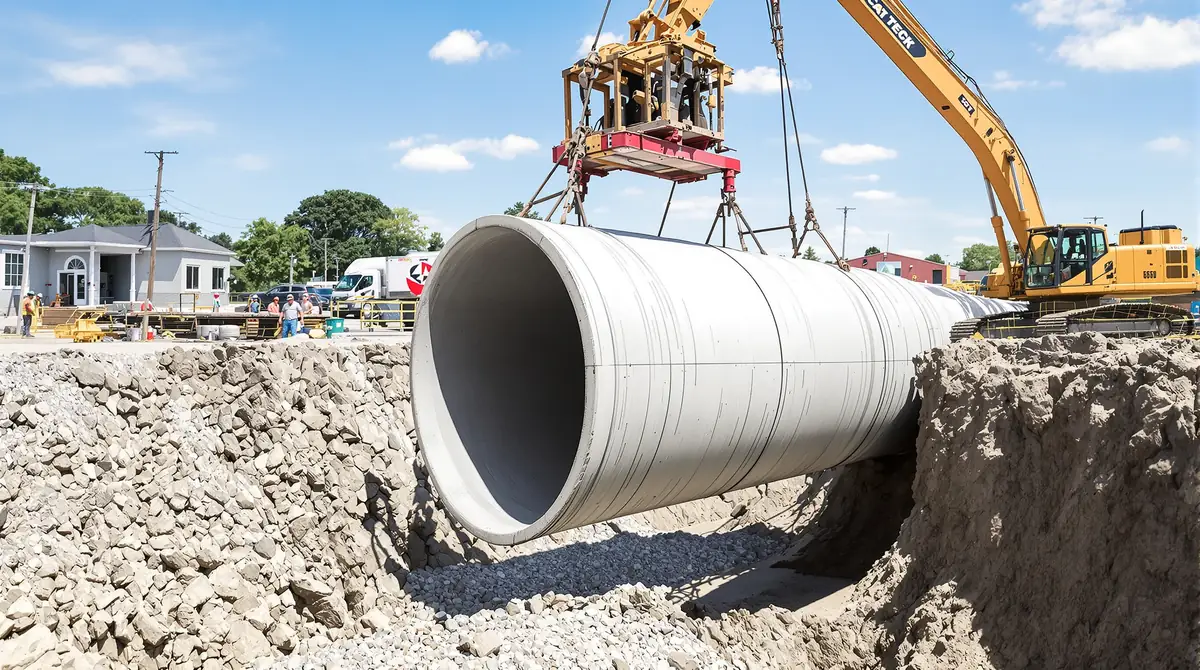
Reinforced Concrete Pipe RCP & HDPE Corrugated Drainage Pipe
Storm pipe is the backbone of a commercial drainage system — the material call is driven by diameter, loading, and the civil plan spec.
Reinforced concrete pipe RCP is the traditional material for large diameter storm mains, public right-of-way tie-ins, and any run where the civil engineer specifies a gasketed bell-and-spigot joint rated for deep cover and heavy H-20 loading. RCP comes in sizes from 12 inches up to 120 inches and handles the loads nothing else can. HDPE corrugated drainage pipe — dual-wall smooth-interior — is the dominant material on private commercial storm drainage across the KC metro. It is lighter than RCP, joints are water-tight with bell and gasket connections, and cost is competitive at mid-range diameters. PVC SDR 35 works for smaller diameter private laterals where cost and speed matter more than heavy loading.
Installation is where the spec becomes reality. Every run starts with proper gravel bedding and haunching under the pipe so it is supported continuously along its length, not spanning between hard points. Joints are sealed with rubber gaskets on RCP and bell/gasket connections on HDPE. Backfill is compacted in lifts. And every linear foot is shot against pipe invert elevation with a rotating laser before backfill closes the trench — because once it is buried, a blown invert means digging it back up.
- ▶ Reinforced concrete pipe RCP installation
- ▶ HDPE corrugated drainage pipe
- ▶ PVC storm pipe for smaller private laterals
- ▶ Gravel bedding and haunching
- ▶ Joint sealing with rubber gaskets
- ▶ Pipe invert elevation verification with rotating laser
02 — Capability
Catch Basin Inlet Box Structures
The catch basin inlet box is the handoff between surface water and the underground pipe network — set it wrong and the pavement around it fails.
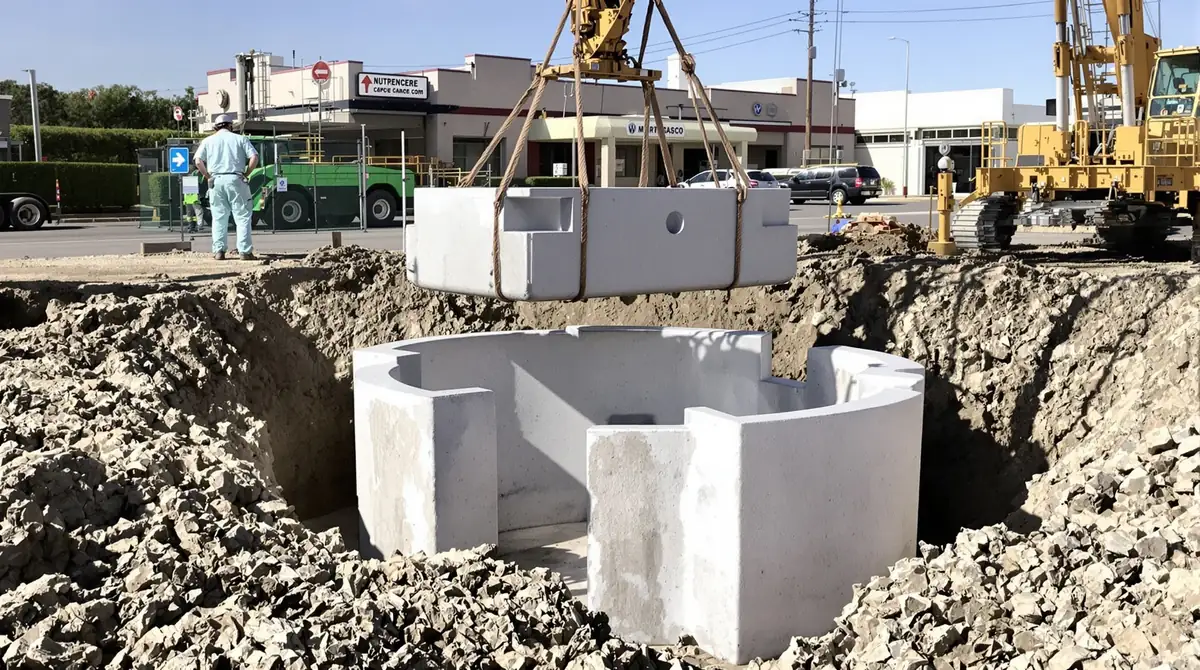
A catch basin inlet box is a precast concrete structure dropped into a prepared excavation at the low point of a parking lot, at the end of a drainage swale, or at the upstream end of every storm run. The box comes from the precaster with pipe stubs cast into the walls at the elevations the civil plan requires. We set the structure plumb, grout the pipe connections water-tight, and leave it ready for the concrete curb crew to build to it. Catch basins carry a sump below the outlet to trap sediment and debris; inlet boxes are simpler structures without the sump, used where sediment capture is not the priority.
Grate selection is where engineering detail matters. Any catch basin inlet box in a drive aisle or parking field gets an H-20 traffic-rated frame and grate to survive loaded delivery trucks. Inlet protection — silt bags, straw wattles, or gravel bags — is wrapped around every structure during construction so sediment from the active site does not migrate into the pipe network before the pavement is down. Frame and grate leveling is the last move: set 1/4 inch below finished pavement so water falls into the grate, never 3/4 inch above where it traps water and chews the asphalt or concrete around it.
- ▶ Precast catch basin inlet box
- ▶ Grate selection H-20 traffic rated
- ▶ Inlet protection during construction
- ▶ Manhole and cleanout access
- ▶ Pipe stub alignment to civil plan
- ▶ Frame and grate leveling to finished pavement
03 — Capability
Detention vs Retention Basin Systems
Detention vs retention basin is the first question on any KC metro commercial project — and on clay soils the answer is almost always detention.
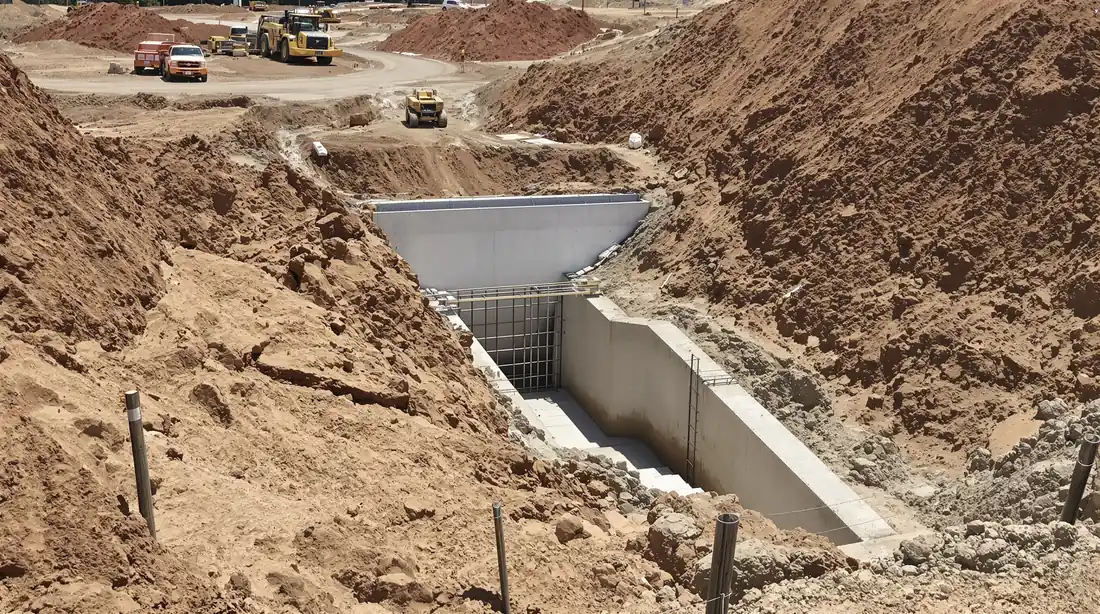
A detention basin holds stormwater temporarily and releases it slowly through a controlled outlet, emptying between storms and sitting dry most of the time. A retention basin holds a permanent pool. KC metro civil engineers almost always specify detention because the region's fat clay soils have very low permeability — there is nowhere for a permanent pool to drain to, and water quality treatment goals are easier to hit with a sized outlet structure than with a wet pond that the clay will not infiltrate. We excavate the basin bowl to the specified cross-section, shape brown graded banks to the 3:1 or 4:1 side slopes the plan calls for, and build the outlet control structure to meter the release rate against the 10-year and 25-year design storms.
An emergency overflow weir is built into the top of the basin as a fail-safe for any storm larger than the design event. A maintenance access road is graded so a skid steer or mini excavator can reach the outlet later to clean it. A rip-rap energy dissipater gets installed at the outlet discharge point to break up flow velocity and prevent downstream scour. And a sediment forebay at the inlet end catches coarse debris before it reaches the main basin, so future maintenance is concentrated where it is cheap to clean.
- ▶ Detention basin excavation
- ▶ Outlet control structure
- ▶ Emergency overflow weir
- ▶ Maintenance access road
- ▶ Rip-rap energy dissipater
- ▶ Sediment forebay at inlet
04 — Capability
French Drain Aggregate & Sub-Surface Drainage
French drain aggregate handles the water the surface inlets cannot catch — ground water, seepage, and lateral flow through saturated clay.
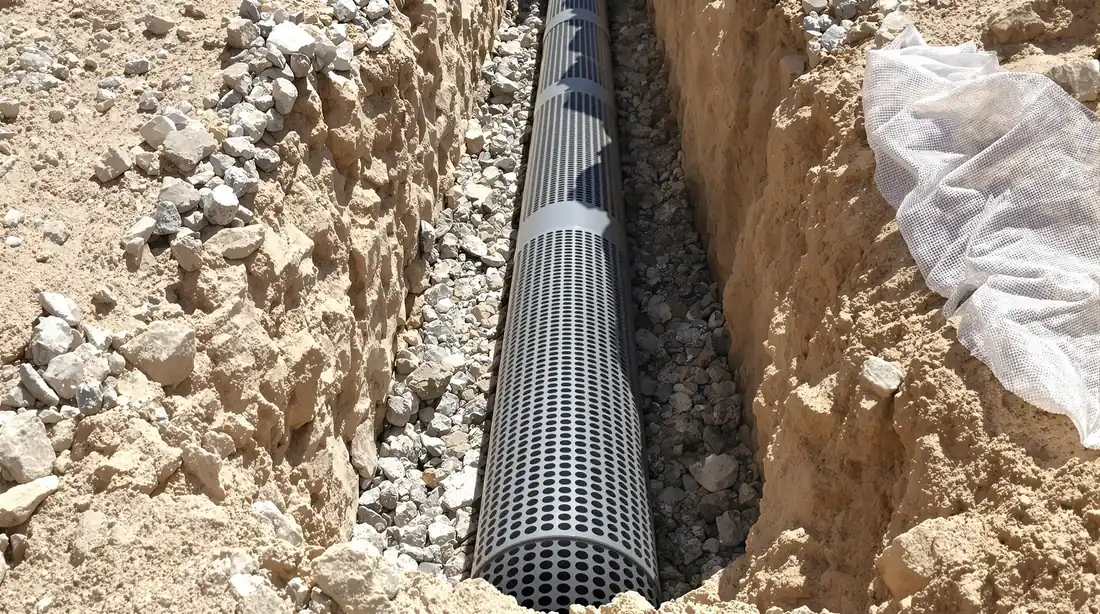
A French drain is a perforated pipe laid in a trench, surrounded by French drain aggregate — clean washed stone large enough to maintain voids that carry water — and wrapped in a geotextile fabric envelope. Water enters the rock envelope, drops through the perforations into the pipe, and flows by gravity to a daylighted discharge or to a storm structure. We install French drains behind retaining walls, along building perimeters at the footing level, under saturated landscape areas, and as sub-surface drainage collection beneath paved areas that sit on poorly draining clay.
The geotextile fabric wrap is what decides whether the drain lasts five years or fifty. Without it, fines from the surrounding clay migrate into the rock envelope, clog the voids, and the drain stops working silently. With it, the fabric filters water in while keeping soil fines out. Discharge daylighting matters too — a French drain that discharges into another saturated area is doing nothing. Swale construction is the open-channel counterpart: a shallow vegetated channel shaped during grading to carry sheet flow across the site to inlets or to a downstream discharge, tightly integrated with the grading scope.
- ▶ Perforated drain pipe installation
- ▶ French drain aggregate envelope
- ▶ Geotextile fabric wrap
- ▶ Daylighted discharge points
- ▶ Swale construction integrated with grading
- ▶ Sub-surface drainage collection
Why Ford Concrete for Storm Drainage
We pour the curb that feeds the catch basin. On a Ford Concrete commercial project the pipe invert elevation at the catch basin inlet box and the gutter line of the curb are set by the same crew, on the same day, to the same laser reference. There is no trade handoff, no mismatched elevation, no water running behind the pavement six months later because two contractors measured from two different benchmarks.
On Amazon's Riverside facility we ran the full storm drainage package — RCP mains, HDPE laterals, precast catch basins, and detention basin outlet structure — alongside the curb, gutter, and warehouse slab work without a single trade handoff. That is why commercial general contractors bring us back: single invoice, single crew, single point of accountability from the rip-rap energy dissipater to the broom-finished slab.
RCP, HDPE & PVC — All Three
Whatever the civil plan specifies, we install it. Reinforced concrete pipe RCP on the mains, HDPE corrugated drainage pipe on the laterals, PVC SDR 35 on the smaller private runs.
Invert Verified Before Backfill
Every pipe invert elevation gets shot against a rotating laser before the trench is closed. No buried mistakes.
Curb & Drainage Same Crew
The concrete crew that pours the curb inlet is the crew that set the catch basin below it. No handoff, no invert mismatch.
Aaron Ford Answers The Phone
Invert questions, schedule changes, and field conditions go directly to the owner.
Storm Drainage on Kansas City Clay
Kansas City's clay soils have very low permeability — storm drainage design here cannot rely on infiltration. That single fact drives every major engineering decision on a KC metro commercial project. Most civil plans specify detention (temporary storage with a controlled release) rather than retention (permanent storage) because a wet pond on impermeable clay will not drain and the standing pool creates more problems than it solves. Storm pipe sizing in the KC metro typically follows the 10-year or 25-year storm frequency depending on jurisdiction, with the 100-year event checked for the emergency overflow weir.
This service connects directly to Ford's existing curb and gutter work — the catch basin inlet box and the concrete curb line share the same elevation benchmark because we pour them as one sequence. For the full clay-soil breakdown by county and bearing capacity detail, see our Kansas City soil conditions guide and the concrete curbs and gutters page for the integrated surface drainage system. This page owns the pipe, structure, and basin scope — those pages own the soil and curb detail.
Our Storm Drainage Process
Six steps. One crew. The first five are where every drainage contractor operates. The sixth is where we keep going and they stop.
Civil Plan Review & Invert Takeoff
We pull every storm structure and pipe run off the civil plan, build an invert elevation takeoff, and flag any conflicts with utility trenching or building footings before we mobilize.
Trench Excavation & Bedding
Trenches are cut to the design depth with a benched or shored sidewall where required. Gravel bedding and haunching are placed so the pipe is supported continuously along its length.
Pipe Installation & Invert Verification
RCP, HDPE, or PVC storm pipe is laid in the trench, joints are sealed, and every invert is shot against the rotating laser before the trench is backfilled.
Catch Basin & Structure Setting
Precast catch basin inlet boxes, manholes, and outlet control structures are set into prepared excavations, grouted to the pipe connections, and leveled to finished grade.
Detention Basin & Outlet Construction
The detention basin bowl is excavated to cross-section, banks are shaped, the outlet control structure is built, and the rip-rap energy dissipater is placed at the discharge point.
Curb, Gutter & Pavement Integration
The same crew that installed the storm drainage builds the curbs and gutters that feed it — no trade handoff, no mismatched inverts, no water running behind the pavement.
This is where most drainage contractors stop. We keep going — same crew, through the pour.
Storm Drainage in Kansas City — FAQs
What is the difference between a detention vs retention basin?
A detention basin holds stormwater temporarily and releases it slowly through a controlled outlet — it empties between storms and sits dry most of the time. A retention basin holds a permanent pool of water. KC metro cities almost always require detention because the clay soils here will not infiltrate a permanent pool, and detention with a sized outlet structure is the cleanest way to meter developed runoff back to pre-development peak flow rates.
When do you use reinforced concrete pipe RCP vs HDPE corrugated drainage pipe?
Reinforced concrete pipe RCP is the choice for large diameter runs, public right-of-way tie-ins, and deep cover applications where the civil engineer wants the mass and the rigidity of concrete. HDPE corrugated drainage pipe — dual-wall smooth-interior — is the dominant material on private commercial storm drainage across the KC metro because it is lighter, joints are water-tight, and cost is competitive at mid-range diameters. PVC SDR 35 is used for smaller private laterals. The engineer of record specifies the material on the civil plan.
What is a catch basin inlet box and how is it different from a plain inlet?
A catch basin inlet box is a precast concrete structure with a sediment sump below the outlet pipe — the sump traps sediment and debris before it reaches the pipe network. A plain inlet box is the same structure without the sump, used where sediment capture is not a priority. Both are set into prepared excavations with pipe stubs cast into the walls at the elevations the civil plan requires, and both get an H-20 traffic-rated frame and grate wherever traffic loads apply.
What is pipe invert elevation and why does it matter?
The pipe invert elevation is the inside bottom of the pipe at a specific station — it is the number the civil engineer uses to size the run and to guarantee the gravity slope drains correctly. If the invert at the upstream catch basin is too low or the invert at the downstream structure is too high, the pipe holds water instead of flowing. We shoot every invert against a rotating laser before the trench gets backfilled, because correcting an invert after the trench is closed means digging it back up.
Can you install French drains and sub-surface drainage?
Yes. A French drain is a perforated pipe laid in a trench, surrounded by French drain aggregate and wrapped in geotextile fabric. We install them behind retaining walls, along building perimeters at the footing level, under saturated landscape areas, and as sub-surface drainage collection beneath paved areas on poorly draining clay. The geotextile fabric wrap is what keeps the drain working long-term — without it, clay fines clog the rock envelope and the drain silently fails.
Why does KC clay favor detention over retention?
Kansas City sits on fat clay soils with very low permeability. A retention basin needs the ground underneath to slowly absorb the permanent pool — and on KC clay, it will not. Detention basins instead hold runoff temporarily behind a controlled outlet structure and release it at a metered rate that matches pre-development peaks. This is why almost every commercial civil plan in the KC metro specifies detention, sized against the 10-year or 25-year storm frequency depending on jurisdiction. For the full soil breakdown see our Kansas City soil conditions guide.
Related Sitework Services
Storm drainage sits inside a larger sitework and concrete sequence. Here is where it connects.
Site Grading
Drainage grading, 2% minimum slope across paved areas, swale shaping, and inlet elevation matching.
Learn more →Concrete Curbs & Gutters
The concrete that collects surface runoff and feeds it into every catch basin we install.
Learn more →Erosion Control
Construction-phase BMPs — silt fence, inlet protection, and wattles — that protect the drainage system during the build.
Learn more →Utility Trenching
Water, sewer, electric, gas, and comms trenching that shares the same excavation equipment and invert discipline.
Learn more →Excavation
Mass and structural excavation — the earthwork that precedes every storm pipe run and detention basin.
Learn more →KC Soil Conditions
The full clay-soil breakdown that drives the detention-over-retention call on every KC metro project.
Learn more →Storm Drainage Service Area
Ready to Start Your Storm Drainage Project?
Commercial pipe runs, catch basin inlet boxes, detention basins, French drain aggregate — we install the full scope and pour the curbs that feed it with the same crew. Call Aaron directly or request a bid.
Ready to Get Started?
From call to concrete — the fastest in KC.
Get a free, no-obligation estimate for your concrete project. We serve the entire Kansas City metro — call (816) 721-1699 or request your estimate online.