Demolition Contractor in Kansas City
Structural demolition, concrete slab removal, foundation demolition, and selective interior demolition across the KC metro — with in-house concrete replacement from the same crew when the job is a tear-out and re-pour.
What Is Demolition?
Definition
Demolition is the controlled removal of an existing structure — walls, floors, frame, slab, and foundation — on a permitted and sequenced plan that protects adjacent property, separates recyclable debris, and leaves a clean pad ready for the next phase of construction.
Demolition is the first move on most redevelopment projects. It sits at the very front of the sitework sequence — before excavation, grading, utility trenching, or concrete. On a typical commercial tear-out the crew walks the building, pulls the demolition permit KCMO (or the equivalent on the Kansas side), coordinates a pre-1980 asbestos survey if the structure age triggers EPA NESHAP, disconnects utilities, and then takes the building down from the top with excavators and hydraulic attachments.
On a Ford Concrete job, demolition is rarely a stand-alone scope. Most of the demolition work we do is bundled with a concrete replacement — a failing slab, a tear-out parking lot, a warehouse floor, a foundation that has to come out before a new one goes in. The advantage of keeping demolition and concrete under the same crew is no re-mobilization between trades and no finger-pointing when the pad is not quite right. Load-out and haul-off ends, and the first form set begins, with the same people on site.
Selective demolition is the other half of the business. Commercial tenant buildouts need interior walls, ceilings, and mechanicals removed without touching the surrounding structure or the neighboring suites. That is a different job than a full building teardown — hand tools, dust containment, and careful scheduling around live tenants. We handle both.
Demolition Capabilities
Four capability blocks — structural demolition, concrete slab and foundation removal, selective interior demolition, and C&D debris recycling — all handled in-house by the same crew that pours your new concrete.
01 — Capability
Structural Demolition
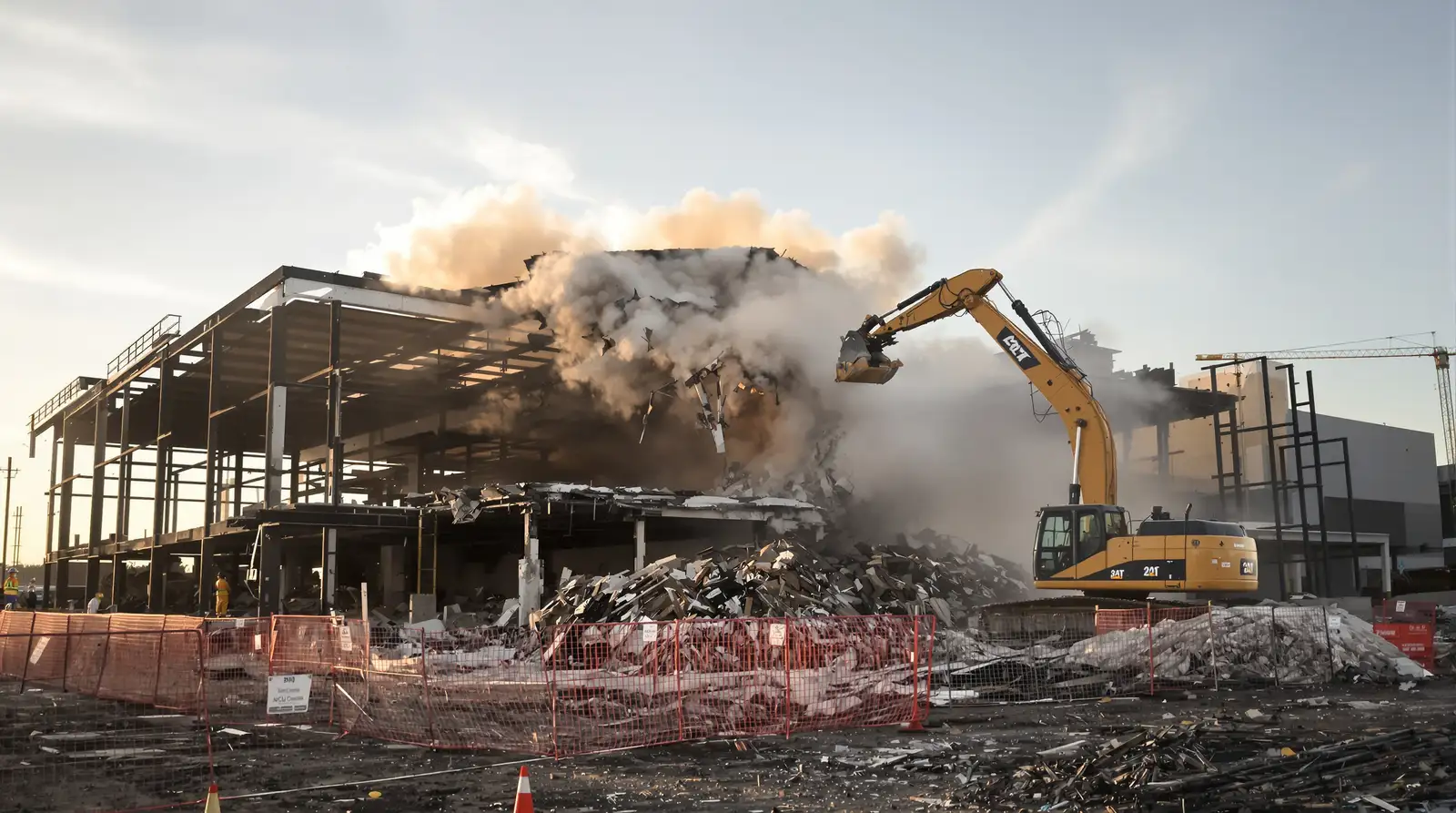
Structural demolition is the full teardown of a building — walls, floors, roof, and frame — under a sequenced plan that keeps the site safe at every stage.
Structural demolition covers full building teardown on both commercial and residential scopes. We run tracked excavators paired with hydraulic shears, grapples, and processors to dismantle steel frames, masonry walls, and wood structures from the top down. Heavy equipment is the right tool for volume — but it only works when the crew knows what has to come down first and what has to stay standing until the last minute.
Safe sequencing is the part most people never see. Load paths are walked before the first bite, utilities are disconnected and capped, hazardous materials are handled before demo starts, and dust and debris control is managed with water trucks and silt fencing throughout the teardown. The goal is a clean building pad ready for the next phase — not a pile to be picked through after the fact.
- ▶ Full building teardown — commercial and residential
- ▶ Commercial structure demolition
- ▶ Residential structure demolition
- ▶ Excavator with shears, grapples, and processors
- ▶ Safe top-down sequencing
- ▶ Dust, debris, and runoff control
02 — Capability
Concrete Slab Removal & Foundation Demolition
Concrete slab removal and foundation demolition is where a demolition contractor either hands off to another trade — or, in our case, pours the replacement.
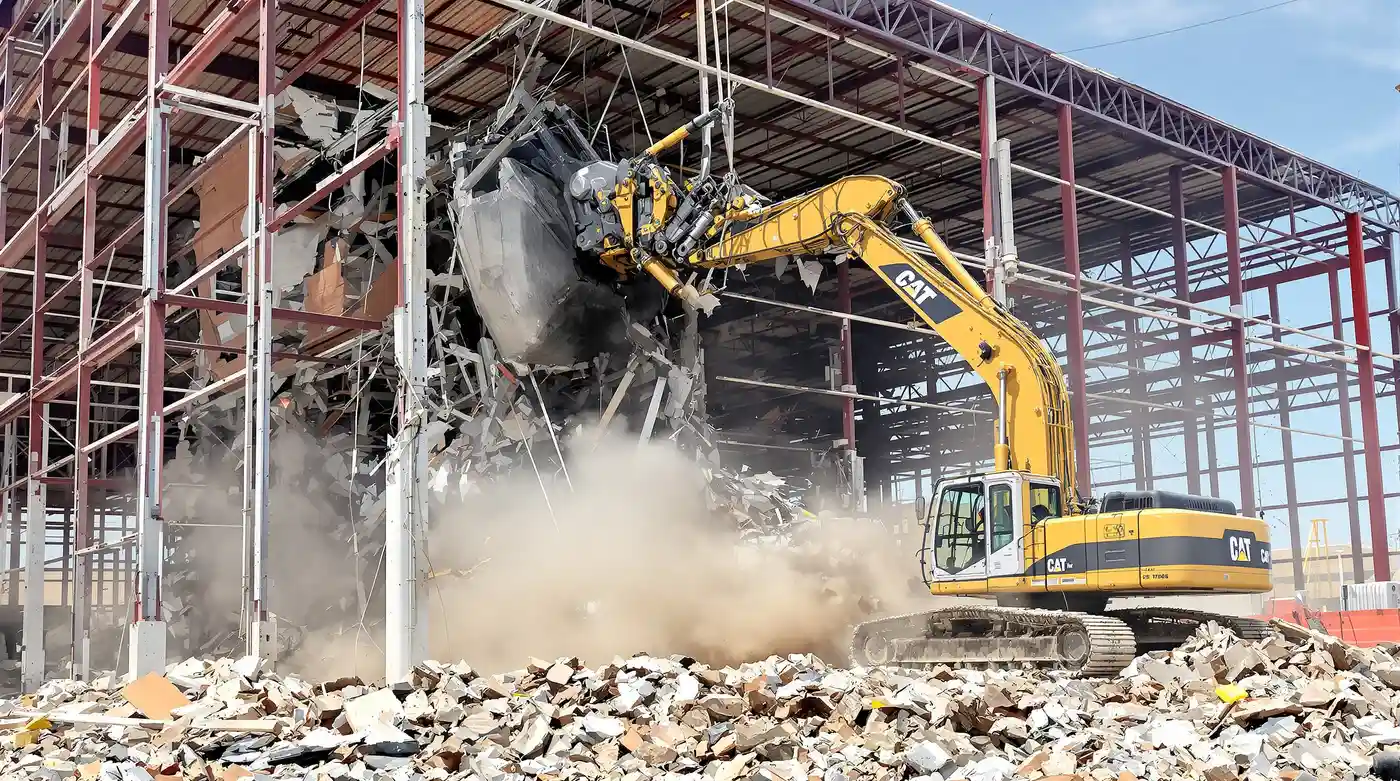
Concrete slab removal starts with sawcutting a clean line so adjacent slabs, curbs, and walkways stay intact. From there we break with hydraulic breakers, separate rebar from broken concrete for recycling, and load out the debris in roll-offs. Foundation demolition runs the same sequence on footings, grade beams, and stem walls — cut, break, separate, haul.
Ford removes the old concrete and pours the new — no sub-contractor handoff. Most slab removal jobs are a step in a larger concrete replacement scope, and on those projects the same crew that breaks out the old pad forms and finishes the new one. No re-mobilization fee, no scheduling gap between demo and pour, no finger-pointing when the sub-grade isn't ready.
- ▶ Sawcutting layout for clean edges
- ▶ Hydraulic breaker work on slabs and footings
- ▶ Rebar cutting and separation
- ▶ Foundation demolition
- ▶ Load-out and haul-off
- ▶ C&D debris recycling where feasible
03 — Capability
Selective Interior Demolition
Selective interior demolition is surgical — the parts we take out are precise, and the parts we leave untouched are protected at every stage.
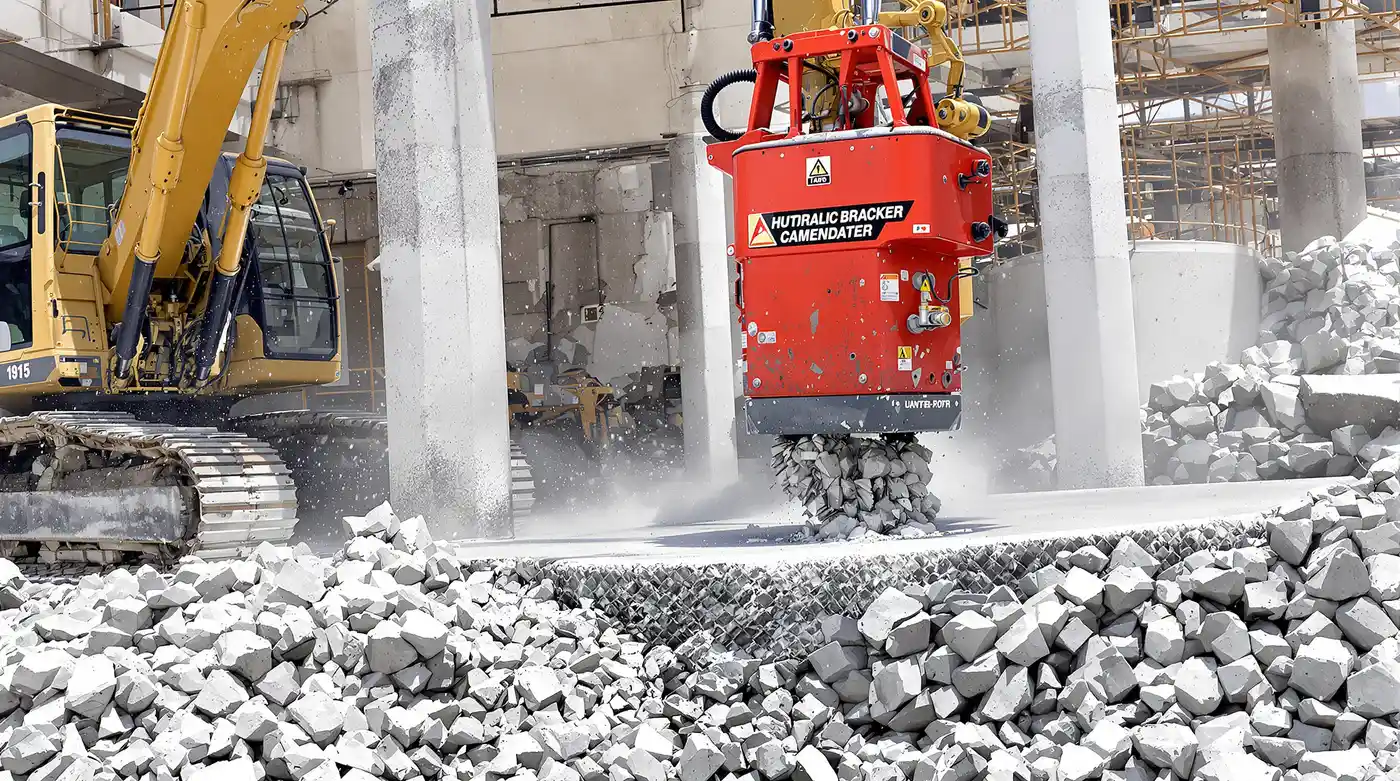
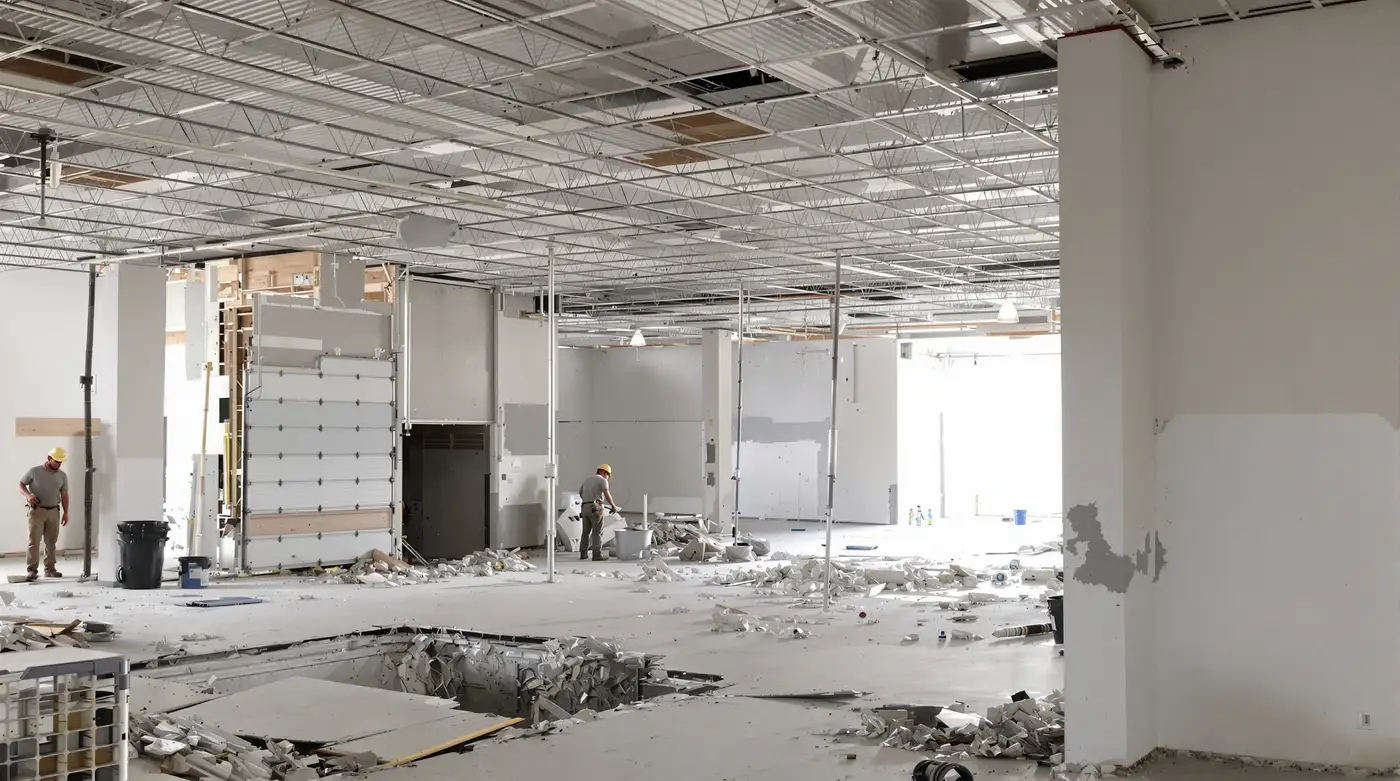
Selective interior demolition is how commercial tenant buildouts get started. We take out ceilings, partition walls, flooring, and mechanical runs while preserving adjacent structural elements, neighboring suites, and any finishes the new tenant is keeping. It is hand-tool work as much as equipment work — pry bars, reciprocating saws, and dust containment are more useful inside an occupied building than a 50,000-pound excavator.
Coordination with adjacent occupants is part of the job. On shopping centers and office buildings with live tenants on either side, we schedule noisy work around business hours, run debris chutes out to roll-offs without crossing neighboring spaces, and protect shared walls, ceilings, and floors with dust containment and hard barriers. The finished product is a clean, square shell ready for a tenant buildout.
- ▶ Selective interior demolition for tenant buildouts
- ▶ Tenant buildout demo prep
- ▶ Adjacent structure protection
- ▶ Dust containment and negative air
- ▶ Debris chute routing to roll-offs
- ▶ Hand-tool precision work
04 — Capability
Debris Management & C&D Recycling
C&D debris recycling is what turns a demolition project from a landfill problem into a material stream — concrete gets crushed, metal gets separated, clean fill gets reused.
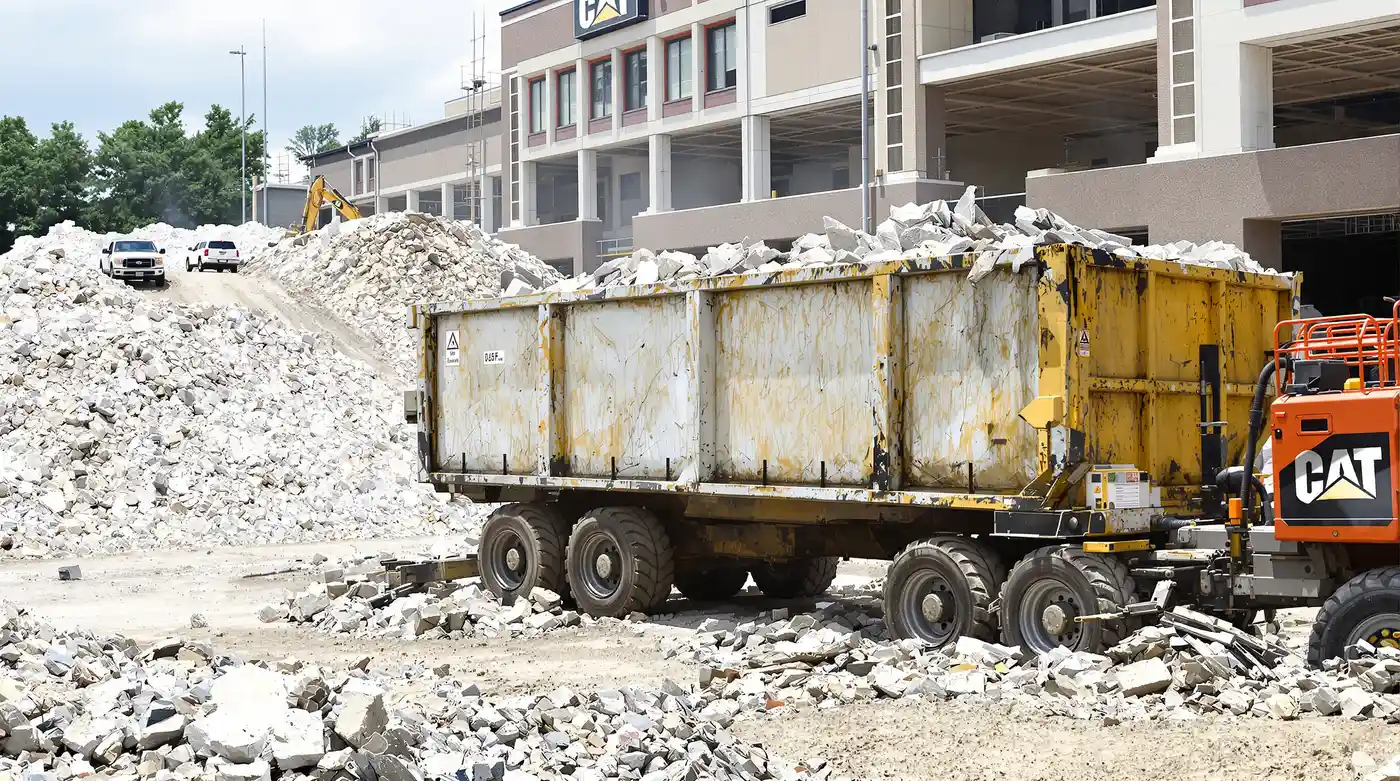
Debris management starts the moment the first wall comes down. Broken concrete is crushed and reused as sub-base material on the same site or hauled to a recycler — keeping it out of the landfill and lowering the disposal cost on the bid. Metal is separated at the pile and sold to scrap processors. Clean fill is stockpiled for reuse on grading. Only mixed, non-recyclable C&D debris ends up in the landfill.
Roll-off container management keeps the site workable. We stage containers near the active tear zone, swap them as they fill, and coordinate landfill and recycler tickets so the general contractor sees an accurate waste stream by category. The result is less volume to the landfill, a lower disposal line item, and a cleaner job site throughout.
- ▶ C&D debris recycling
- ▶ Concrete crushing and on-site reuse
- ▶ Metal separation at the pile
- ▶ Landfill coordination and manifests
- ▶ Clean fill separation and stockpile
- ▶ Roll-off container management
Why Ford Concrete for Demolition
Ford removes the old concrete and pours the new — no sub-contractor handoff. Most demolition contractors load out the debris and leave. We load out the debris and start setting forms. On the Domino's Pizza new construction in Independence, that meant the crew that broke up the existing pad and hauled it away was the same crew that placed the new slab and finished it out. Single mobilization, single invoice, single point of accountability.
That delivery model is the reason general contractors bring us back for tear-out and re-pour work. The coordination gap between demolition and concrete is where most schedules slip and where most finger-pointing starts. We eliminate both by being both trades.
Demo and Concrete, One Crew
No re-mobilization fee between the tear-out and the new pour. Load-out ends and form-setting begins with the same people on site.
Permits and Asbestos Handled
We pull the demolition permit KCMO or the Kansas-side equivalent and coordinate the pre-1980 asbestos survey per EPA NESHAP.
C&D Debris Recycling Default
Concrete crushed and reused, metal separated and sold, clean fill stockpiled. Landfill is the last resort, not the default.
Aaron Ford Answers The Phone
Commercial and residential. Scope changes, schedule conflicts, and field conditions go directly to the owner.
Demolition Permits & Asbestos in Kansas City
KCMO requires a demolition permit for any structural demolition — the application runs through the city's Codes Administration and has to be in hand before a single wall comes down. Any structure built before 1980 requires an asbestos survey pre-demolition under EPA NESHAP regulations, performed by a licensed inspector, with any positive findings abated before demo starts.
The Kansas side varies by city — Overland Park, Olathe, and Lenexa each run their own demolition permit process with slightly different timelines and inspection requirements. We handle the per-city applications as part of the job. For the full breakdown of permit timelines, fees, and jurisdiction rules, see the sitework permits and regulations reference. That page owns the detail — this page sticks to demolition methodology.
Our Demolition Process
Six steps. One crew. The first five are where every demolition contractor operates. The sixth is where we keep going and they stop.
Pre-Demo Site Walk & Permitting
We walk the building with the owner or general contractor, confirm scope, pull the KCMO or Kansas-side demolition permit, and schedule any pre-1980 asbestos survey required under EPA NESHAP before a single wall comes down.
Utility Disconnects & Hazard Abatement
Gas, electric, water, sewer, and comms are confirmed disconnected and capped. Hazardous materials flagged on the survey — asbestos, lead paint, universal waste — are abated by licensed specialists before demo starts.
Soft Strip & Selective Removal
Interior finishes, salvageable fixtures, and anything worth recycling or reusing are pulled before the structure comes down. On tenant buildouts this is where selective interior demolition happens.
Structural Teardown
Excavators with shears and breakers take the building down in a planned top-down sequence. Dust is controlled with water trucks, debris is kept inside the work zone, and load paths are monitored as the frame comes apart.
Slab & Foundation Breakout
Once the building is down, hydraulic breakers remove the concrete slab and foundation. Rebar is cut and separated. Broken concrete is staged for crushing or haul-off under the C&D debris recycling plan.
Site Clean, Grade, and Hand-Off to Concrete
The pad is cleaned to bare soil, rough-graded, and either handed to excavation for new construction or turned directly over to our concrete crew for forming and pour. Same crew, same invoice, no gap between demo and new slab.
This is where most demolition contractors stop. We keep going — same crew, through the new pour.
Demolition in Kansas City — FAQs
Do I need a demolition permit KCMO to tear down a commercial building?
Yes. A demolition permit KCMO is required for any structural demolition inside Kansas City, Missouri — the application runs through the city's Codes Administration. We pull the permit as part of the job. On the Kansas side, Overland Park, Olathe, and Lenexa each have their own demolition permit process, and we handle those per-city applications the same way. See our sitework permits and regulations page for the full detail.
When is an asbestos survey pre-demolition required?
Any structure built before 1980 requires an asbestos survey pre-demolition under EPA NESHAP regulations before a demo permit can be issued. The survey is performed by a licensed inspector and any positive findings are abated by a licensed asbestos contractor before we start tearing the building down. We coordinate the survey and abatement schedule into the overall demolition timeline so permitting does not stall the project.
What is the difference between structural demolition and selective interior demolition?
Structural demolition is full building teardown — walls, floors, frame, and foundation all come down. Selective interior demolition is precision removal of interior finishes, partition walls, ceilings, and mechanicals while the surrounding structure and adjacent occupied spaces are preserved. Structural demo is an excavator job. Selective interior demo is a hand-tool and small-equipment job with dust containment and protection of everything around it. We do both.
What happens to the concrete after slab removal?
Concrete slab removal produces broken slab and separated rebar. Under a C&D debris recycling plan, the concrete is crushed — either on site or at a regional recycler — and reused as sub-base material. Rebar is separated at the pile and sold to a scrap processor. Only mixed, non-recyclable debris goes to the landfill. This is standard on every Ford Concrete demolition scope and it lowers the disposal cost on the bid.
Can Ford Concrete pour new concrete after the demolition?
Yes — that is the point. Ford removes the old concrete and pours the new with the same crew. Most of our demolition work is tied to a concrete replacement scope — a failing slab, a tear-out parking lot, a warehouse floor replacement — and on those projects there is no sub-contractor handoff between the demo crew and the concrete crew. Single invoice, single point of accountability, no gap between load-out and haul-off and the first form set.
How is dust and runoff controlled on an active demolition site?
Dust is controlled with water trucks spraying the active tear zone throughout the day, silt fencing and perimeter berming catch runoff, and debris is kept inside the work zone until it is loaded out. On sites adjacent to occupied buildings we add hard barriers and negative air containment for any interior work. KCMO and Kansas-side jurisdictions both have nuisance dust rules and stormwater requirements we build into the permit and the site plan from day one.
Related Sitework & Concrete Services
Demolition sits at the front of the sitework sequence. Here is where it connects.
Excavation
Post-demo excavation, structural excavation, and rock ripping for new foundations on the cleared pad.
Learn more →Site Grading
Laser-guided rough and fine grading of the cleared site once demolition is complete.
Learn more →Land Clearing
Brush removal, tree felling, and stump grinding — usually sequenced alongside demolition on greenfield expansion work.
Learn more →Erosion Control
Silt fencing, perimeter berms, and SWPPP compliance for active demolition and construction sites.
Learn more →Concrete Repair
Targeted repair and resurfacing — the alternative to full slab removal when damage is localized.
Learn more →Commercial Parking Lots
New parking lot construction, formed and poured by the same crew that removed the old slab.
Learn more →Warehouse & Industrial Floors
Heavy commercial slab replacement — demolition and new pour on the same mobilization.
Learn more →Demolition Service Area
Ready to Start Your Demolition Project?
Full teardown, slab removal, or selective interior — we demo it, haul it, and pour the new concrete with the same crew. Call Aaron directly or request a bid.
Ready to Get Started?
From call to concrete — the fastest in KC.
Get a free, no-obligation estimate for your concrete project. We serve the entire Kansas City metro — call (816) 721-1699 or request your estimate online.