Excavation Contractor in Kansas City
Mass excavation, structural and precision excavation, limestone rock work, and compacted structural fill placement across the KC metro — priced in bank cubic yards, verified by nuclear density gauge, and followed by in-house concrete construction from the same crew.
What Is Excavation?
Definition
Excavation is the physical removal and placement of earth to bring a commercial site to the elevations, bearing capacity, and drainage the structural drawings require — cut in bank cubic yards, hauled in loose cubic yards, and verified by nuclear density gauge when the fill goes back in.
Excavation sits at the front of the sitework sequence. It comes after land clearing has stripped vegetation and demolition has removed existing structures, and before grading, utility trenching, and concrete construction can begin. On a typical Kansas City commercial project, mass excavation runs the first weeks of the job, structural excavation for footings and foundations follows immediately, and the final backfill and compaction pass is what the grading crew takes over from. Every trade downstream — grading, utilities, concrete, MEP — is sitting on the excavation and fill we place.
When excavation is done poorly, everything downstream pays for it. A missed lift on structural fill placement cracks a slab a year later. A footing cut into soft bearing soil settles differentially and pulls a wall out of plumb. A spoils hauling estimate that ignored swell factor clay soil comes in twenty percent short on the haul ticket. We have spent eleven years in the Kansas City metro running excavation on projects from a single residential footing to Amazon-scale mass earthwork in Riverside, and the conclusion is the same every time — the hole decides what the finished building is worth.
Excavation Capabilities
Four capability blocks — mass excavation, structural and precision work, rock excavation, and backfill with compaction — all handled in-house by the same crew that pours the concrete that sits on top.
01 — Capability
Mass Excavation — Bank Cubic Yards vs Loose Cubic Yards
Mass excavation is bulk earth movement priced in bank cubic yards but hauled in loose cubic yards — and on Kansas City clay the gap between those two numbers decides whether your bid was accurate or short.
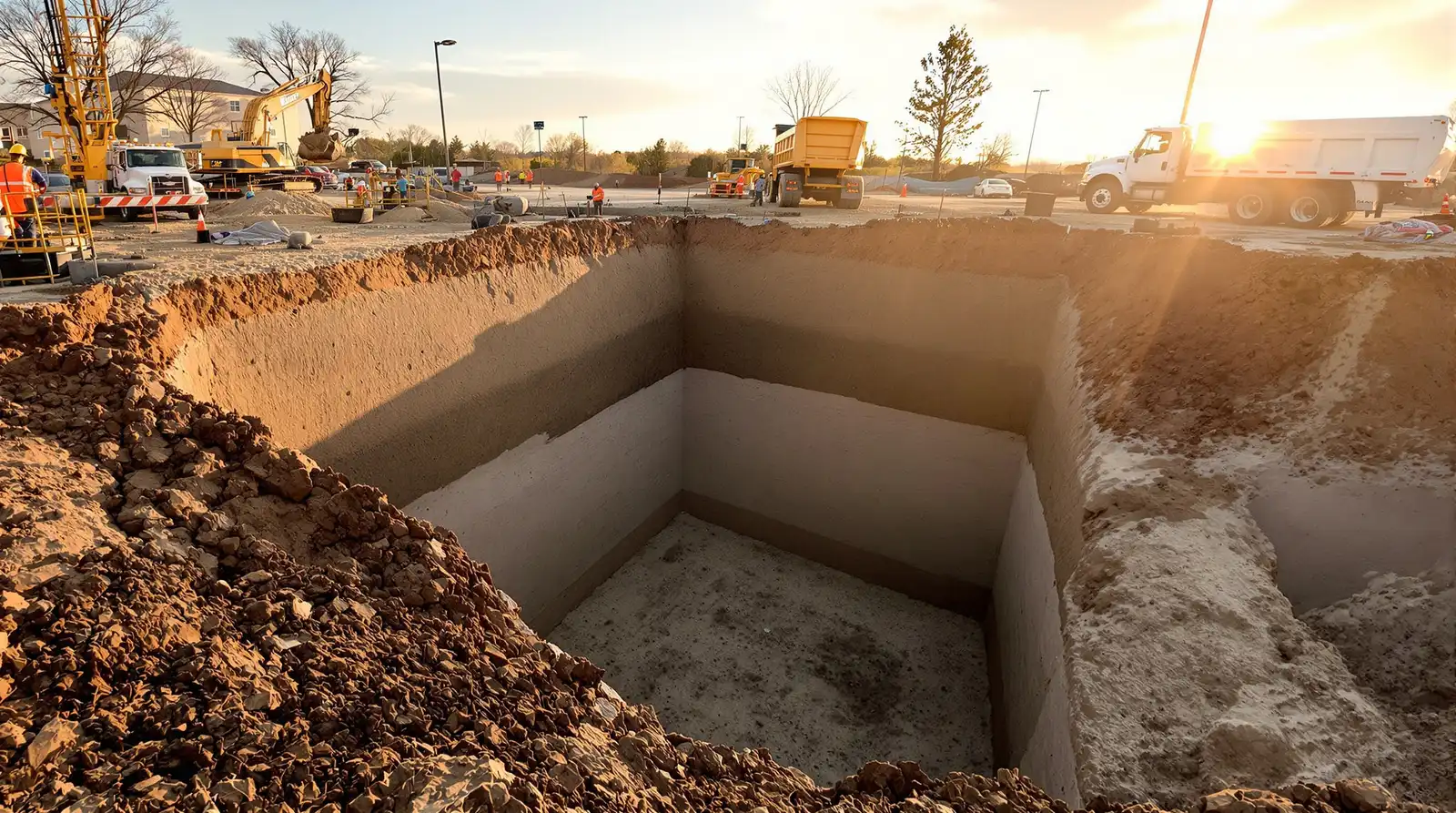
Mass excavation is where a commercial pad stops being a drawing and becomes an open hole. Dozers strip topsoil, tracked excavators cut bulk volumes of earth, and a fleet of dump trucks runs the spoils hauling rotation on a planned haul route. On a 5-acre Kansas City commercial site that can mean moving tens of thousands of cubic yards of dirt before anything resembles a building pad. Cut and fill are balanced against the civil model — every cubic yard we can keep on-site as structural fill is a cubic yard we are not paying to truck to a permitted spoils site.
Haul route optimization is its own discipline. The wrong route chews up the part of the site already shaped, blocks delivery access for other trades, or runs trucks past a neighboring business that will call the city by the end of the week. We plan the route before the first bucket hits the ground, stage import and export stockpiles on the parts of the site that come last in the schedule, and keep the import/export balance as close to zero as the civil design allows.
- ▶ Mass earth movement with tracked excavators and dozers
- ▶ Bulk cut and fill to civil model
- ▶ Large commercial building pad excavation
- ▶ Spoils hauling and permitted disposal
- ▶ Haul route optimization and staging
- ▶ Import/export balance against civil design
02 — Capability
Structural & Precision Excavation — Over-Excavation Poor Bearing Soil
Precision structural excavation is footing, foundation, and utility corridor work held to tight tolerances — with over-excavation poor bearing soil called the moment the bucket finds it.
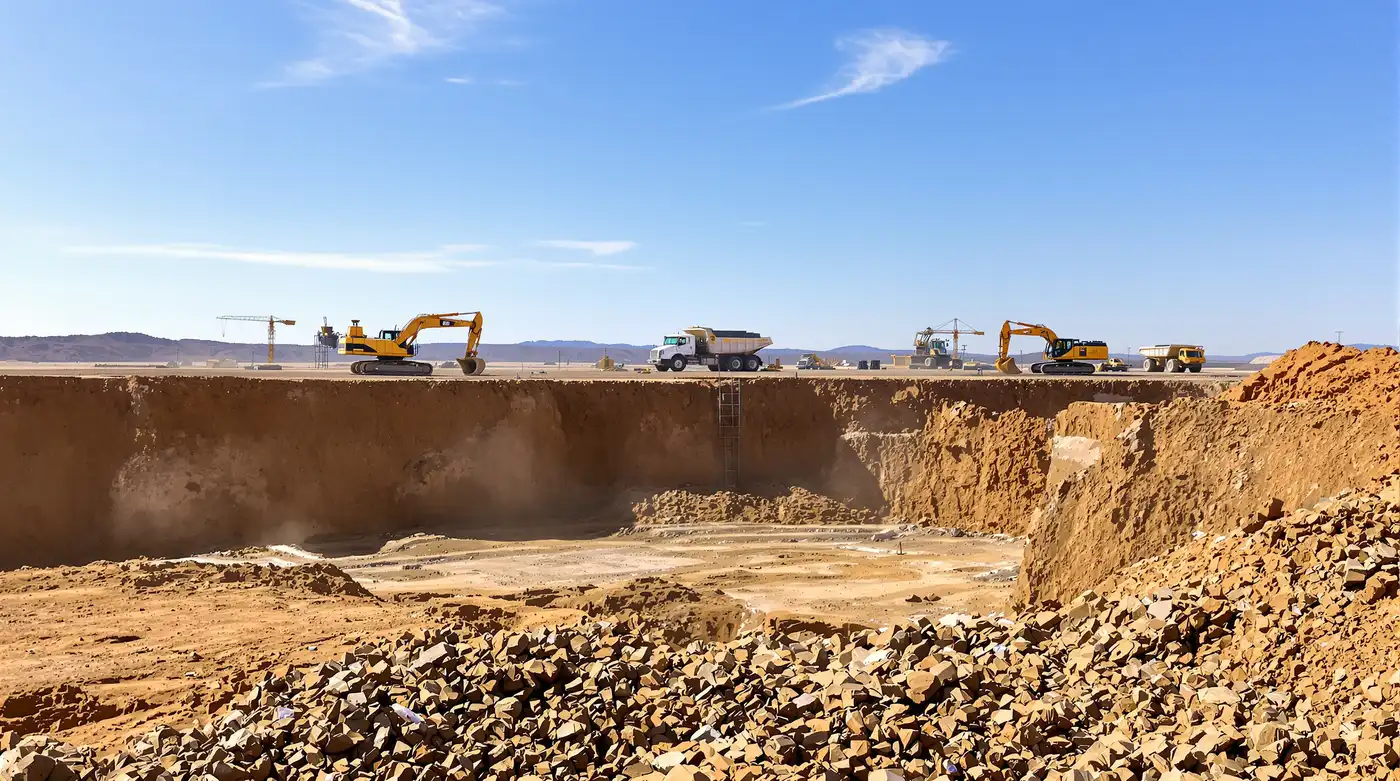
Structural excavation is the opposite discipline of mass work. Instead of moving bulk volumes, we are cutting precise geometry — footing trenches, foundation pits, pile caps, and utility corridors — directly from the structural drawings. Over-dig has to be minimized because every extra inch of width means extra concrete on the pour and extra backfill on the close-out. We dig to the specified bearing elevation, check the exposed subgrade against the geotech report, and stop the moment the conditions stop matching the plan.
When the bucket finds soft clay, organic material, saturated old fill, or anything else that cannot carry the structural load, we over-excavate the poor bearing soil and replace it with compacted structural fill before the footing gets formed. On Kansas City clay that decision gets made under a Type C soil competent person who has classified the excavation at the start of the shift — wet KC clay is frequently Type C and requires flatter slopes or full trench box shoring before any worker enters. Because Ford Concrete is also the concrete crew, the over-excavation call happens in the same conversation that pours the footing — no RFI, no three-day wait, no re-mobilization charge.
- ▶ Footing and foundation excavation
- ▶ Utility corridor excavation
- ▶ Over-excavation poor bearing soil
- ▶ Tight tolerance digging from structural drawings
- ▶ Type C soil competent person compliance
- ▶ Trench box shoring at 5 ft and deeper
03 — Capability
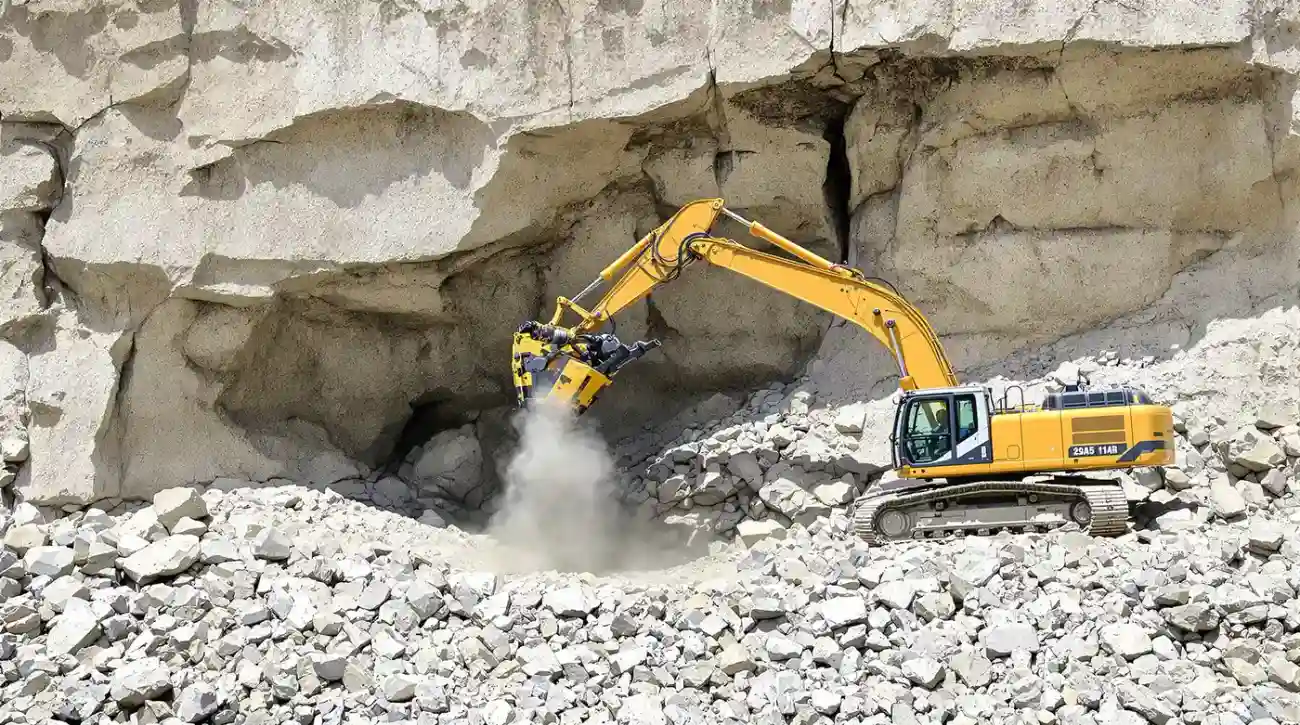
Rock Excavation — Limestone Ripping in Southern Johnson County
Rock excavation is a different job from common excavation — production rates drop to a fraction of soil digging, and it has to be priced as a separate unit before the bucket ever touches the ledge.
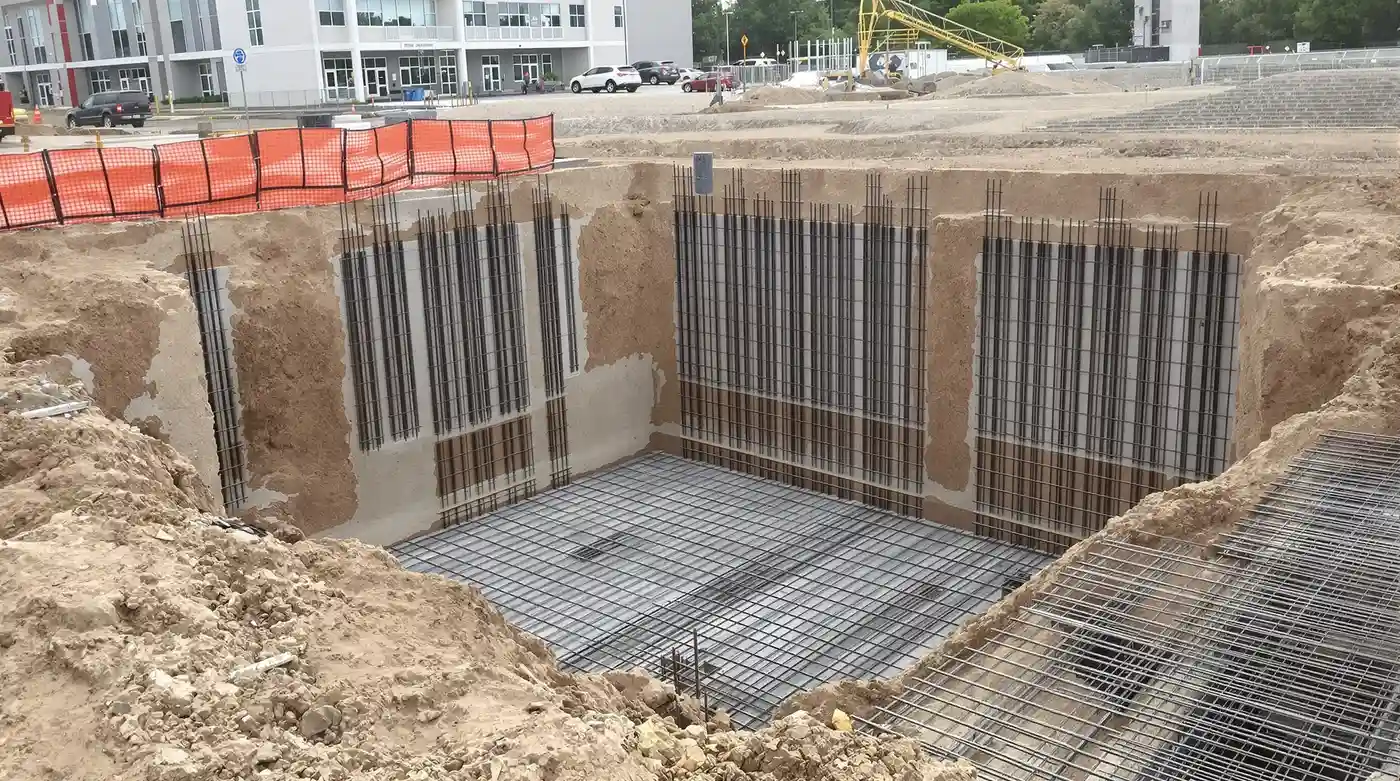
Southern Johnson County — Olathe, Gardner, Spring Hill, and parts of Stilwell — sits on shallow limestone bedrock that surfaces anywhere from 3 to 8 feet below grade. Parts of eastern Jackson County show the same ledge. When a commercial excavation hits rock, the production rate collapses and the equipment requirement changes overnight. We mount a hydraulic breaker attachment to an excavator and rip the fractured limestone, chip the harder shelves, and haul the broken rock off as a separate load from common spoils.
Rock is always priced as a unit — dollars per cubic yard of rock excavation, not a lump sum — so the general contractor is not exposed to an unknown and we are not gambling on production rates. We pull any existing geotech borings before bidding, inspect the site when rock is suspected, and flag trench rock removal separately when a utility line has to punch through a ledge. For the soil map that predicts where rock shows up across the metro, see the Kansas City soil conditions guide.
- ▶ Hydraulic breaker work on limestone ledges
- ▶ Limestone ripping in southern Johnson County
- ▶ Rock chipping on harder shelves
- ▶ Rock haul-off priced separately from spoils
- ▶ Southern Johnson County bedrock expertise
- ▶ Trench rock removal for utility corridors
04 — Capability
Backfill & Compaction — Structural Fill Placement and Nuclear Density Gauge Testing
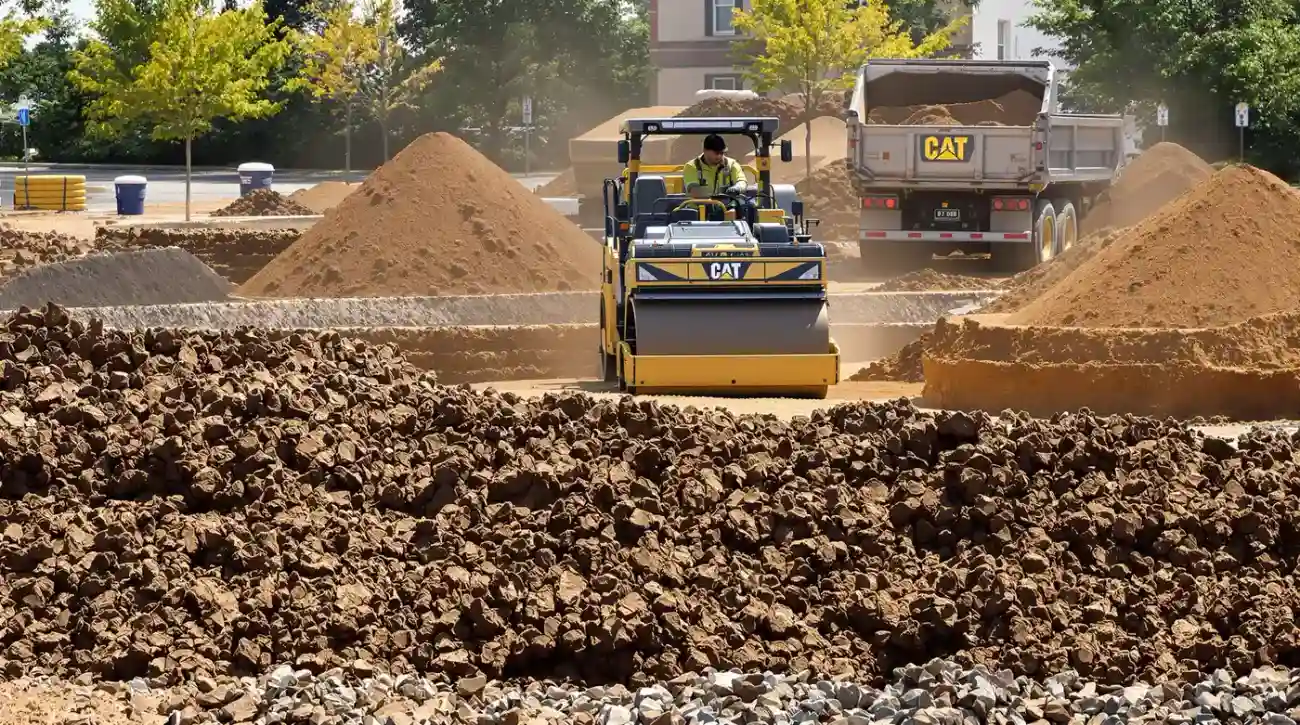
Structural fill placement is where most excavation jobs quietly fail — lifts go in too thick, moisture is wrong, and the nuclear density gauge never comes out until the slab has already cracked.
Backfill is the half of excavation nobody gets credit for. A commercial project depends on it because every foundation, slab, parking lot, and utility corridor is sitting on fill that somebody placed, conditioned, and compacted. On a Ford Concrete project, structural fill placement happens in controlled lifts — 6 to 8 inch lift heights for cohesive clay, up to 12 inches for granular material — with moisture conditioning between lifts to hold the fill within 2% of optimum moisture before the roller ever makes a pass.
Proctor testing is how compaction is actually verified on this page — and this is the Ford Concrete page that owns the explanation. A modified proctor test is a laboratory procedure that determines the maximum dry density a given soil can reach at an ideal moisture content. The field target on a Kansas City commercial project is 95% of that laboratory maximum, held within 2% of optimum moisture. We verify in-place density with a nuclear density gauge, which reads moisture and compaction at each lift in real time. Results are recorded, turned over to the general contractor or the geotech of record, and filed before the next lift goes in. A single missed lift under a building pad can cause differential settlement that cracks the slab within a year — so we do not miss lifts, and we do not let trench box shoring backfill go in uncompacted behind the box as it pulls out.
- ▶ Structural fill placement in 8-inch lifts
- ▶ Moisture conditioning to optimum
- ▶ 95% modified proctor density target
- ▶ Nuclear density gauge in-place testing
- ▶ Trench box shoring backfill compaction
- ▶ Documented test results to geotech of record
Why Ford Concrete for Excavation
We pour the concrete that sits on the fill. That single fact changes every excavation decision we make. An excavator who will never see the finished slab has no reason to obsess over a lift that is 30 minutes past optimum moisture or a soft spot in the corner of a pad. We do — because the crew that hauls the last load of spoils is the same crew that forms and pours the foundation above it.
On Amazon's Riverside facility we ran the full sitework package from mass excavation through finished warehouse slab without a single trade handoff between the excavator and the concrete contractor. Same crew, same invoice, same point of accountability from raw ground to broom finish. That is not the normal Kansas City delivery model, and it is exactly why commercial general contractors bring us back on the next job.
Nuclear Density Gauge On Every Lift
Compaction is verified in real time at each lift, not estimated from the number of roller passes. Results go to the geotech of record before the next lift goes in.
Competent Person On Every Shift
A Type C soil competent person classifies every excavation 5 feet or deeper before anyone enters. No shortcuts on trench box shoring.
Same Crew Through The Pour
No trade handoff between the excavator and the concrete contractor. Over-excavation decisions happen in the same conversation that pours the footing.
Aaron Ford Answers The Phone
Commercial and residential. Bid questions, haul logistics, and field conditions go directly to the owner.
Excavating Kansas City Clay and Limestone
Kansas City clay swells 25 to 35 percent when excavated — a 5,000 bank cubic yard cut generates 6,250 to 6,750 loose cubic yards of material once it is on the trucks. Haul pricing that ignores that swell factor clay soil number comes in short on every job. Limestone bedrock in southern Johnson County — Olathe, Gardner, Spring Hill — starts showing up anywhere from 3 to 8 feet below grade and has to be priced as rock, not common excavation.
For the full soil breakdown by county, bearing capacity ranges, and county-level soil behavior, see the Kansas City soil conditions guide. For permit thresholds, grading permits, and stormwater compliance across MO and KS jurisdictions, see the sitework permits and regulations reference. Both pages own that detail — this page sticks to excavation methodology.
Our Excavation Process
Six steps. One crew. The first five are where every excavation contractor operates. The sixth is where we keep going and they stop.
Site Assessment & Geotech Review
We walk the site with the general contractor, pull any existing geotech borings, and flag probable rock zones, soft bearing soil, and groundwater before the first bucket hits the ground.
Topsoil Strip & Stockpile
Topsoil is stripped off the active work footprint and stockpiled for reuse on final landscaping, not hauled off and re-imported at the end of the project.
Mass Excavation & Spoils Hauling
Bulk cut and fill is run against the civil model. Cut-side spoils are hauled off under a planned route or redirected to fill-side stockpiles so the import/export balance stays tight.
Structural Excavation & Bearing Check
Footings, foundations, and utility corridors are cut to the structural drawings. A Type C soil competent person classifies the excavation and over-excavation poor bearing soil is called when conditions require it.
Structural Fill Placement & Density Verification
Structural fill goes in at 8-inch lift heights with moisture conditioning, compacted to 95% modified proctor, and verified with a nuclear density gauge before the next lift is approved.
Handoff to Grading & Foundation Pour
The finished excavation and backfill is turned directly over to the same crew for fine grading and foundation forming — no trade handoff, no re-mobilization, no coordination gap between the excavator and the concrete contractor because we are both.
This is where most excavation contractors stop. We keep going — same crew, through the pour.
Excavation in Kansas City — FAQs
What is the difference between bank cubic yards and loose cubic yards on a Kansas City clay site?
Bank cubic yards (BCY) measure dirt while it is still undisturbed in the ground. Loose cubic yards (LCY) measure the same dirt after it has been excavated and dumped into a truck. On Kansas City clay, the swell factor clay soil runs roughly 25 to 35 percent — a 5,000 BCY cut becomes 6,250 to 6,750 LCY on the trucks. We price the excavation in bank cubic yards and the hauling in loose cubic yards so the bid reflects the real volume on both sides of the ledger. Eleven years of KC clay work has calibrated those numbers to what actually shows up on the haul tickets.
How does proctor testing and nuclear density gauge verification actually work?
A modified proctor test is a laboratory procedure that determines the maximum dry density a specific soil can reach at its optimum moisture content. That lab number becomes the field target — typically 95% of modified proctor on Kansas City commercial work, held within 2% of optimum moisture. In the field, we verify in-place density with a nuclear density gauge, which sends a neutron source into the fill and reads both density and moisture content in a few minutes at each lift. If the gauge reads short, we re-roll the lift or adjust the moisture before the next lift goes in. Results are documented and filed with the geotech of record. This is the page Ford Concrete owns proctor testing explanation on — our grading page links here for the full mechanics.
When is over-excavation poor bearing soil required?
Over-excavation is called when the bearing soil exposed at footing depth cannot meet the required compaction or bearing capacity. On a commercial pad, if the bucket finds soft clay, organic material, or saturated undocumented fill, we excavate below design grade and replace the unsuitable material with compacted structural fill. This is common on KC projects because Wymore-Ladoga clay is a high shrink-swell soil and old sites often have buried fill that is not in the geotech report. Because Ford Concrete is also the concrete contractor, the over-excavation decision happens in the same conversation that pours the footing.
How deep can you excavate without shoring?
OSHA 29 CFR 1926 Subpart P requires a protective system — trench box shoring, sloping, or a benched system — for any excavation 5 feet or deeper where workers will enter. A Type C soil competent person on our crew classifies the soil at the start of each shift and inspects the excavation before anyone enters. Wet Kansas City clay is frequently Type C and requires flatter slopes or full trench box shoring. Dry cohesive clay can sometimes be Type B. The classification is not a guess — it is made by the competent person on the ground that day.
Can you handle limestone rock excavation in Olathe, Gardner, and Spring Hill?
Yes. Southern Johnson County has shallow limestone bedrock that shows up during most commercial excavations in Olathe, Gardner, Spring Hill, and parts of Stilwell. Depending on the hardness and fracture pattern, we rip it with a hydraulic breaker attachment or chip the harder shelves. Rock is always priced separately from common excavation as a unit — dollars per cubic yard of rock — because the production rate drops to a fraction of soil digging. We pull existing geotech borings before bidding and inspect the site whenever rock is suspected.
What happens to the spoils you haul off the site?
Spoils hauling is included in the excavation bid. Clean soil may be reused as structural fill elsewhere on the project, stockpiled for final landscaping, or hauled to a permitted disposal site. Contaminated material or unsuitable fill goes to a landfill that accepts it. We track haul tickets for every load so the cubic yardage and destination are documented for the general contractor.
Related Sitework Services
Excavation sits at the front of a larger sitework sequence. Here is where it connects.
Site Grading
Laser-guided rough and fine grading that takes over where excavation finishes — same crew, no re-mobilization.
Learn more →Utility Trenching
Water, sewer, gas, electric, and communications trenching with bedding, haunching, and trench box shoring.
Learn more →Land Clearing
Brush removal, tree felling, stump grinding, and topsoil stockpiling before the first excavation cut is made.
Learn more →Demolition
Structure and slab demolition ahead of excavation — foundations, pads, and existing infrastructure removed cleanly.
Learn more →Commercial Parking Lots
The concrete that sits on every sub-base we excavate and backfill — formed and poured by the same crew.
Learn more →Warehouse Floors
Heavy commercial slab work that depends on documented structural fill placement to perform for decades.
Learn more →Retaining Walls
Over-dig and poorly compacted backfill are the leading cause of retaining wall failure — we handle both correctly.
Learn more →Excavation Service Area
Ready to Start Your Excavation Project?
Commercial or residential, one footing or fifty acres — we excavate it, backfill it, and pour the concrete with the same crew. Call Aaron directly or request a bid.
Ready to Get Started?
From call to concrete — the fastest in KC.
Get a free, no-obligation estimate for your concrete project. We serve the entire Kansas City metro — call (816) 721-1699 or request your estimate online.