Site Grading Contractor in Kansas City
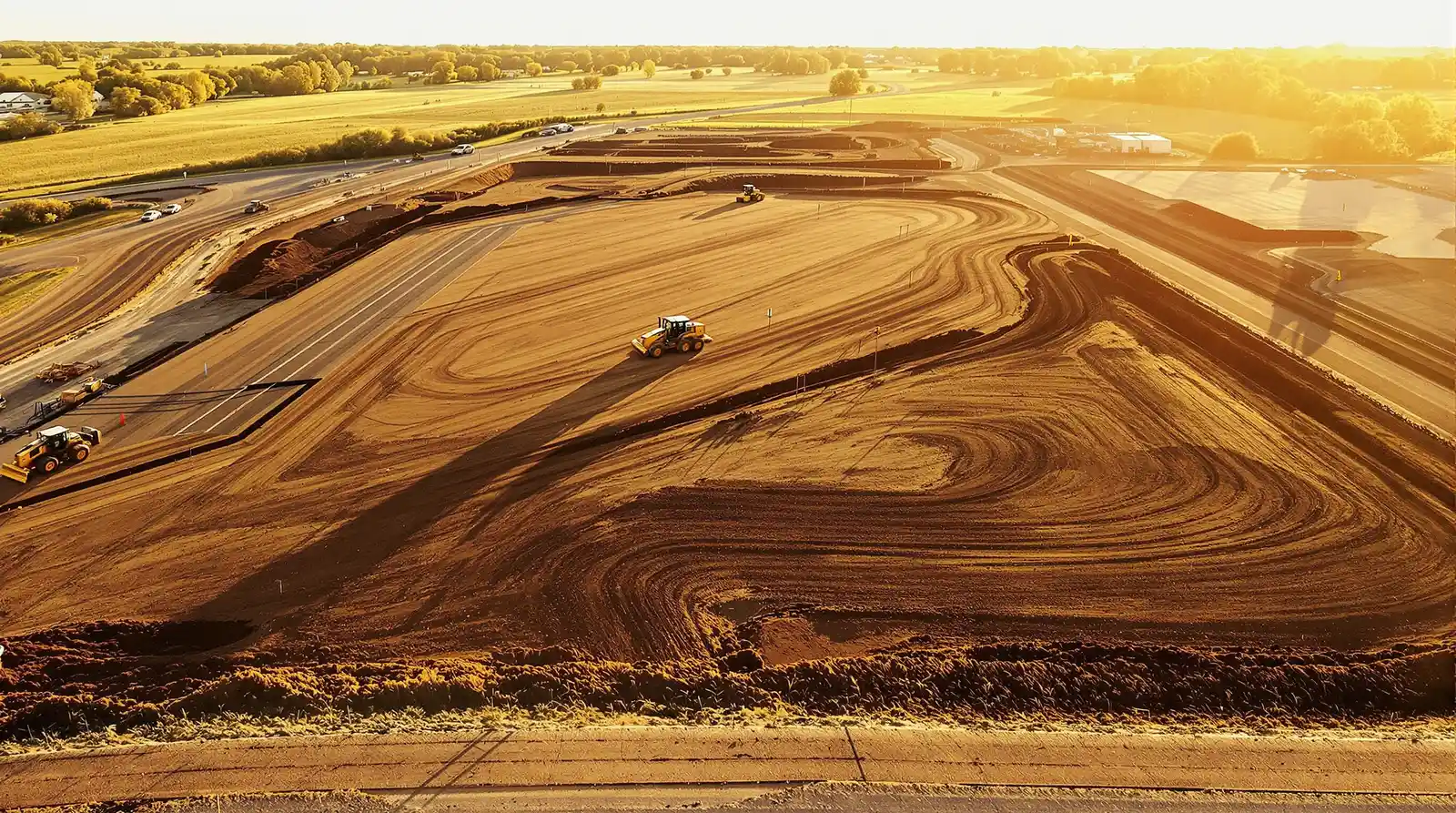
Laser-guided rough and fine grading, drainage grading, and building pad sub-grade preparation for commercial and residential projects across the KC metro — followed by in-house concrete construction from the same crew.
What Is Site Grading?
Definition
Site grading is the discipline of shaping raw or rough-cut ground to the exact elevations a civil plan calls for — establishing building pad elevation, cross-slope tolerance, and 2% minimum slope drainage so every structure, pavement, and drainage feature built on top performs for the life of the project.
Grading sits in the middle of the sitework sequence. It comes after land clearing and mass excavation have stripped vegetation and moved bulk volumes of earth, and before utility trenching, sub-base placement, and concrete construction can begin. On a typical commercial project, rough grading starts once the site is cleared and rough-cut, fine grading happens once drainage and utilities are roughed in, and the final sub-grade pass is the last thing that happens before forms go down.
When grading is done poorly, every trade downstream pays for it. Building pad elevation that drifts an inch high throws off finished floor elevations across an entire slab. Cross-slope tolerance missed by half a percent creates ponding that rots pavement from underneath. Sub-grade preparation that skipped proof rolling hides soft zones that show up as cracks the first winter. We have spent eleven years in the Kansas City metro fixing the downstream consequences of bad grading, and the conclusion is always the same — the grade decides everything that follows.
Grading Capabilities
Four capability blocks — rough grading, laser-guided fine grading, drainage grading, and sub-grade preparation — all handled in-house by the same crew that pours your concrete.
01 — Capability
Rough Grading
Rough grading is where thousands of cubic yards of dirt become the first recognizable shape of a commercial site.
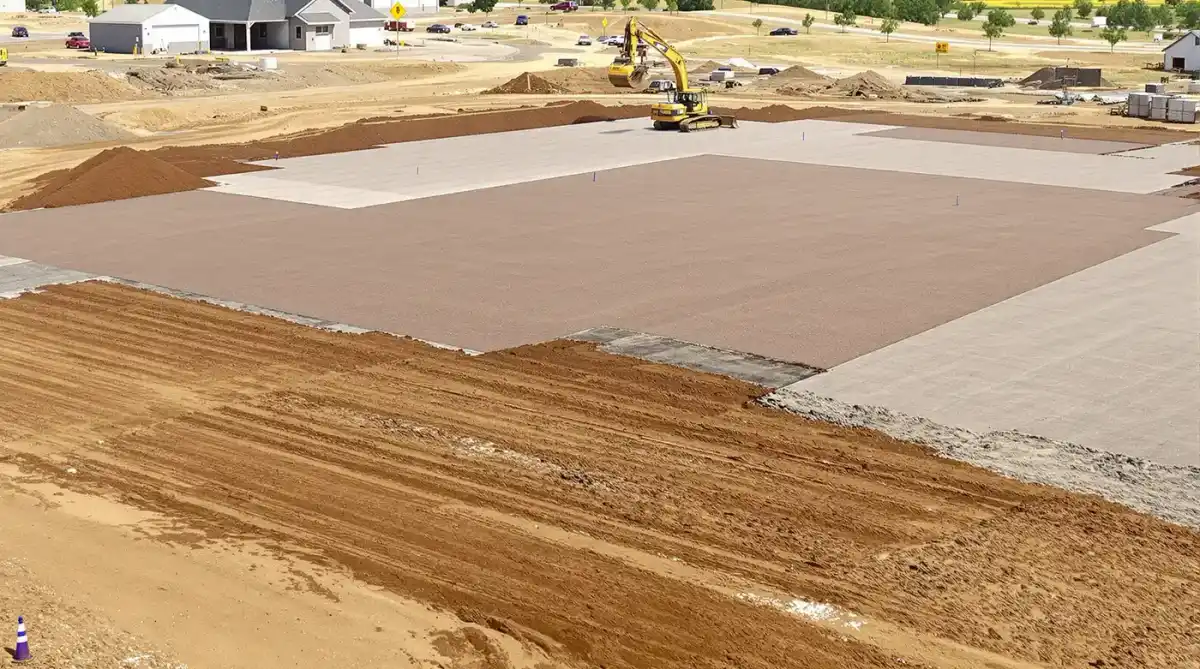
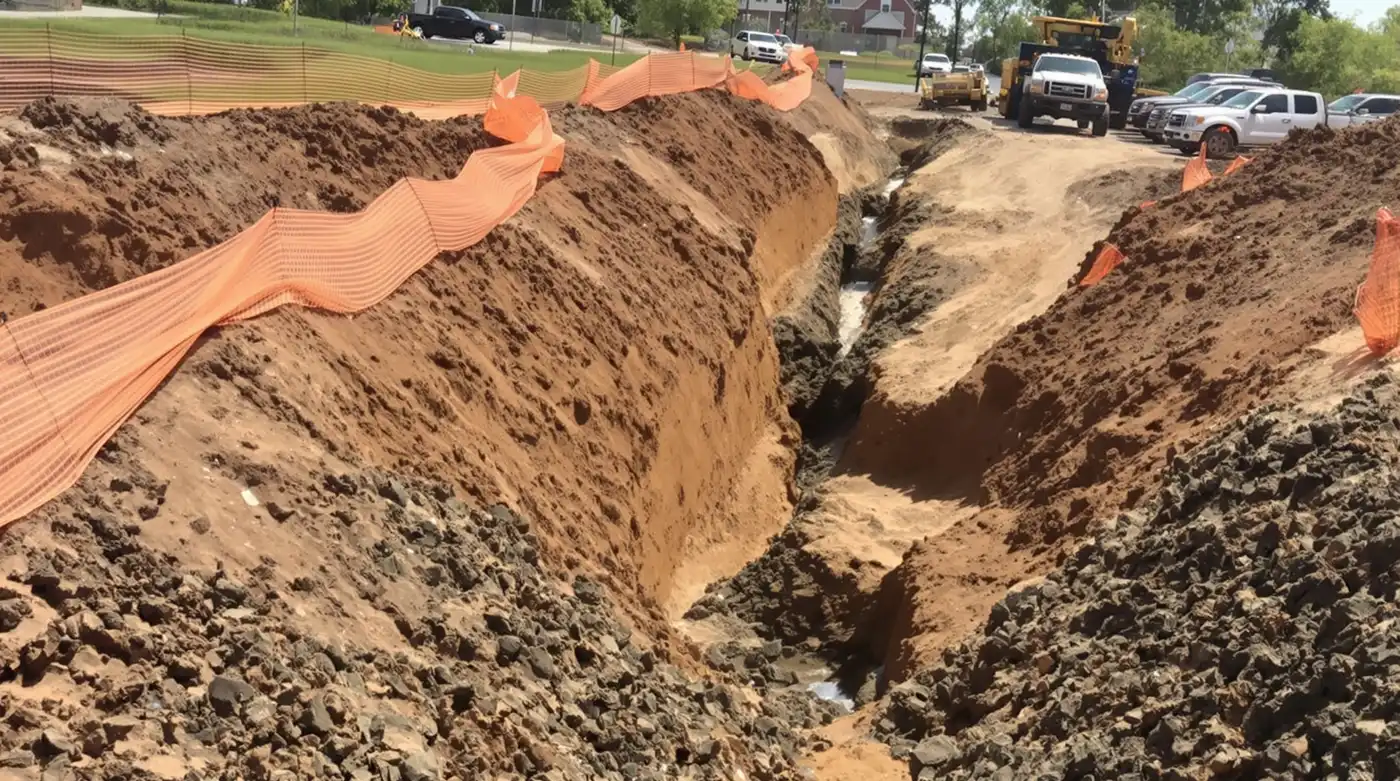
Rough grading is mass earth movement. Dozers and motor graders cut and push bulk volumes of soil to bring a site within a few tenths of a foot of the design elevations on the civil plan. On a 5-acre commercial pad, that can mean moving tens of thousands of cubic yards before anything looks close to finished. The priority here is speed and balance — moving the right dirt to the right place without hauling loads off-site that could have been reused on the same job.
Cut/fill balancing is the math behind that balance. We work the civil model against the existing topography, identify where material has to come out and where it has to go in, plan haul routes that do not chew up the parts of the site already shaped, and strip and stockpile topsoil so it can be reused on final landscaping instead of trucked in at the end of the project.
- ▶ Mass earth movement with dozers and motor graders
- ▶ Major contour establishment from civil model
- ▶ Cut/fill balancing to design elevation
- ▶ Haul route planning and staging
- ▶ Topsoil stripping and stockpile management
- ▶ Building pad elevation roughed in
02 — Capability
Fine Grading & Laser-Guided Precision
Laser-guided grading is how rough dirt becomes a surface the concrete crew can build against without guessing.
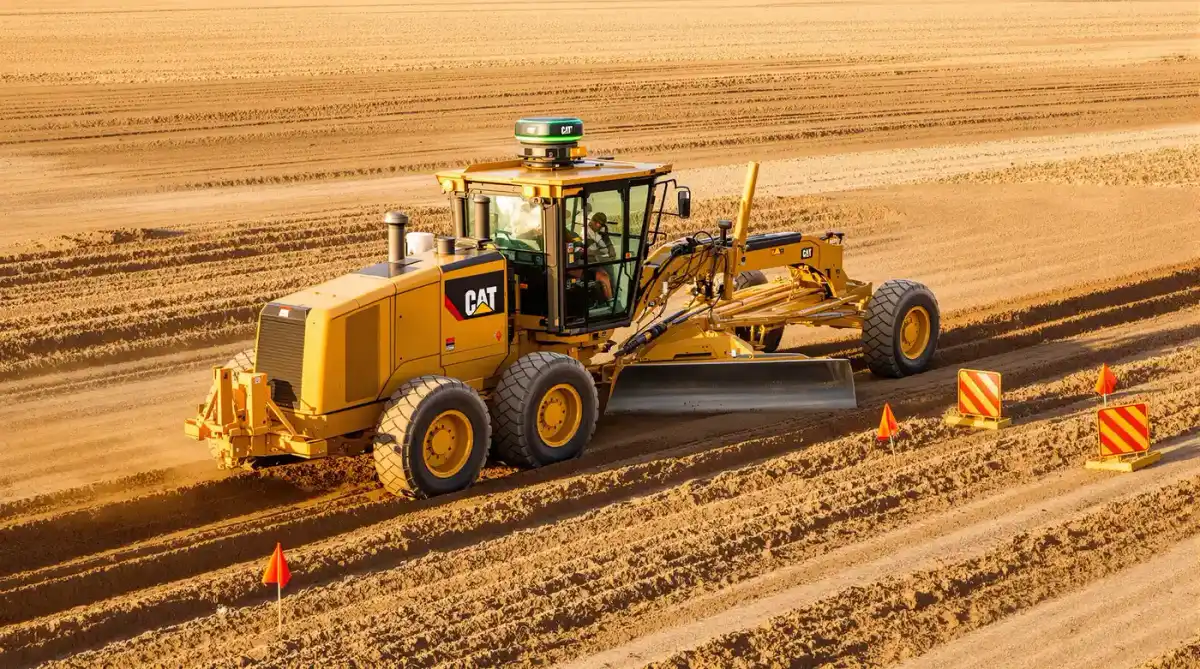
Laser-guided grading holds elevations to within ±0.1 ft — in many commercial scopes, within a quarter inch. A rotating laser on a tripod broadcasts a reference plane across the whole site, a receiver on the motor grader or skid steer reads that plane continuously, and the blade responds automatically as the operator works the pad. On larger commercial projects we run GPS machine control so the grader reads the civil model directly off the plan without constant staking.
Blue top stakes are the visible handoff between grading and the concrete trade. Wooden lath is driven at the finished elevation and painted blue across the top so the concrete crew has a permanent reference when forms go in. Cross-slope tolerance is checked with the rotating laser and grade rod at every grade break before the sub-base is signed off.
- ▶ Laser-guided motor grader operation
- ▶ ±0.1 ft finished elevation tolerance
- ▶ Blue top stakes at finished grade
- ▶ GPS machine control on larger commercial scopes
- ▶ Cross-slope tolerance verification
- ▶ Final fine-trim before sub-base sign-off
03 — Capability
Drainage Grading with 2% Minimum Slope
2% minimum slope drainage is the rule that decides whether water leaves the site or sits on it for thirty years.
Drainage grading shapes the surface so water moves where the civil engineer intended. The baseline rule on Kansas City commercial projects is a 2% minimum slope across paved areas to carry water to inlets, catch basins, or swales. Landscape areas run 2 to 5%. Any flatter than that and the 40 inches of annual rainfall the metro absorbs every year will find the flat spots fast.
Swale formation, crown and invert cuts, and positive drainage away from structures are all set during grading — not patched on after. We match inlet elevations to the civil plan, shape detention ponds and overflow routes to the specified cross-section, and verify every slope with a rotating laser before the sub-base is accepted.
- ▶ 2% minimum slope drainage on paved areas
- ▶ Swale formation to plan cross-section
- ▶ Crown and invert cuts at catch basins
- ▶ Positive drainage from structures
- ▶ Inlet elevation matching
- ▶ Detention pond grading
04 — Capability
Building Pad & Parking Lot Sub-Grade Preparation
Sub-grade preparation is where the building load actually gets supported — everything above it depends on this pass.
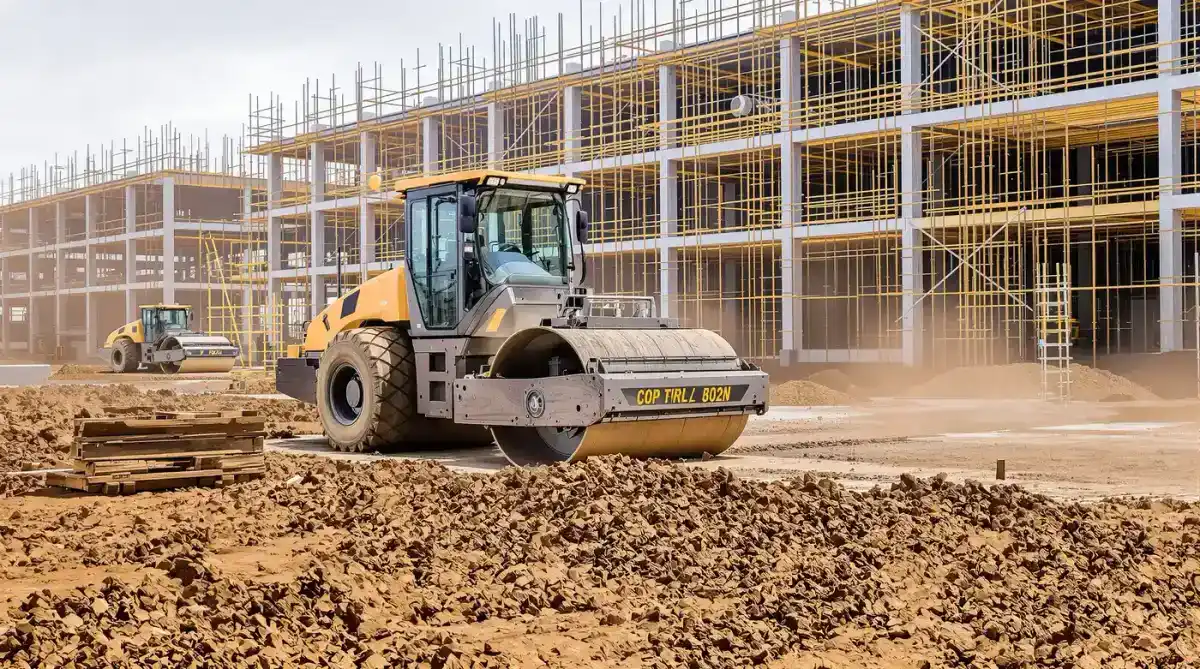
Sub-grade preparation brings the material beneath a building pad or parking lot to the bearing capacity the structure needs. On commercial work that means compacting to 95% modified proctor across the full footprint before any forms go in. Proof rolling is how we verify it — a loaded dump truck or compaction roller is driven across the finished sub-grade to reveal any soft zones that pump or deflect under load.
Building pad elevation is set from the civil plan and marked with blue top stakes so the concrete crew has a visible reference. Parking lot base is crowned to the drainage pattern. Any area that fails proof rolling gets undercut and replaced with structural fill before we sign the pad off. For the mechanics of proctor testing itself and how cut/fill volumes convert across bank, loose, and compacted states, see our excavation contractor page — that page owns the earthwork detail.
- ▶ Sub-grade preparation to design bearing
- ▶ 95% modified proctor compaction
- ▶ Proof rolling verification
- ▶ Building pad elevation with blue top stakes
- ▶ Parking lot base crown and drainage
- ▶ Undercut and replacement of soft zones
Why Ford Concrete for Site Grading
We pour the concrete. That single fact changes every grading decision we make. A grading contractor who will never see the finished slab has no reason to obsess over a soft spot in the corner of a pad or a cross-slope that is half a percent shy. We do — because the crew that sets the blue top stakes is the same crew that forms against them.
On Amazon's Riverside facility we ran the full sitework package from mass earthwork through finished warehouse slab without a single trade handoff between grading and concrete. That is not a normal Kansas City delivery model, and it is the reason commercial general contractors bring us back: single invoice, single crew, single point of accountability from raw ground to broom finish.
Laser-Guided On Every Job
Rotating laser setups on residential and small commercial work, GPS machine control on larger commercial pads. No hand-shooting past rough grade.
Proof Rolling Is Non-Negotiable
Every commercial sub-grade gets proof rolled before sign-off. Soft zones get undercut and replaced, not ignored.
Same Crew Through The Pour
No re-mobilization fee, no coordination gap between trades, no finger-pointing when something goes sideways.
Aaron Ford Answers The Phone
Commercial and residential. Bid questions, schedule changes, and field conditions go directly to the owner.
Grading in Kansas City's Shifting Clay
Kansas City sits on the Wymore-Ladoga soil complex, a fat clay with a very high shrink-swell rating. That makes grading here a precision game — finished grades can shift one to two inches seasonally as the clay expands and contracts with moisture. Compaction has to be held within about 2% of optimum moisture, and we build a little extra margin above the 2% minimum slope on problem soils so drainage still works after the first full wet-dry cycle.
For the full soil breakdown by county, bearing capacity notes, and permit detail, see the Kansas City soil conditions guide and the sitework permits and regulations reference. Both pages own that detail — this page sticks to grading methodology.
Our Grading Process
Six steps. One crew. The first five are where every grading contractor operates. The sixth is where we keep going and they stop.
Site Assessment & Grade Review
We walk the site with the general contractor, overlay existing topography against the civil model, and flag elevation busts, drainage conflicts, and soft zones before the first bucket hits the ground.
Rough Grading & Cut/Fill
Mass earth movement brings the building pad and parking areas within a few tenths of a foot of design. Topsoil is stripped and stockpiled for reuse on final landscaping.
Drainage Shaping
Swales, crowns, and inverts are cut to the specified 2% minimum slope. Detention areas and inlet elevations are matched to the civil plan before the sub-base goes in.
Sub-Grade Compaction & Proof Rolling
Sub-grade preparation is compacted in lifts to 95% modified proctor, then proof rolled with a loaded truck or roller. Any soft spot gets undercut and replaced with structural fill.
Laser-Guided Fine Grading
A rotating laser or GPS machine control brings the finished grade to ±0.1 ft tolerance. Blue top stakes are set at the finished elevation around the perimeter and at interior reference points.
Concrete Construction
The same crew that prepared the sub-base forms, pours, and finishes the concrete. There is no handoff, no re-mobilization, and no coordination gap between the grading contractor and the concrete contractor — because we are both.
This is where most grading contractors stop. We keep going — same crew, through the pour.
Site Grading in Kansas City — FAQs
What does laser-guided grading mean, and when do you use it?
Laser-guided grading uses a rotating laser on a tripod to broadcast a reference plane across the site. A receiver mounted on the motor grader or skid steer reads that plane continuously and the blade responds automatically, holding finished elevations to within a quarter inch. We use it on every commercial fine grading pass and on residential work large enough to justify the setup. On our biggest commercial pads we upgrade to GPS machine control so the grader reads the civil model directly.
What is the 2% minimum slope drainage rule?
2% minimum slope drainage is the standard almost every Kansas City civil plan specifies across paved areas — two feet of fall for every hundred feet of run. Anything flatter than that and water starts to pond instead of moving to catch basins or swales. Landscape areas run 2 to 5%. We verify every slope against the approved drawings with a rotating laser before the sub-base is signed off, and we adjust during grading rather than patching after pour.
What are blue top stakes and why do they matter?
Blue top stakes are wooden lath driven at the finished grade elevation and painted blue across the top. They give the concrete crew a permanent visible reference for building pad elevation and perimeter forms, so footings and slabs can be built against a known grade without re-shooting every corner. On a Ford Concrete project the crew that sets the blue tops is the same crew that pours the concrete against them.
What is proof rolling and why is it part of sub-grade preparation?
Proof rolling is driving a loaded dump truck or a compaction roller across the finished sub-grade to reveal any soft spots that pump or deflect. Any failing area gets undercut and replaced with structural fill before the pad is signed off. Proof rolling catches problems that visual inspection alone will miss, which is exactly why it is required on commercial work. For the full explanation of proctor testing and compaction mechanics, see our excavation contractor page.
Do you grade sites that another contractor already rough-graded?
Yes. We regularly come in behind another excavator to fine grade a sub-base, correct drainage errors, or rebuild a building pad that failed proof rolling. We prefer to run the full sequence ourselves because the handoff is where most schedule problems start, but we will take over partial work when the general contractor needs it.
How much does grade actually move on Kansas City clay after the job is done?
Wymore-Ladoga clay is a high shrink-swell soil. Finished grades can shift one to two inches seasonally as the clay expands and contracts with moisture. That is why compaction has to be held within about 2% of optimum moisture, why we proof roll aggressively, and why drainage slopes are built with a little extra margin above the 2% minimum on problem soils. For the full soil breakdown, see the Kansas City soil conditions guide.
Related Sitework Services
Grading sits inside a larger sitework sequence. Here is where it connects.
Excavation
Mass earthwork, structural excavation, rock ripping, and proctor testing explained in detail.
Learn more →Storm Drainage
RCP and HDPE pipe, catch basins, detention and retention basins — everything downstream of grading.
Learn more →Utility Trenching
Water, sewer, electric, gas, and comms trenching with bedding, haunching, and 811 locates.
Learn more →Land Clearing
Brush removal, tree felling, stump grinding, and topsoil stockpiling before grading starts.
Learn more →Commercial Parking Lots
The concrete that sits on every sub-grade we build — formed and poured by the same crew.
Learn more →Warehouse Floors
Heavy commercial slab work that depends on laser-flat sub-grade preparation to perform for decades.
Learn more →Grading Service Area
Ready to Start Your Grading Project?
Commercial or residential, one acre or fifty — we grade it, prep it, and pour the concrete with the same crew. Call Aaron directly or request a bid.
Ready to Get Started?
From call to concrete — the fastest in KC.
Get a free, no-obligation estimate for your concrete project. We serve the entire Kansas City metro — call (816) 721-1699 or request your estimate online.