Land Clearing Contractor in Kansas City
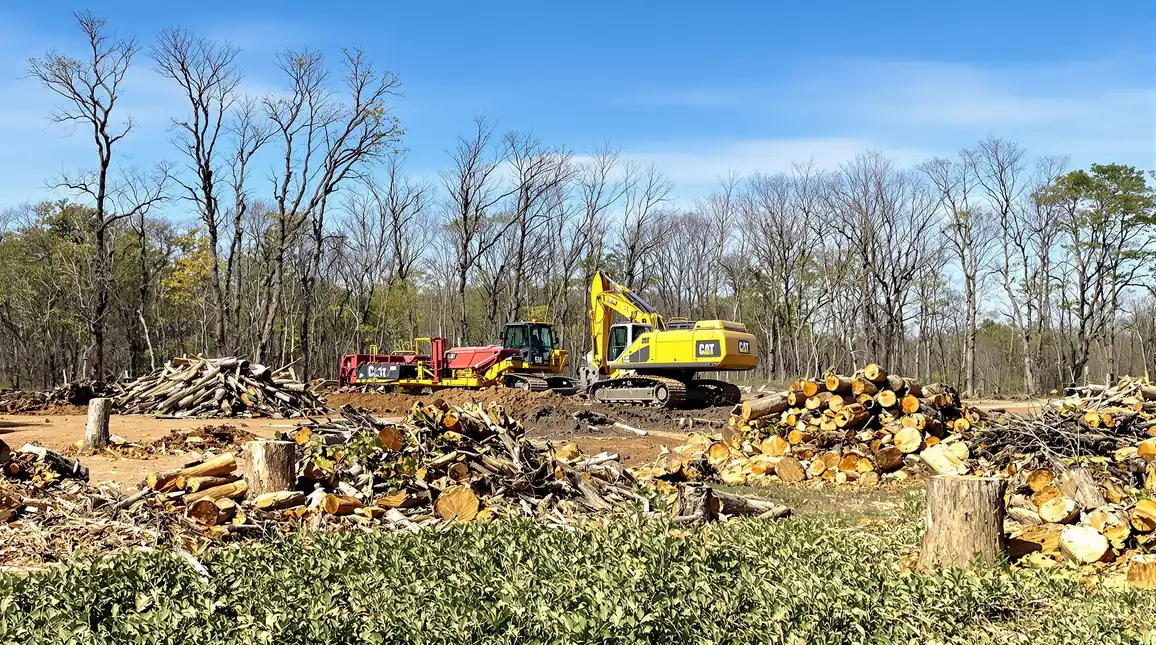
Full site clearing and grubbing, selective clearing with tree protection fencing, stump grinding below grade, forestry mulching, and documented debris haul-off across the KC metro — followed by in-house grading and concrete construction from the same crew.
What Is Land Clearing?
Definition
Land clearing is the complete removal of vegetation, stumps, root mats, and surface debris from a project site — clearing and grubbing performed in sequence so the ground is ready for excavation, grading, and structural construction with no hidden organics left to decompose under the finished work.
Clearing sits at the very front of the sitework sequence. It comes before excavation, before grading, before utility trenching, and before a single concrete form is set. On a typical Kansas City commercial project, tree and brush removal opens the site, stump grinding below grade and root grubbing finish the organics, debris is hauled off or mulched in place, and the graded surface is turned over to the earthwork crew — all before the first cut on the civil model happens.
When clearing is done poorly, every trade downstream pays for it. A buried stump left under a parking lot becomes a rotten void and a cracked pavement section three years later. Tree protection fencing skipped on a selective clearing job becomes a five-figure fine and a replanting order. Debris hauled off without tickets becomes a LEED documentation problem at closeout. We have spent eleven years clearing sites across the Kansas City metro — from single residential lots to the wooded acres behind the Amazon Riverside facility — and the rule is the same every time: clearing looks simple from a spreadsheet and complicated on the ground.
Land Clearing Capabilities
Four capability blocks — full site clearing and grubbing, selective clearing with tree protection fencing, stump grinding below grade and root grubbing, and debris management with forestry mulching — all handled in-house by the same crew that grades and pours the concrete that follows.
01 — Capability
Full Site Clearing — Clearing and Grubbing
Clearing and grubbing is complete vegetation removal — trees, brush, root mats, and surface debris taken down to raw dirt in a single coordinated sweep.
Full site clearing is what a greenfield commercial development starts with. Tracked dozers and skid steers with grapple buckets push standing timber, brush, and small saplings into staged piles. Tree and brush removal happens in planned working zones so the operation does not backtrack across ground it has already cleared. On a 10-acre Kansas City commercial site that can mean days of continuous tree and brush removal before anything resembles a building footprint, and the priority is getting the entire project limit stripped before grading crews mobilize.
Clearing and grubbing are priced together because a site is never actually ready for earthwork until both are finished. Clearing removes what is above grade. Grubbing pulls what is left in the ground — root balls, buried stumps, and root mats that will rot under a slab and cause settlement. We coordinate structure demolition on the same mobilization whenever a site has existing buildings, sort debris into reusable versus haul-off piles, and hand the site over to the grading contractor with nothing but clean dirt and the project stakes visible.
- ▶ Complete vegetation removal
- ▶ Tree and brush removal in planned zones
- ▶ Clearing and grubbing to raw dirt
- ▶ Structure demolition coordination
- ▶ Debris sorting on site
- ▶ Site preparation handoff to grading
02 — Capability
Selective Clearing with Tree Protection Fencing
Selective clearing is surgical work — preserving specific trees, groves, or buffer strips while clearing everything around them, with tree protection fencing installed before equipment ever moves.
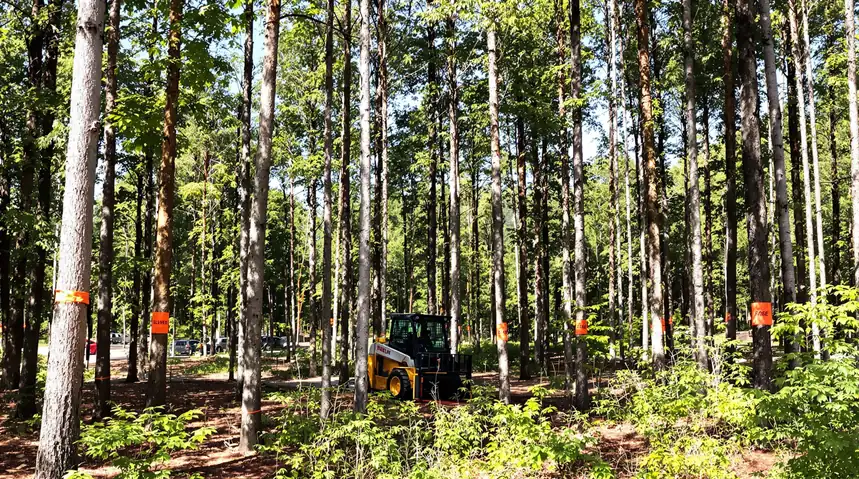
Selective clearing preserves designated trees, tree groups, or vegetated buffers while the rest of the site comes down. Landscape plans, environmental requirements, HOA entitlements, and municipal tree ordinances all drive selective work on Kansas City commercial projects. Understory clearing takes out the brush and small growth around preserved trees without damaging the critical root zone. The equipment shrinks — compact tracked loaders and hand crews replace full-sized dozers — and the pace slows, because losing a protected tree to a careless operator carries fines that can run into tens of thousands of dollars.
We install tree protection fencing at the drip line or engineered critical root zone before any equipment enters, flag every preserved trunk with orange tape, and brief every operator on the preservation plan before a single tree comes down. For municipal and HOA projects with arborist-stamped preservation plans, we coordinate directly with the arborist of record throughout the operation. Selective clearing is not a cheaper version of full clearing — it is a different, slower discipline, and it gets priced that way.
- ▶ Selective tree preservation
- ▶ Understory clearing around saved trees
- ▶ Tree protection fencing at critical root zone
- ▶ Flagging coordination with arborist
- ▶ Environmental compliance
- ▶ Arborist coordination on preservation plan
03 — Capability
Stump Grinding Below Grade and Root Grubbing
Stump grinding below grade is what separates a cleared site from a buildable one — root grubbing pulls the last of the organics so foundations and utilities have clean soil to sit on.
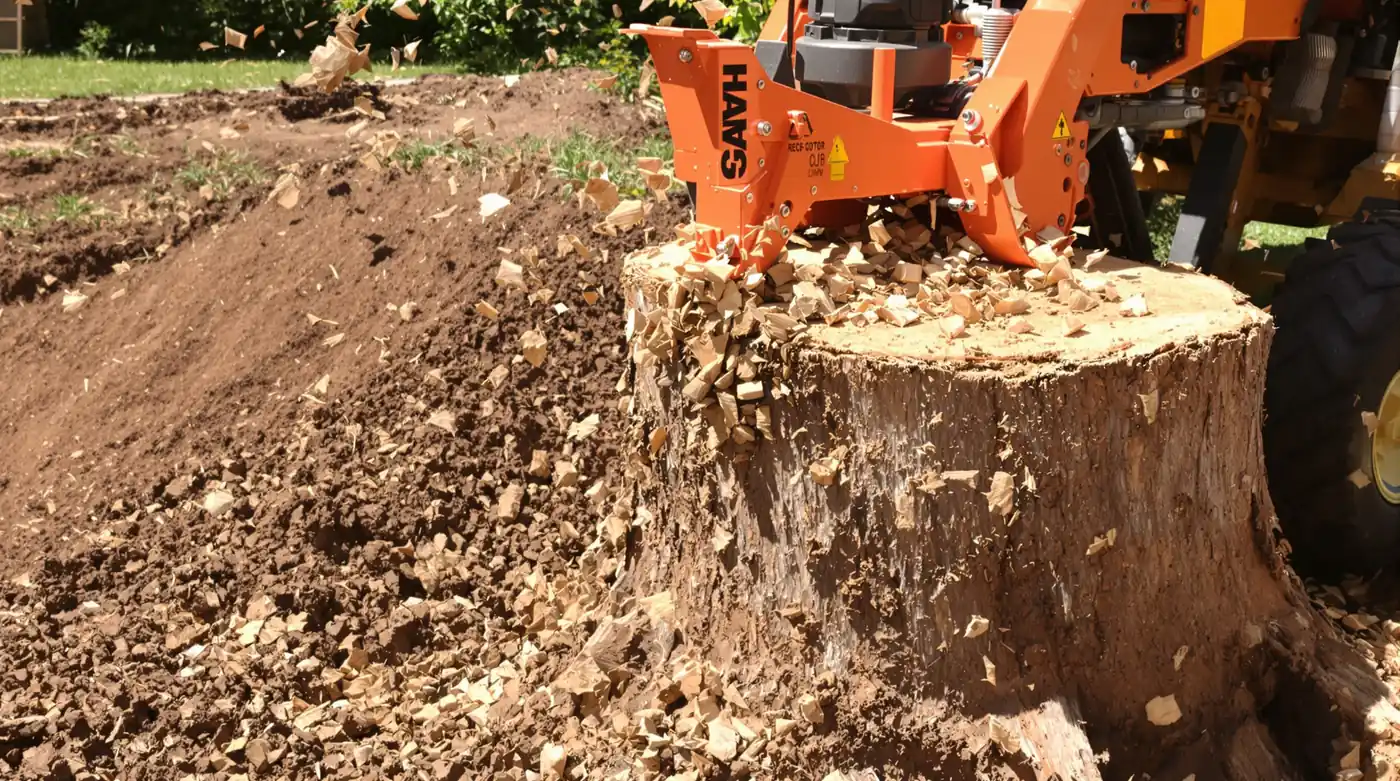
Stump grinding below grade takes every stump down 8 to 12 inches under finished grade in landscape areas, and all the way out on anything that will carry structural load. Under a building pad, parking lot, or structural slab, a ground stump is not good enough — the wood left behind still decomposes, and when it does, the ground above it settles into a low spot or a cracked slab. For those zones we excavate the full root ball, haul it off, and backfill the void with compacted structural fill so the pad has clean soil handoff to the grading and foundation crew.
Root grubbing is the companion operation — pulling root mats and buried runners that stump grinding alone will miss. Below-grade removal is verified zone by zone before the grading contractor takes over. Stump chip management is part of the scope: the chips left from grinding are raked, stockpiled, or hauled off depending on whether the area will be landscaped or built on. The objective is a foundation-ready site — no hidden organics under anything structural. The excavation and compaction mechanics for that backfill are covered on our excavation contractor page.
- ▶ Stump grinding below grade
- ▶ Root grubbing and root mat removal
- ▶ Below-grade removal verification
- ▶ Clean soil handoff to grading
- ▶ Stump chip management
- ▶ Foundation-ready site delivery
04 — Capability
Debris Management — Haul-Off and Forestry Mulching
Debris haul-off cubic yard pricing, on-site forestry mulching, and documented disposal are how cleared material actually leaves the site — or stays on it as reusable mulch.
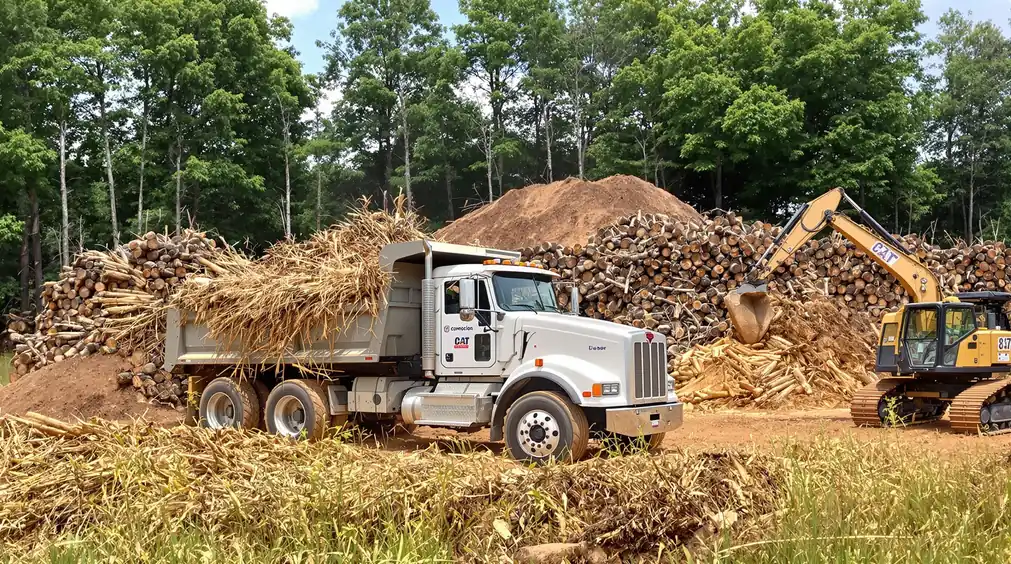
Every tree that comes down becomes debris somebody has to move. Debris haul-off cubic yard pricing is how we bid the disposal line so the general contractor sees the real volume leaving the site instead of a lump sum. Sorting and recycling start at the pile: merchantable logs get staged for a sawmill, chipped brush goes to a permitted mulch yard or composting facility at low tipping fees, and stumps, root balls, and contaminated material go to a construction debris landfill at higher rates. Every load gets a ticket, and tickets get turned over for LEED documentation or municipal reporting.
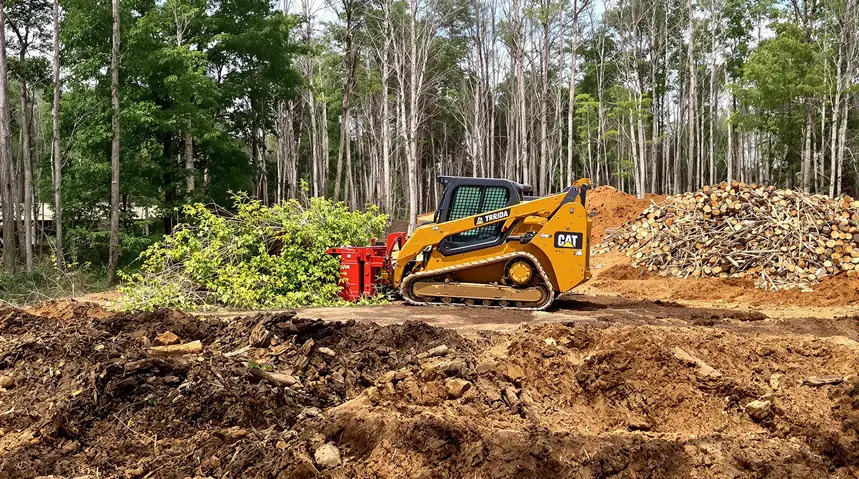
Forestry mulching is the alternative when the project allows it. Instead of hauling brush off, a dedicated mulching head on a skid steer reduces everything — standing brush, small timber, understory — into chip-sized mulch in a single pass that stays on the ground. The mulch layer controls erosion, returns organics to the soil, and saves the tipping fees and truck loads that a haul-off operation burns. Chipper operation handles the in-between case: material too large for a mulching head but not worth loading whole onto a truck. Landfill coordination and mulch reuse are both options on the table — the plan and the site pick the approach.
- ▶ Debris haul-off cubic yard pricing
- ▶ Sorting and recycling at the pile
- ▶ Forestry mulching on site
- ▶ Chipper operation
- ▶ Landfill coordination with haul tickets
- ▶ Mulch reuse for erosion control
Why Ford Concrete for Land Clearing
We grade and pour the concrete that eventually sits on the ground we cleared. That single fact changes every clearing decision. A clearing-only contractor has no reason to worry about a root ball left under the corner of a future parking lot — we do, because we are the ones who will be forming and finishing the slab above it nine months later.
On Amazon's Riverside facility we ran the full sitework package from wooded ground through finished warehouse slab without a single trade handoff. Same crew cleared the trees, grubbed the stumps, graded the pad, and poured the concrete. That is not the normal Kansas City delivery model, and it is exactly why commercial general contractors bring us back on the next project.
Tree Protection Fencing Before Equipment Moves
Preserved trees get fenced at the critical root zone before the first piece of equipment enters the project limits. No shortcuts.
Documented Haul Tickets
Every load that leaves the site is ticketed by volume and destination — ready for LEED documentation or municipal reporting at closeout.
Same Crew Through The Pour
No trade handoff between the clearing contractor, the earthwork contractor, and the concrete contractor. One crew, one invoice, one point of accountability.
Aaron Ford Answers The Phone
Commercial and residential. Bid questions, preservation questions, and disposal logistics go directly to the owner.
Clearing Under KC Tree Ordinances and Bird Nesting Restrictions
The Kansas City metro has a patchwork of local tree ordinances — cities like Prairie Village and Leawood require permits for removing trees over a certain caliper, and HOA developments frequently attach arborist-stamped preservation plans to the entitlement. Selective clearing on those sites is not optional, it is entitlement compliance, and the fines for a missed protected tree run well into five figures.
Spring clearing runs into a second constraint: the federal Migratory Bird Treaty Act restricts clearing of occupied habitat roughly March through August, and active nests cannot be disturbed. On sensitive wooded sites we frequently schedule clearing for fall or winter to sidestep the restriction — which is also when frozen ground supports equipment best. For the full permit picture across MO and KS jurisdictions, see the sitework permits and regulations reference. That page owns the regulatory detail — this page sticks to clearing methodology.
Our Land Clearing Process
Six steps. One crew. The first five are where every clearing contractor operates. The sixth is where we keep going and they stop.
Site Walk & Preservation Plan Review
We walk the project limits with the general contractor, overlay the civil plan and any arborist preservation drawings, and flag protected trees, buffers, and sensitive areas before equipment arrives.
Tree Protection Fencing & Flagging
Orange tree protection fencing is installed at the critical root zone of every preserved tree. Flagging tape marks individual specimens. Operators are briefed on the preservation plan before a single tree comes down.
Tree & Brush Removal
Standing timber, brush, and understory are taken down in planned working zones. Merchantable logs are staged for haul-off or sawmill. Brush is piled, chipped, or mulched depending on the disposal plan.
Stump Grinding & Root Grubbing
Stumps in landscape areas are ground below grade. Stumps and root balls under structural zones are excavated whole and hauled off. Root mats are grubbed out and the area is verified before backfill.
Debris Haul-Off & Mulching
Debris is sorted, loaded, and hauled to permitted facilities with documented tickets, or mulched on site depending on the plan. The site is swept of surface debris before handoff.
Handoff to Grading & Earthwork
The cleared site is turned directly over to the same crew for grading and earthwork. No trade handoff, no re-mobilization, no coordination gap between the clearing contractor and the earthwork contractor — because we are both.
This is where most clearing contractors stop. We keep going — same crew, through grading and the pour.
Land Clearing in Kansas City — FAQs
What does clearing and grubbing actually include?
Clearing and grubbing is complete vegetation removal — above grade and below grade. Clearing takes out standing trees, brush, small timber, and surface debris. Grubbing pulls root balls, buried stumps, and root mats that would otherwise rot under a slab and cause settlement. They are priced together because a site is never actually ready for earthwork until both are finished. On a Ford Concrete project, clearing and grubbing are the first operations on the ground, and the finished product is raw dirt the grading crew can walk directly onto.
What is stump grinding below grade and when is it enough?
Stump grinding below grade takes a stump down 8 to 12 inches under finished grade with a dedicated stump grinder attachment. That is enough in lawn and landscape areas where nothing structural will sit on top. Under a building pad, parking lot, or structural slab, stump grinding alone is not acceptable — the remaining wood decomposes over time and creates a void that the ground above settles into. For those zones we excavate the entire root ball and backfill with compacted structural fill.
What is selective clearing and why does tree protection fencing matter?
Selective clearing preserves designated trees, tree groups, or vegetated buffers while clearing everything around them. Municipal ordinances — Prairie Village and Leawood, for example — require permits for removing trees over a certain caliper, and HOA entitlements often mandate preservation of mature hardwoods. Tree protection fencing is installed at the critical root zone before any equipment moves, and operators are briefed on the preservation plan. Losing a protected tree carries fines that can run into tens of thousands of dollars on commercial work — the fencing is not optional, it is the line between compliance and a very expensive mistake.
How do you price debris haul-off cubic yard disposal?
Debris haul-off cubic yard pricing means the disposal line is bid as volume of material leaving the site, not a lump sum. That keeps the general contractor from paying for air or getting surprised when a site generates more material than an eyeball estimate predicted. Chipped brush goes to a permitted mulch yard or composting facility at low tipping fees, stumps and root balls go to a construction debris landfill at higher rates, and merchantable logs occasionally go to a sawmill. Every load gets a ticket and tickets are turned over for documentation.
Can you run forestry mulching instead of haul-off?
Yes. Forestry mulching uses a dedicated mulching head on a skid steer to reduce brush, small timber, and understory into chip-sized mulch that stays on the ground in a single pass. It eliminates the haul cycle, controls erosion on cleared ground, and returns organics to the soil. It works best on wooded and brushy sites where the material size is compatible with the mulching head. On sites with large standing timber or existing structures, a mix of mulching and traditional haul-off is usually the better plan.
Can you clear in spring during bird nesting season?
It depends on the site and the project. The federal Migratory Bird Treaty Act restricts clearing of occupied habitat during nesting season — roughly March through August — and active nests cannot be disturbed. On sensitive sites with mature trees, we frequently schedule clearing for fall or winter to avoid the restriction entirely, which is also when frozen ground supports equipment best. For permitted commercial projects we coordinate with the environmental consultant of record to determine whether a nest survey is required before clearing can start.
Related Sitework Services
Clearing sits at the very front of a larger sitework sequence. Here is where it connects.
Site Grading
Laser-guided rough and fine grading that takes over where clearing finishes — same crew, no re-mobilization.
Learn more →Excavation
Mass and structural excavation, rock ripping, and structural fill placement after the site is cleared to raw dirt.
Learn more →Demolition
Structure and slab demolition coordinated with clearing on sites that have existing buildings.
Learn more →Erosion Control
Silt fence, erosion blanket stabilization, and SWPPP compliance immediately after clearing exposes raw ground.
Learn more →Permits & Regulations
Tree ordinances, land disturbance permits, Section 404, and bird nesting season restrictions by KC metro jurisdiction.
Learn more →Commercial Parking Lots
The concrete that eventually sits on the ground we cleared — poured by the same crew.
Learn more →Warehouse Floors
Heavy commercial slab work on greenfield sites that started as wooded, brushy ground.
Learn more →Land Clearing Service Area
Ready to Clear Your Kansas City Site?
Commercial or residential, one lot or fifty acres — we clear it, grub it, haul it off, and grade and pour the concrete with the same crew. Call Aaron directly or request a bid.
Ready to Get Started?
From call to concrete — the fastest in KC.
Get a free, no-obligation estimate for your concrete project. We serve the entire Kansas City metro — call (816) 721-1699 or request your estimate online.