Utility Trenching Contractor in Kansas City
Water, sewer, electrical conduit, and communications trenching with bedding stone pipe zone, haunching and initial backfill, tracer wire, OSHA trench box shoring, and Kansas One-Call 811 coordination across the KC metro — followed by in-house concrete construction from the same crew.
What Is Utility Trenching?
Definition
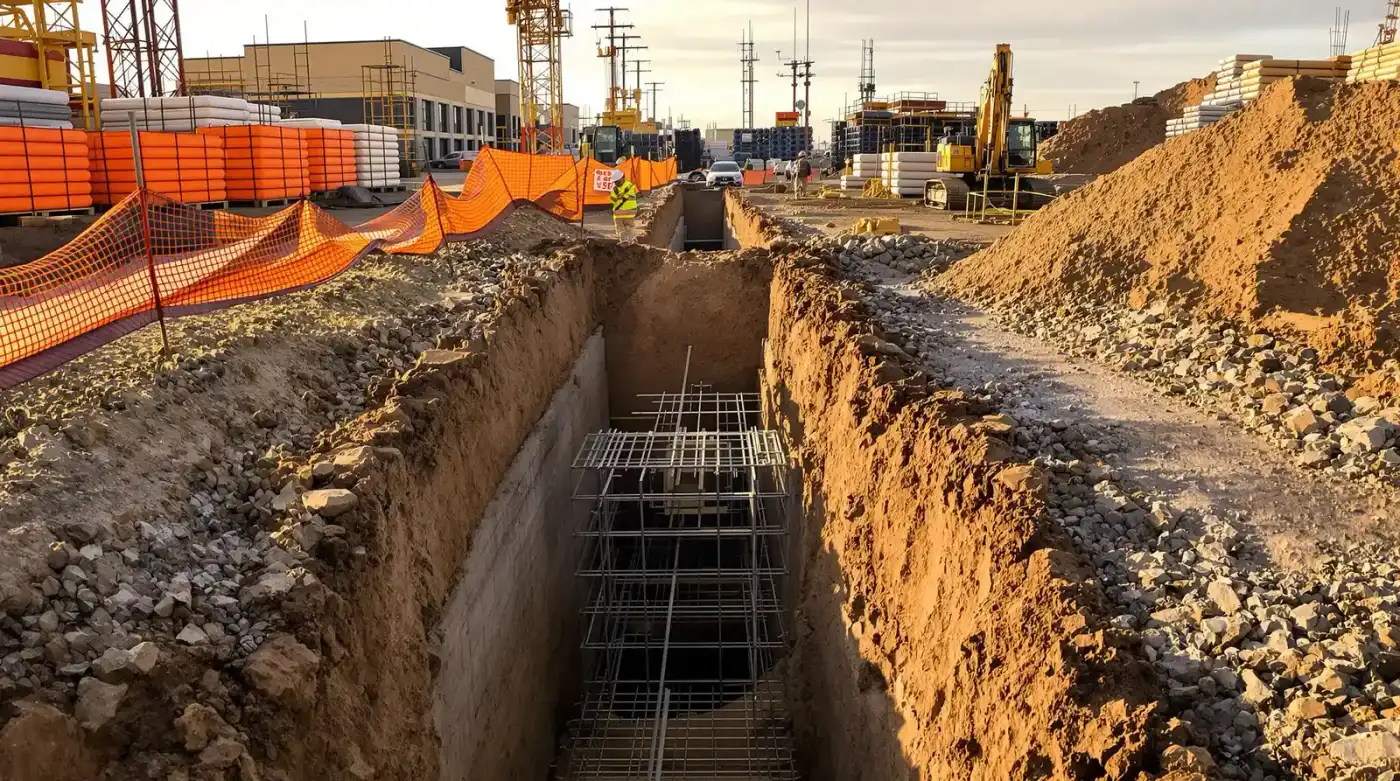
Utility trenching is the discipline of excavating, bedding, installing, and backfilling buried water, sewer, electrical, gas, and communications lines — held to minimum cover depth, a properly compacted bedding stone pipe zone, haunching and initial backfill, tracer wire on every non-metallic run, and OSHA-compliant trench box shoring any time depth crosses 5 feet.
Trenching sits between grading and concrete in the sitework sequence. Land clearing and mass excavation come first, rough grading follows, then utility trenching goes in ahead of the sub-base and final pour. Every buried line on the site has to be installed and signed off before the slab, pavement, or curb above it can be formed — because once the concrete is down, any trench that was not installed correctly becomes a saw-cut demo job instead of a simple backfill correction.
Utility trenching is where sitework becomes engineering. A sanitary sewer back-pitched by half a percent, a water main laid without haunching, a fiber run buried shallow under a parking lot, or a non-metallic gas line with no tracer wire are all invisible the day the site closes out — and all of them turn into five-figure problems later. Ford Concrete has been running trench work across the KC metro for eleven years on commercial and residential projects, and the rule is the same on every job: the trench gets installed the way the engineer drew it, the way OSHA requires it, and the way the utility owner standards say it has to be.
Utility Trenching Capabilities
Four capability blocks — water and sewer, electrical and communications, trench safety and shoring, and 811 locate and coordination — all handled in-house by the same crew that pours the concrete that sits on top.
01 — Capability
Water & Sewer Line Trenching — Bedding Stone Pipe Zone and Haunching
Water and sewer trenching is where minimum cover depth, bedding stone pipe zone, and haunching and initial backfill decide whether the line lasts eighty years or five.
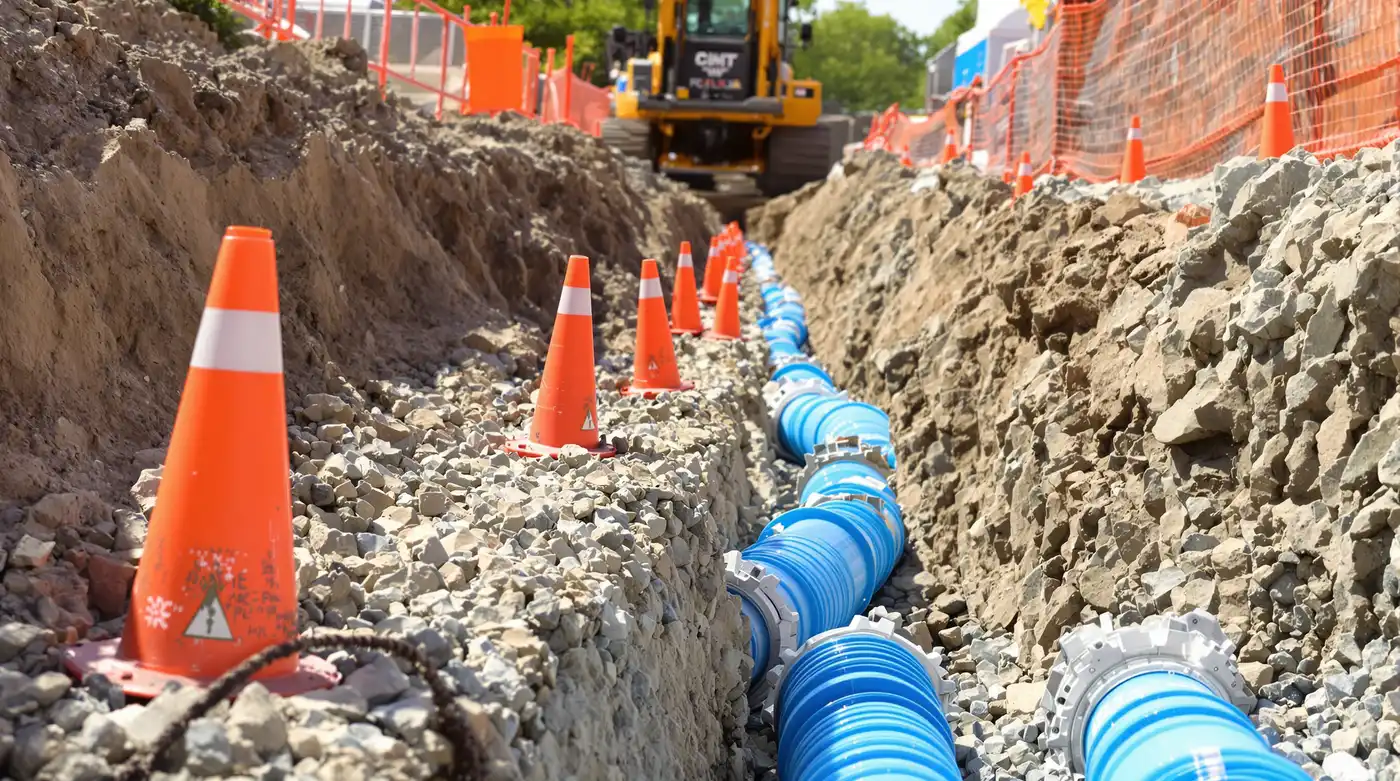
Domestic water service in the Kansas City metro is buried below the 36-inch frost depth — typically 42 inches of cover on residential service and 48 to 60 inches on commercial water mains. Sanitary sewer depth is set by the gravity grade required to reach the downstream main, which means the deeper the run, the more excavation depth we have to carry. We install PVC C-900 and ductile iron on pressure water, SDR 35 PVC on gravity sanitary sewer, and HDPE on fused service and directional bore work — each with its own joint, bedding, and backfill spec pulled directly from the engineer's drawings.
Bedding stone pipe zone preparation happens before the pipe is set. A 4 to 6 inch layer of uniform crushed aggregate goes in first, shaped to cradle the pipe barrel along its full length. Haunching and initial backfill is hand-placed and tamped into the springline on both sides of the pipe so no voids remain below the haunches — that is the zone that carries roughly half the structural load on a buried line. Thrust blocks are formed and poured at every bend, tee, and dead end on pressure water mains to resist hydraulic thrust. Minimum cover depth is verified against the plan before backfill rises above the pipe zone.
- ▶ Water line trenching below frost depth
- ▶ Sewer line grade maintenance
- ▶ Bedding stone pipe zone
- ▶ Haunching and initial backfill
- ▶ Thrust block placement at bends
- ▶ Minimum cover depth verification
02 — Capability
Electrical & Communications Conduit — Tracer Wire and Locatable Warning Tape
Electrical and communications trenching is conduit, duct banks, and non-metallic pull runs — with tracer wire and locatable warning tape making every inch of non-metallic pipe findable years later.
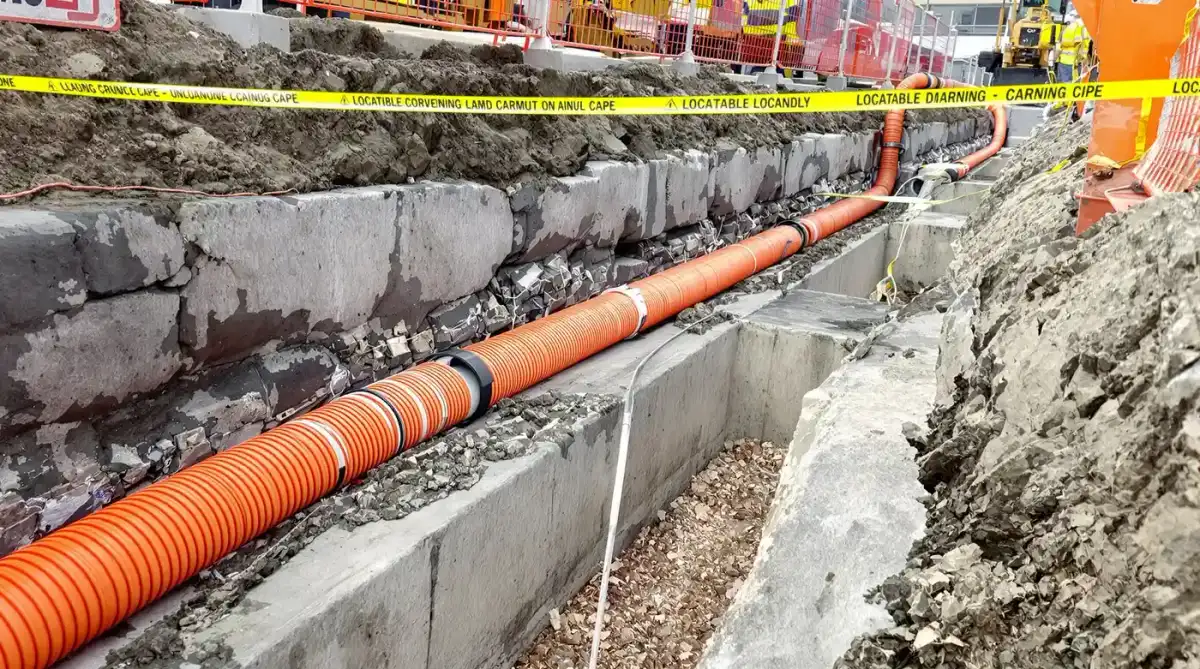
Dry utility trenching covers primary and secondary electric, site lighting conduit runs, fiber optic routing, telecom, and low-voltage controls. On commercial sites we install straight conduit runs, multi-pipe duct banks concrete-encased where the spec requires it, and pull boxes and hand holes at every transition. Conduit is swept at bends, pull strings are left in every run, and depth is held to the utility owner standard — typically 24 to 36 inches of cover depending on the line type and whether it crosses under pavement.
Tracer wire for non-metallic pipe is not optional on modern dry utility work. We lay a solid-copper tracer along the top of every PVC or HDPE run and terminate both ends in surface access boxes so a locator can energize the line later. Locatable warning tape — printed plastic tape in the appropriate color for the utility, buried 12 to 18 inches above the conduit during backfill — is the second warning the next excavator will hit before they reach the actual line. Both are code on almost every utility owner standard in the KC metro and both add almost nothing to the cost of the install.
- ▶ Electrical conduit runs
- ▶ Duct bank construction
- ▶ Pull box installation
- ▶ Fiber optic routing
- ▶ Tracer wire for non-metallic
- ▶ Locatable warning tape placement
03 — Capability
Trench Safety & Shoring — Type C Soil Classification and Trench Box Protection
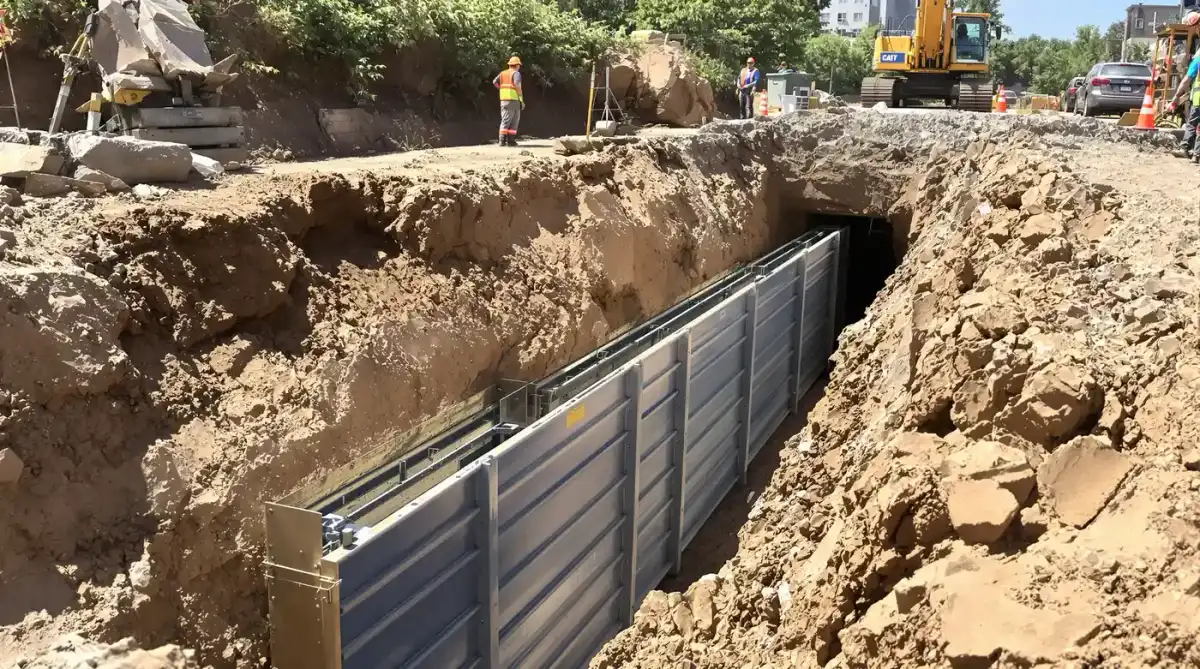
Trench safety on Kansas City clay starts with a Type C soil classification at the beginning of every shift and trench box shoring the moment depth crosses 5 feet.
OSHA 29 CFR 1926 Subpart P classifies soil into Type A, Type B, and Type C for protective system selection. Wet Kansas City clay is frequently Type C — the least stable category — which means flatter slopes, benching, or full trench box shoring before any worker enters the excavation. A competent person on our crew classifies the soil at the start of each shift, inspects the excavation, and re-inspects any time conditions change. There is no such thing as a five-minute dip into an unprotected trench on a Ford Concrete job.
Trench box shoring is required on every excavation 5 feet or deeper that a worker will enter. We size the box to the trench width, pull it forward with the excavator as the line progresses, and maintain safe egress points every 25 feet in the form of ladders or ramps. Sloping and benching are acceptable alternatives on shallower work when the soil classification allows. Daily trench inspections are documented, and no worker enters the trench until the protective system is in place. The rule on this crew is simple: the trench does not open without a plan for how the trench gets closed.
- ▶ OSHA Type C soil compliance
- ▶ Trench box shoring
- ▶ Competent person on site
- ▶ Daily trench inspections
- ▶ Sloping and benching
- ▶ Egress every 25 ft
04 — Capability
811 Utility Locate & Coordination — Kansas One-Call and Missouri One-Call
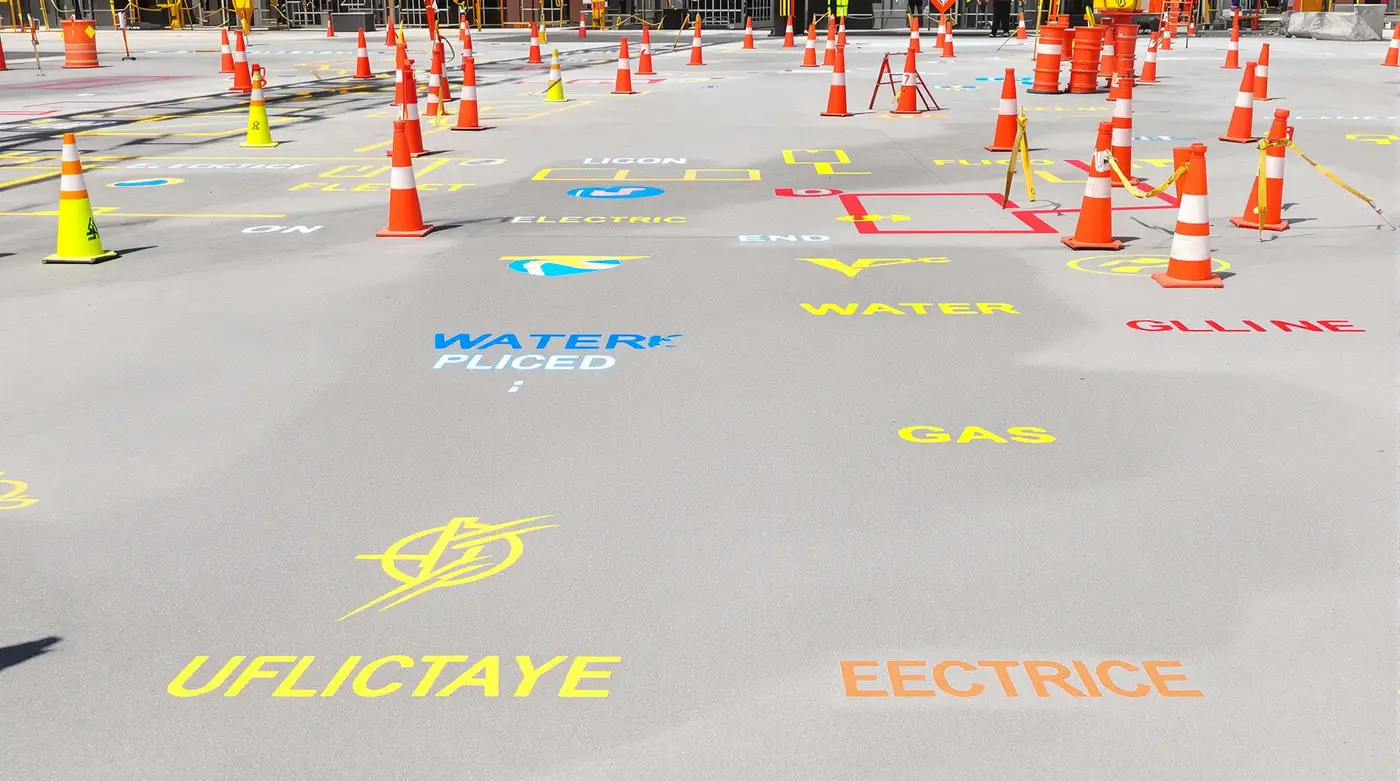
Kansas One-Call 811 and Missouri One-Call are two separate systems, and any project near the state line has to notify both before the first bucket touches the ground.
Kansas One-Call 811 and Missouri One-Call System are operated independently. State law in both jurisdictions requires a locate ticket at least 48 hours — two business days — before excavation begins. Projects in Johnson, Wyandotte, or Leavenworth County go through Kansas One-Call. Projects in Jackson, Clay, Platte, or Cass County go through Missouri. Anything near the state line — downtown KCMO and KCK, the Fairfax industrial district, Riverside, southern Kansas City — needs a ticket filed with both systems because facility owners routinely cross the line without the project knowing it.
Once the ticket is filed, each facility owner sends a locator to mark their lines with colored paint and matching flags — red for electric, yellow for gas, orange for communications, blue for water, green for sewer. Crossing conflicts are resolved in the field before excavation reaches the conflict point, hand-dig tolerance zones are honored within 24 inches of any marked line, and daily markout verification makes sure nothing has been mowed off or washed away overnight. A line you failed to have located is a five-figure fine and an OSHA recordable the day it gets hit.
- ▶ Kansas One-Call 811 notification
- ▶ Missouri One-Call notification
- ▶ 48-hour lead time
- ▶ Crossing conflict resolution
- ▶ Hand-dig tolerance zones
- ▶ Daily markout verification
Why Ford Concrete for Utility Trenching
We pour the concrete that sits over every trench. That single fact changes every trenching decision we make. A trenching contractor who will never see the finished slab has no reason to hand-tamp the haunches of a water main or push an extra lift of granular backfill compaction under a parking lot saw-cut. We do — because the crew that backfills the trench is the same crew that forms against it a week later.
On Amazon's Riverside facility we ran the full sitework and concrete package, including the under-slab and site utility trenching that fed the warehouse. No trade handoff between the trenching crew and the concrete crew, no mystery backfill under the slab, no finger-pointing when a line had to be verified later. Commercial general contractors bring us back on the next job because the trench and the slab above it are priced, scheduled, and delivered by one crew with one invoice.
Tracer Wire On Every Plastic Run
Every non-metallic water, sewer, and gas sleeve gets tracer wire and a surface access box so the line is findable with a transmitter for the life of the building.
Trench Box On Every Type C Job
Wet KC clay is almost always Type C. A competent person classifies the soil at the start of the shift and no one enters the trench until the box is set.
Both 811 Systems On Every Ticket
Kansas One-Call and Missouri One-Call are filed 48 hours ahead on any project near the state line. No excavation until the locates are on the ground.
Aaron Ford Answers The Phone
Commercial and residential. Bid questions, locate conflicts, and field conditions go directly to the owner.
Trenching Kansas City Clay and the State Line
Water lines in the KC metro must sit below the 36-inch frost depth — 42 inches of cover is the practical residential minimum, 48 to 60 inches on commercial mains. Kansas City clay classifies Type C under the OSHA soil classification system in most wet conditions, which means trench box shoring is required at any depth over 5 feet. Missouri One-Call and Kansas One-Call are two independent 811 systems — projects near the state line require a locate ticket filed with both, 48 hours ahead of excavation, every time.
For the full county-by-county soil breakdown and shrink-swell behavior, see the Kansas City soil conditions guide. For permit thresholds, right-of-way cuts, and stormwater compliance across MO and KS jurisdictions, see the sitework permits and regulations reference. Both pages own that detail — this page sticks to trenching methodology.
Our Utility Trenching Process
Six steps. One crew. The first five are where every trenching contractor operates. The sixth is where we keep going and they stop.
Locate Ticket & Plan Review
We file the Kansas One-Call 811 and Missouri One-Call tickets at least 48 hours before excavation, walk the site against the civil and utility drawings, and flag crossing conflicts before the excavator shows up.
Trench Excavation & Soil Classification
A competent person classifies the soil as Type A, B, or C at the start of the shift. Wet KC clay is usually Type C, so the trench box goes in the ground before any worker enters.
Bedding Stone & Pipe Installation
A 4 to 6 inch bedding layer is placed and shaped to cradle the pipe. Water, sewer, gas sleeve, electrical conduit, or fiber is laid to grade, checked with a laser, and coupled to the specified joint standard.
Haunching, Initial Backfill, and Tracer Wire
Pipe zone material is hand-placed and tamped into the haunches so no voids remain. Tracer wire runs along the top of every non-metallic line and terminates in surface access.
Compacted Backfill and Warning Tape
Granular backfill compaction is run in lifts — tighter under pavement, looser under landscape. Locatable warning tape is buried 12 to 18 inches above the line as a visual stop for the next excavator.
Restoration & Handoff to Concrete
The trench is restored to grade, the surface is rebuilt, and the work is handed straight to the same crew that will form and pour the slab, curb, or pavement above it — no re-mobilization, no coordination gap.
This is where most trenching contractors stop. We keep going — same crew, through the pour.
Utility Trenching in Kansas City — FAQs
What is the difference between Kansas One-Call 811 and Missouri One-Call, and do I need both?
Kansas One-Call 811 and Missouri One-Call System are two independent state-run 811 services. Both require a locate ticket at least 48 hours before excavation. A project entirely inside one state only needs that state's ticket, but anything near the state line — downtown KCMO, KCK, Fairfax, Riverside, southern Kansas City — almost always requires notification to both because facility owners cross the line without the project seeing it on paper. We file with both systems whenever there is any chance of a cross-jurisdictional facility, which on most metro projects is the default.
How deep does a water line have to be buried in Kansas City to stay below frost depth?
The Kansas City metro frost depth is 30 to 36 inches, so domestic water service is typically installed with at least 42 inches of cover to keep the line comfortably below the freeze zone. Commercial water mains run deeper, usually 48 to 60 inches of cover, both for frost protection and because the plan depth is set by the depth of the tap on the public main. Sanitary sewer depth is driven by the gravity slope required to reach the downstream main — not by frost — and can be much deeper the farther the line runs.
What is bedding stone pipe zone and why does haunching and initial backfill matter so much?
Bedding stone pipe zone is the layer of uniform crushed aggregate placed in the bottom of the trench and up the sides of the pipe to its springline. Haunching and initial backfill refers to the material placed and tamped into the triangular voids below the pipe haunches on both sides of the barrel. That zone carries roughly half the structural load on a buried line — if it is not hand-placed and compacted correctly, the pipe sags, joints deflect, and the line fails within a few years. Skipping haunching is the fastest way to install a sewer line that will need replacement before the building is fully depreciated.
What is tracer wire, and why is it required on non-metallic pipe?
PVC water line, HDPE gas, and PVC sewer are invisible to a standard electromagnetic locator. Tracer wire is a solid-copper conductor laid along the top of the pipe and terminated in surface access boxes so the line can be energized and located years later. Locatable warning tape — printed plastic tape in the appropriate utility color — is buried 12 to 18 inches above the line as a second warning. Both are required under most Kansas City utility owner standards on modern utility installations, and the combined cost is trivial compared to the cost of locating a mystery line later.
When is trench box shoring required on Kansas City utility work?
OSHA 29 CFR 1926 Subpart P requires a protective system — trench box shoring, sloping, benching, or another engineered method — for any excavation 5 feet or deeper where a worker will enter. Wet Kansas City clay is frequently classified Type C under the OSHA soil classification system, which means flatter slopes or full trench box protection. A competent person on our crew makes the call at the start of each shift. We do not enter unprotected excavations and we do not let granular backfill compaction or pipe laying happen in a trench that has not been properly shored.
Do you handle the connection to the public water main or the gas utility?
We handle trenching, bedding, pipe installation, tracer wire, backfill, and restoration up to the point of connection on the private side of the meter or service point. The actual wet-tap on the public water main inside a public right-of-way is typically performed by the municipal crew or a utility-approved contractor, depending on the city. Final gas and electric connections to the utility company main are performed by the utility or their authorized contractor. Fiber and communications trenching on private property is straightforward dry utility work that we bid and install directly. For the broader excavation and backfill mechanics that apply to trench work, see our excavation page.
Related Sitework Services
Utility trenching sits in the middle of a larger sitework sequence. Here is where it connects.
Excavation
Mass and structural excavation, structural fill, and nuclear density gauge compaction — the earthwork detail that sits upstream of trenching.
Learn more →Site Grading
Laser-guided rough and fine grading that finishes the surface after utility trenches are backfilled and tied off.
Learn more →Storm Drainage
RCP and HDPE storm pipe, catch basins, and detention — the stormwater half of buried site utilities.
Learn more →Demolition
Structure and slab demolition ahead of utility trenching — old service lines cut, capped, and abandoned cleanly.
Learn more →Commercial Parking Lots
The concrete that sits over every trench we backfill — formed and poured by the same crew.
Learn more →Warehouse Floors
Heavy commercial slabs that sit on top of under-slab utility runs — trench compaction decides slab performance.
Learn more →Utility Trenching Service Area
Ready to Trench Your Kansas City Site?
Commercial or residential, a single water service or a full under-slab utility package — we trench it, bed it, backfill it, and pour the concrete with the same crew. Call Aaron directly or request a bid.
Ready to Get Started?
From call to concrete — the fastest in KC.
Get a free, no-obligation estimate for your concrete project. We serve the entire Kansas City metro — call (816) 721-1699 or request your estimate online.